Cultural Citizenship, Spirit of Place, Uncategorized

“I see you”

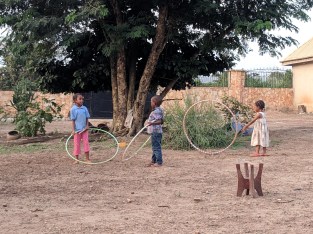
One can learn the mysteries of life through the playing of the children’s peek-a-boo game of “I see you.”

IMG_20181117_173820

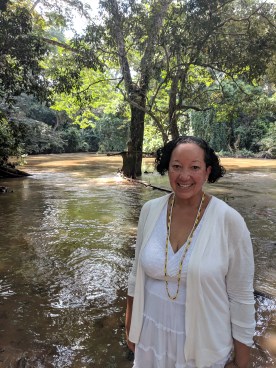
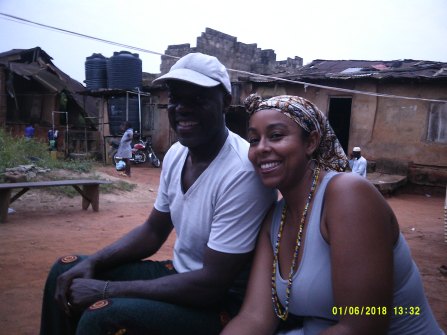
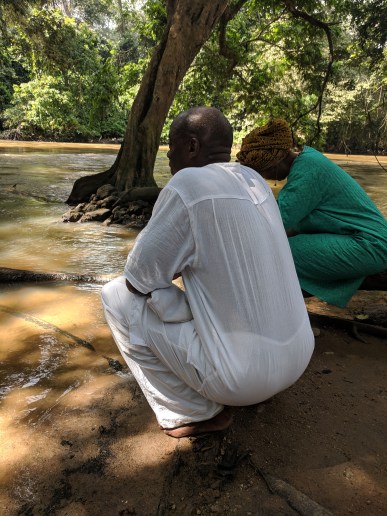
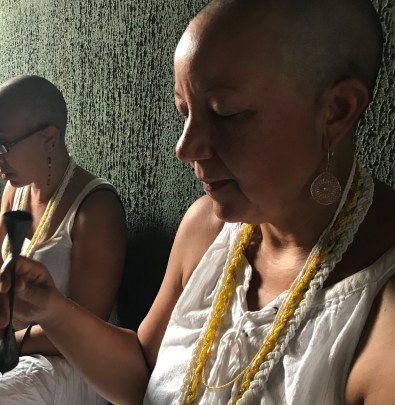
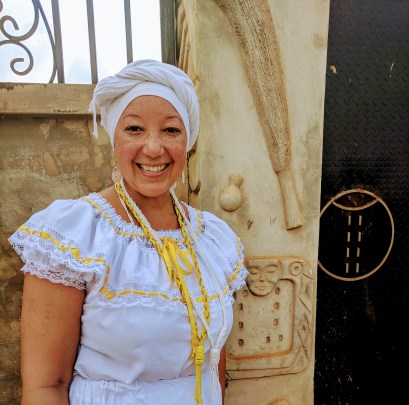
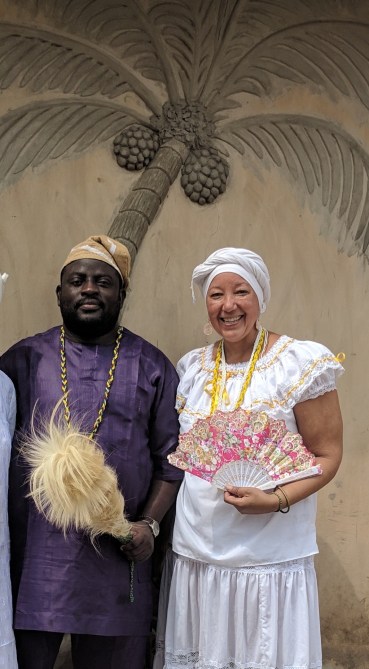
Last week I was in Nigeria on a spiritual quest to fulfill a destined step on my personal journey into the mysteries of Ifa. For many years, I shied away from traveling to Nigeria out of a colonial fear of militarization, bribes and corruption, and overall overwhelming sense of not being safe. Yet, Nigeria is the womb of my destiny, the homeland of my Ifa lineage and where I would need to go for spiritual initiation – starting with the blessings of the orishas Oshun and Obatala. So after more than two decades of mental and spiritual preparation, my turn had come to surrender and be led by faith.

IMG_20181112_143252

On the second night I asked my African American Babalawo why were there no memorials for the Trans-Atlantic Slave trade like one finds in Senegal and Ghana? I was to ask a friend of our our Oluwo – but never had the chance. Later on, in the week, Baba, his daughter an Iyanifa, and myself had a deep discussion on why it is our tendency to always begin Black American history with the slave trade. Why must that part of history be the seed of our conception? This experience awakened in me the deepness of our sense of self – Africa never left us. Like patient and forgiving parents, she lay dormant inside of us, waiting for us to acknowledge her. Nigeria does not need to memorialize the slave trade. Within her bloodstream we were never separated and she knew we would eventually come back home. Instead of memorializing our separation, she honors our return.

IMG_20181112_145741

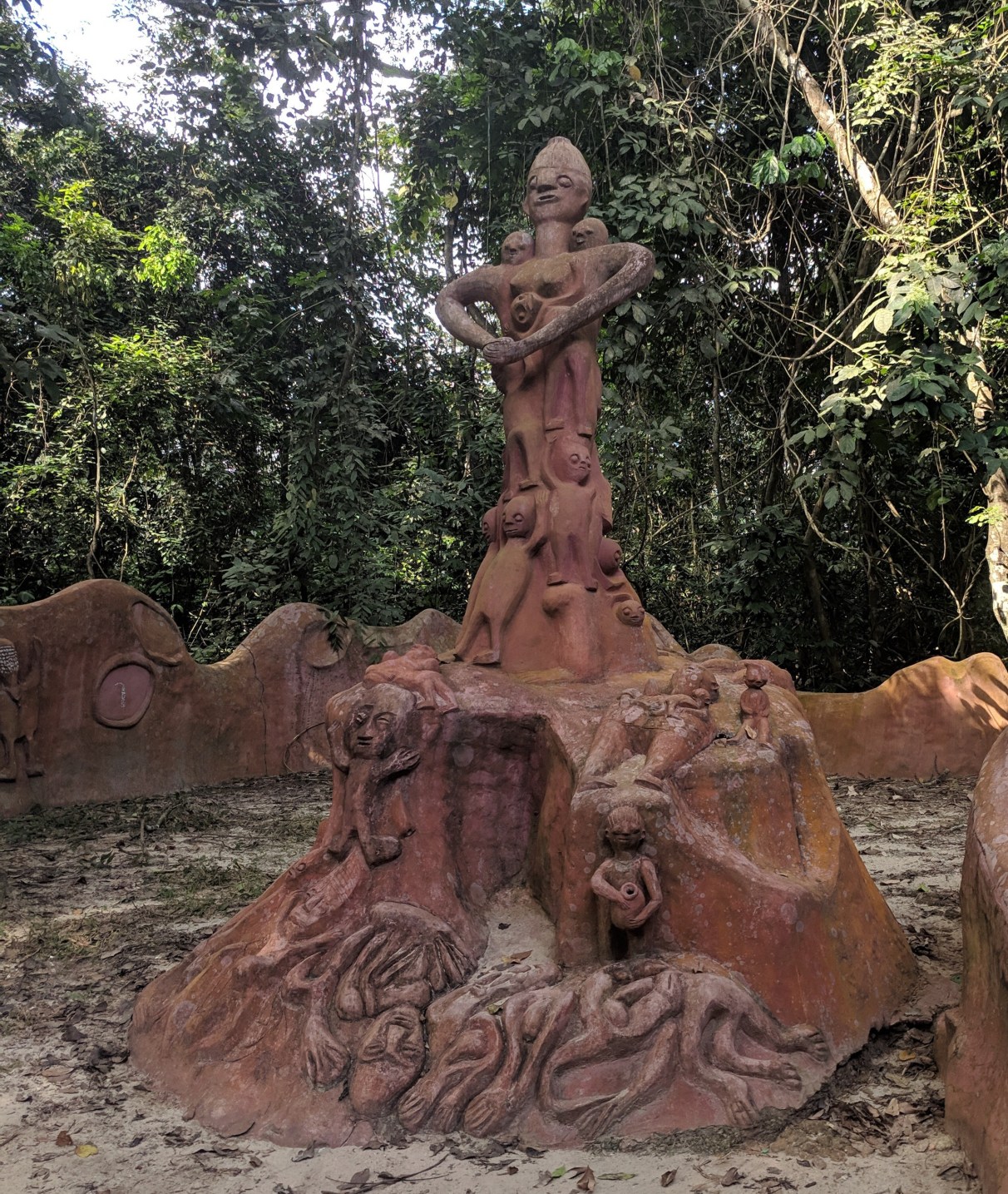
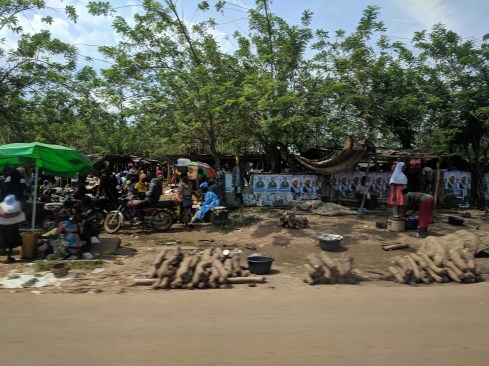
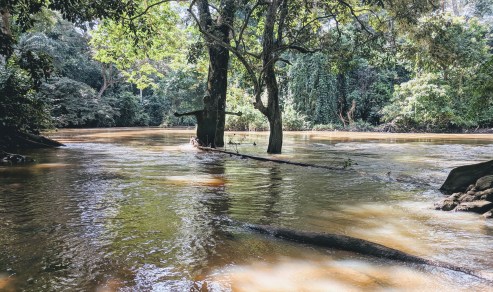
This story is not about the process of initiation but about the Divine feminine energy of the landscape that embraced me and supported me as soon as I set foot onto her belly. These words are shared through the nano-micropad of time and space and people encountered on a nine-day journey from Lagos to Ibidan to Oshogbo to Ode Remo. They can in no way represent truth, only my insight and reflection.

IMG_6101

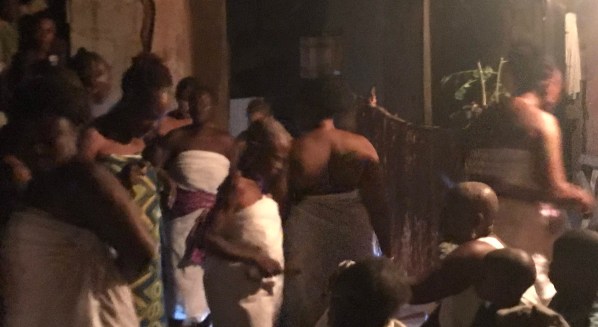
After decades of turmoil and violence, Nigeria seems to be in a place of peace where co-existence across faith lives. In the pre-Dawn hour, I awakened on more than one morning to the sound of the Adhan and Iqam – calls for Muslim worshipers; light drum beats and soprano pitches of Christian morning service; and rich voices of the Iyas winding down a series of call and response after a night of praying over me. In that moment, the day was full and rich – a gathering of the ancestors, spirit, humans, and all beings – celebrating life together.

IMG_20181112_130842

This was far difference from the divisiveness, segregated landscape, and echoes of hate talk and violence experienced at home in the U.S. In fact, the day I left there was a mass shooting that killed 12 people enjoying music at a Thousand Oaks bar, 2 to 3 wild fires sparked by global warming – one of which destroyed an entire town killing at least 60 people and many animals, and the President standing by the execution of a journalist. And which is the uncivilized nation?

IMG_20181118_112758

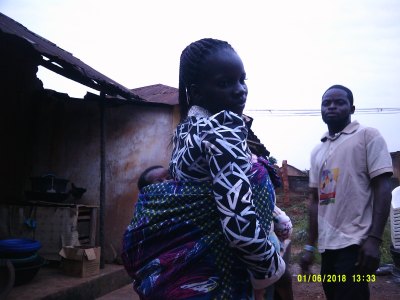
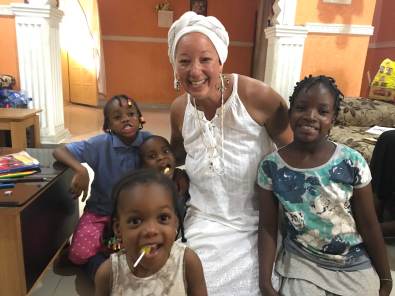
For a week I entered a vortex of time into a clay womb, where the woman was honored, where men embraced the feminine within and took pride in their role as fathers, community leaders, healers. One of the most precious moments was when one of my youngest teachers – a three year old girl whom I played a game of ” I see you” with earlier in the day, woke up crying in the middle of the night. Not sure if I should get up to check on her, I rose up grabbing my robe when suddenly I heard the deep, yet soft voice of Oluwo- her uncle, assuring her that she was safe and to go back to sleep.

Digital Camera

How many little girls, little Black girls in the U.S. yearn to hear the warmth of their fathers’ voices affirming them in their moment of need. Fatherhood is an African tradition and through embracing the feminine, we can guide our men back to their roots to regain the knowledge and redefine Black masculinity in the U.S. today.


Digital Camera

Gender relations in Nigeria are going through a cultural adjustment. As women gain greater responsibilities out of the home, there is concern by some of Western cultural  influences and the impact on family structures and shifts in traditional roles.

IMG_20181112_114626  IMG_6208

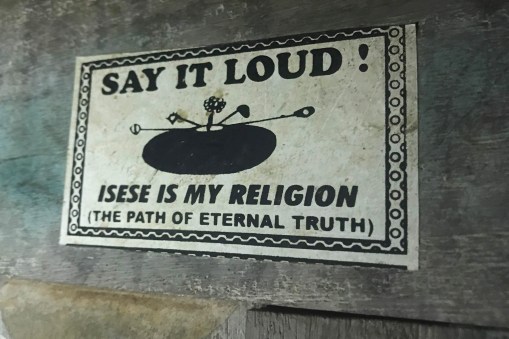
I think though the answer is more present- at least in the practice of Ifa – Isese- the tradition I practice. Through the eyes of this tradition, I observed women, older women  – the Iyas – priestesses of the community in Ode Remo- hold the space of ritual and tradition with strength and prestige with nods from the powerful male Babalawos (priest of Ifa). Each respected the others role in the tradition and yielded the space to perform those roles without competition or intrusion. Like a dance performing the balance of a living eco-system, the men and women accepted and performed their roles with pride and respect for their respective callings. There was no anger, insult, of dehumanization – only mutual appreciation. Instead of looking outward in competition, they look inward into the the soul guided by the wisdom of their Odu’s – life paths- and gifts given by the Orishas, primordial ancestors and energies of the universe that help sustain the lifeforce for continuous regeneration and rebirth.

IMG_20181112_142208

Within this experience I relearned the value of relationships – that they are not about finding the most handsome guy or smartest teammate, or other external factors – but seeking out a mate who complements my essence and call to duty in this life for the work will get done when there is a balanced energetic force behind it.

img_6097.jpg

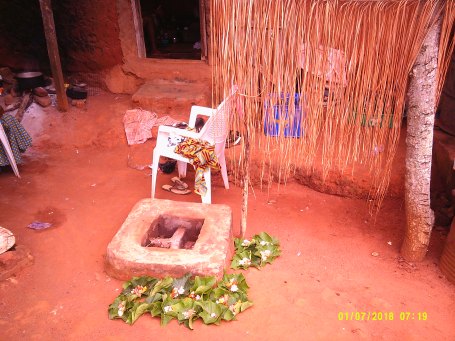
The feminine face of nature also was present in the offerings that we gave to the land in honor of our ancestors. Beautiful flowers and leaves filled with sweets and other essences that were quickly absorbed by a natural predatory eco-system of ants, flies, chickens, goats, hawks, and the unknown. I thought how foolish some of our traditions in the U.S. have become when we clog up our rivers with perfume bottles and lipstick – seeking favor from the Goddess – an earth-based Goddess – of the earth and thus shouldn’t also be her gifts? Why do we seek the most exquisite clothes to mark our worth, when the wisest people I have ever met were bare-breasted women with goat eyes who saw the mysteries of this world and beyond? What material mind taught us shame in being close to the earth? It is this skin that truly catches our blood, our tears, our excrement and turns this waste into fertilizer to nourish rebirth of crops that feed our bodies and our soul. Earth is the greatest orisha and why have we gone against our natural intellect to treat her so wrong. She is the most forgiving, but even the most patient mother wears down. How can we look to traditions like Ifa, humbly ask for the medicine needed to reawaken the divine knowledge latent within? How do we act with urgency so that she does not withdraw her wisdom into the earth – for it will be us humans who are unable to survive.

Digital Camera

IMG_20181112_142214

Many people think of initiation as a final step of destiny. I was one of those. Yet on the other end, I realize that this current mile-marker was just an entrance into a study hall where the desire to learn was ignited. I pray for the resources to return for 3 to 6 months. To sit, assist, observe, hold space in the sacred circle of the feminine as was held for me. It is my duty and responsibility.

IMG_6251

I am honored how I am now called:  Iyalorisha Oshunfunke- she who is to be supported.

IMG_20181118_112607

img_20181118_110912-e1542902047402.jpg

Nigeria, I see You. I am inspired by your struggle and your fight. I now respect your pride. I honor your traditions. May you support your Indigenous practices – the world  needs the medicine.  I see you in me, and I see me within you. I am thankful that we are made of the same earth. To our future together . . . IMG_6227

Spirit of Place, Uncategorized

Ode to Orisha Aya, Mother Earth

Initiation is a starting point with intention. An opening to new knowledge. To begin any process of decolonization, a popular word today in the dialogue around equity, one must begin with identification of the colonizer within oneself.

This process is an iterative process, as encounters with life events raise new levels of consciousness, unpacking layers of subjectivity – programmed by friends, family, religion, language, culture, traditions, society.

I am currently on a journey toward a spiritual initiation that will open up new mysteries to me about the Divine feminine energy of Oshun, a manifestation of earth/water energy in the Yoruba tradition of Ifá. Each day on this journey brings new lessons. Today’s began with a sense of restlessness – possibly the space movement of the recent lunar eclipse and planetary retrogrades – creating a desire to journey onto “Native” land. Native land being a magical place in my imagination.

A few weeks ago, a Tongva Clan Mother opened a workshop on racial equity. While her words were gracious as she told the stories of her people and how she and other Elders are sustaining survival through retaining language, customs, participation and presence, her words haunted me. In all of my work on social justice and action, I recognized my own failure of not seeing my hometown of Los Angeles as sacred, Native Land.

I have recognized the seduction by the Queen of Angeles as she captivated the imagination of the Spaniards and others who have settled on these lands in search of freedom of expression and its shadow in the thin line between financial opportunity and exploitation.

I have even celebrated and honored Queen Calafia, a Black Warrior Amazon Queen that came in a vision to another Spaniard of Moorish influence and for whom that state of California is named after.

Yet when it comes to the First Nations – the Tongva and the Chumash – I segregate their presence in a glass box of time/space separation and objectification. This is even as the constant vision of Cahuilla Clan Mothers weeping in the reeds along a dried riverbed walks with me and the sound of their crying never ceases. And even as the Tsalagi blood of my great-grandfather runs through me, confirmed by my 10% Native American blood by my Ancestor.com DNA.

I never had access to my direct Native heritage outside of family stories and given prejudice toward Blacks within Native communities and shaming of appropriation by Blacks  – associated with complex ideas of racial denialsim – claiming linkages to Indigenous identifies has been risky and taboo. Thus my own cultural biases have objectified the beings of First Nations, romanticizing them in my imagination, yet segregating them in my psyche and creating a cognitive dissonance between what I feel and believe and how I act.

The way I see and how I walk in World has been distorted. No wonder why I tippy-toe verse walking flatfooted with confidence – walking unsure whose maternal belly am I intruding on, whose blood fills the underground waterstreams that nourish the food I eat?

This revelation into the biases of self both appalled me and blessed me. At the same time manifested new meaning to a recent DafaIfá divination reading – that said Aje, Mother Earth is supporting my spiritual journey and I must foreibale – touch my head to the earth – to thank her each and everyday.

In my work as a practitioner/researcher in the area of Black Homelessness Studies, I have held space in my writings for deeper emergence into the understanding of harm created by man-made borders and boundaries on the skin of the Earth. Concretized rivers, barbed wire fences, highways that cut off the migratory flow of neighbor conversations, plastic fauna choking our oceans and the respiratory systems of the fish and mammals who survive off of marine eco-systems, riverbank homes for those experiencing homelessness – marginalized from society – reflect a cultural ignorance of man’s predatory nature.

That predator is within me – unless I use new learning to guide and transform a new vision of how I see the world and a new sense of touch to reimagine how I walk with each step intentionally honoring the sacredness of the space supporting my footsteps.

To this end, I walked with intention this morning to reframe my neighborhood state park into a sacred space – a place of Native land. I realized that I do not have to travel to Joshua Tree, Cuba, Honduras, or Palm Springs (although I dearly love each of these places), in fact I do not have to travel outside of me. Like a spider – Alatakun – sacredness is within me.

Today, I began my journey into Kenneth Hahn State Park with the intention to let Ajalaiye – the Winds of Earth – transform my neural pathways to improve my vision of self – allow me to see through sensuality- not my subjectivity.  Walking with beginner’s mind – taking each step full of awareness and feeling.

The biggest lesson that the Walk-about- taught me today, is beyond every place being sacred space – like a womb, nature records our actions. She is forgiving and in a constant place of change and rebirth. Earth is the lifeforce that sustains us, and will continue to survive even if humans destroy the balanced ecosystem that sustains human life. There is a patiki- praise-song/story of when Oshun – the only feminine energy and the Goddess of creation, rebirth, beauty, fertility – was shunned by the male ironmule – the patriarchy- she left the Earth and went back to heaven. In her absence, the earth perished as crops died, there was no rain, people became famished and began to die en mass, the temperature became unbearably hot. The male leaders rushed to heaven to have an audience with Oludumare – the Supreme Being – to partition his advice. Oludumare responded simply- where is Oshun? At this the men realized their mistake in disrespecting the Divine Feminine and rushed back to earth to call on Oshun’s return and ask for forgiveness.

Humans live in an eco-system of balanced Divine Male and Feminine energies. When one is too great, human life will perish.  We must re-learn how to respect the Mother. we must redevelop our City of Angels as Native Land and reconcile history and present through asking permission to be here.

Below is my a photo-journal of the journey.

Uncategorized

Why gentrification hurts

To understand the emotion of those impacted by gentrification and its weapons of rising housing costs and eviction practices;
 
to understand why communities impacted by gentrification are concentrated by race/ethnicity – especially those in and around environmentally impacted geographies (i.e. semi-industrial zones before artist live-work spaces and lofts were hip and actual toxic industries were vibrant and polluting);
 
to understand dis-connected workers – those not even looking for work, and those that tried to take advantage of public education but where local taxes were so low these schools tried to make the best with inexperience teachers, outdated text books, limited extra curricular activities to build character;
 
to understand embodied anger generated when one is tied to place not by choice by by means of social control and public policy;
 
we must understand institutional racist biases in our nation’s housing policy instituted since the post-Reconstruction period after the Civil War.
 
Here is one link to get started in learning:https://www.mappingprejudice.org/what-are-covenants/
Learn more on racial segregation in Los Angeles – recommended books include:
L.A. City Limits – African American Los Angeles from the Great Depression to the Present by Josh Sides
Fire This Time – The Watts Uprising and the 1960’s by Gerald Horne
Bound for Freedom – Black Los Angeles in Jim Crow America by Douglas Flamming
Right Out of California – the 1930’s and the Big Business Roots of Modern Conservatism by Kathryn Olmsted
Essay, Uncategorized

From Boriquén to Balboa: A homeward journey of reclamation among Puerto Ricans in San Diego

[Final paper for Dr. Ed Casey, Ecopsychology 1: Ethics of Place-DPC 732, July 9, 2013]

“To get into the spirit of a place is to enter into what makes that place such a special spot, into what is concentrated there like a fully saturated color” (Casey, 2009, p. 314)

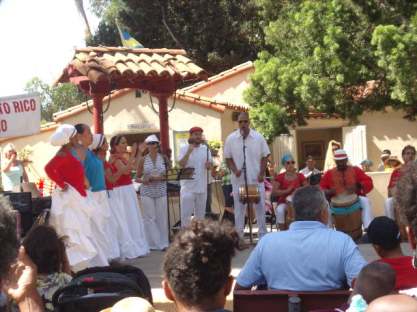
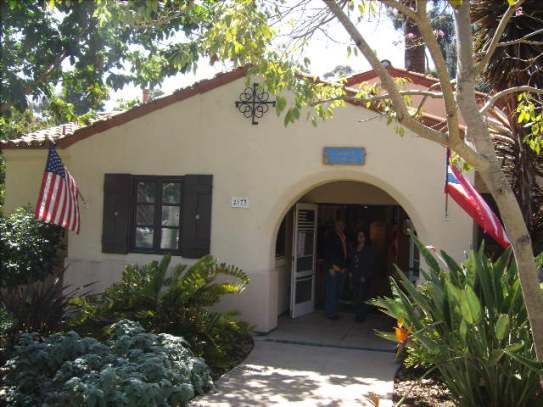
Recently I had an opportunity to intern with the House of Puerto Rico in San Diego (HPRSD), one of the few Spanish Caribbean organizations located in Southern California. HPRSD was founded in 1972 and today serves for the purpose of “sharing and communicating the culture of Puerto Rico to the people of California” (House of Puerto Rico San Diego). Located in historic Balboa Park as a part of the House of Pacific Relations International Cottage program, HPRSD hosts a number of events and activities to highlight the cultures and traditions of Puerto Rico.

Under the guidance and patience of former president Aileen Alvarado Swaisgood, I volunteered to interview former organizational leaders as part of an oral history project to begin archiving the organization’s past.  While I had an increasing ongoing interest in the impact on colonialism on Caribbean identity and culture, I was not prepared for the psychological depths of where I would go in the process of finding meaning and context for the stories that I had collected. Entering the work I was fixated on the presence of Puerto Ricans in San Diego and asked:  “weren’t Puerto Ricans only supposed to live in Chicago and the east coast?” Or “why would they want to live in a gateway city for immigrants escaping poverty in Mexico and Central America when they have the privilege of citizenship and can live anywhere?” And “how were they able to maintain Boriquén pride in a landscape where they only made up 1% of the Latino culture?”

I soon began to realize that my questions were my own prejudices and biases animated and my quest began to understand how I acquired these perceptions. In appreciation of Levins-Morales’ healing stories and an adaptation of an eco-feminist critique, this philosophical journey allowed me to uncover my own way of knowing and introduced a new way of knowing the world we live in today  (Levins-Morales, 1998).
GE DIGITAL CAMERA


This journey begins in a moment of reverie where I actively imagine the initial intense point of contact between the Western and indigenous worlds enacted through the archetypes of the Conquistador and Itiba Cahubaba, an earth goddess (Bachelard, 1983; Jung C. , 1989):

Intrigued by what lay beyond the horizon at the edge of the deep blue-sea and if the Viking legends of far-away enchanted lands were true, European Man invoked his ancestral wisdom and enlisted the Sirens to call forth young men from across Europe to lead explorations on his behalf (Fuentes, 1992). Hundreds responded and a chosen few were selected to lead voyages in the name of Europe under that mask of his god. Excited, European Man joined each voyage, attached to the bowsprit to guide his troops toward the penetration of new found virgin lands.

Of all the lands he entered, he became most in love with tropics of the Atlantic where a string of emerald islands embellished the rich turquoise-blue waters along the equator created a “field of power” that animated trees to dance, mountains to roar, sea animals to sing, and where the people- adorned in gold – gleefully welcomed European Man onto the land, as if they had been waiting for him (Hillman, 1989, p. 40). The place was magical.

One evening while observing a beautiful, glowing sunset, as only exist in this part of the world, and inebriated with wine, the most beautiful woman emerged from the setting sun (Nunez, 2006). Dusted in gold, her body was alchemically designed out of silver, lead, copper, iron, mercury, and lapis. She graciously danced on the surface of the water, spraying her lands with an afternoon mist to cool off the long hot days. She sang as she danced; her voice was as calming as the wind. She was the goddess of the land and her name was Itiba Cahubaba (Baerga, 2013).  

Unable to withhold his desire, European Man leaped forward onto Itiba Cahubaba and raped her. Confident, yet impotent, European Man enslaved Itiba and raped her for 40 days and 40 nights with odd seeds, machinery, and equipment, until at last she became pregnant (Griffin, 1978).  Defeated, the light in Itiba’s soul began to diminish and she stopped singing and dancing; stopping her daily blessing of the land. This rupture in ritual impacted the lands and they became less fertile. Instead of lush tropical rain forests and unimaginable size fruits and other indigenous nutrients, the land began to produce non-edible growths such as cane sugar, tobacco, coffee, and cotton.  Itiba’s children – the fierce Caribs, mighty Arawaks, and tenacious Tainos – also became more lifeless, withdrawn, and for the first time- suicidal. They felt their land rejecting them in favor of European Man’s children and for the first time felt like strangers within their own environment. What did they do to make Itiba Cahubab abandon them?

Finally Itiba’s embryonic water broke. Yet the dry land could not absorb the heavenly flow so the land flooded. Her people had to settle at on the tops of the highest mountains as their landscape was transformed (Crespo, 1993). Itiba’s labor was difficult. Her people cried out for help, yet she could not hear them due to the intensity of the labor pains. Her contractions shook the earth creating hurricanes and earthquakes. Itiba turned toward the sun to allow its warmth to ease her pain and in doing so created a solar eclipse. The people thought for sure the world had come to an end and yielded to death so that only a few survived. As the baby neared the opening of the birth canal, she bled and bled, mixing her blood with those of her people and reddening the earth. 

European Man waited anxiously in anticipation of the birth. He was sure that his influence would create a mighty human being. European Man never felt more alive.

Through my fantasy of the colonial conquest, I sought to honor the indigenous epistemology that existed in pre-Columbian society.

A Taino (the indigenous group on the island of Boriquén) creation myth symbolizes this recall process. According to the legend, after a heroic hunter was swept up in the winds and presumed to be dead, his family placed his hunting equipment into a gourd and hung the gourd from the ceiling according to custom. As the village began to experience a food famine, the gourd filled up with enough fish to feed the people. Eventually the gourd is broken over human greed and the waters flow out creating a great flood and the people had to adapt to a new way of life (Crespo, 1993; Jaffe, 2005). While the fish image resembles Jung’s reference of restoring the “lost soul” I believe the flood is the key image in this myth (Jung C. , 1969). The flood, to me, represents the submergence of the indigenous thought and belief into the unconscious under 500 plus years of colonialism.

GE DIGITAL CAMERA

The pre-Columbians believed in an integrated relationship between man and nature where the world was animated and spirit existed in matter (Ani, 1994; Deloria Jr., 2003; Fuentes, 1992). Man respected nature equally in her visible and non-visible forms.  Fuentes (1992) observed that indigenous groups such as the Tainos lived with fear of nature in respect for her cyclical nature of destruction (i.e. earthquakes, floods, and hurricanes) and creation.  He states, at “the aboriginal culture of Mesoamerica …carried a system of beliefs in which the idea that the world had been created not once but several times was absolutely essential” (p. 94). He believed that the questions of the Indian mind were “how long will we last? How can we build something that will protect us from destruction?” (p. 98). Their epistemology was based on their experience and observations of nature and her changing cycles. Deloria (2003) stated “thousands of years of occupancy on their lands taught tribal peoples the sacred landscapes for which they were responsible….hence revelation was seen as a continuous process of adjustment to the natural surroundings…” (p. 66).

Fuentes (1992) further observes, “The need to understand time was of paramount importance in such a world, for it meant the difference between survival and destruction. To dominate time was to assure the continuity of life” (p. 98). Time was not thought of as a singular event moving along a linear projection as it is in the Western world, but centered on the changes in nature. Deloria (2003) explains, “…a tribal conception of history almost everywhere was the description of conditions under which the people lived and the location in which they lived…when (?)…was …‘a long time ago’ ” (p. 101). Fuentes (1992) also highlights a common theme of a returning god in pre-Columbian stories. Sacred ceremonies and behavioral expectations and norms were set for the community to ensure a positive return. Fuentes (1992) concludes that the initial welcoming among these groups of the initial conquistadors was due to the expectation of the returning god.  This understanding of the pre-Columbian epistemology advances our knowledge of indigenous way of life, culture, and values to not only understand how life existed then, but to also uncover remnants that still exist today (Levins-Morales, Remedios; Stories of earth and iron from the history of Puertorriquenas, 1998).

Pre-Columbian view of life contrasted sharply with the perception developed in Western thought. Plato is credited with the initiation of separating the conscious and unconscious minds through his articulation of forms (Ani, 1994). According to Casey, Plato believed “we are creatures of becoming. I am nothing but an imperfect copy of the perfect form” (Class lecture on January 28, 2013). Plato stated:

therefore, that in all the realm of visible nature, taking each thing as a whole, nothing without intelligence is to be found that is superior to anything with it, and that intelligence is impossible without soul, in fashioning the universe he implanted reason in soul and soul in body, an so ensured that his work should be by nature highest and best (Plato, 1965, pp. 42-43).

Through these words Plato births the foundation of modern Western thought that secularizes the spiritual from the visible world and also initiates a hierarchy among beings. With man created as an imperfect being, the drive toward perfection was also planted by Plato’s words that later became a drive for greater scientific knowledge and even racial superiority (Ani, 1994). Plato’s ideas are also believed to be reflected in Christianity with the thought of an “after-life” where man will finally be able to find perfection (Ani, 1994).

In the sixteenth century Descartes adds scientific value to this separation of the parts as well as introduces man as an individual verse communal being in his thoughts; “substance is a thing that exists in such a way that it needs nothing else in order to exist” (Casey, class lecture on January 28, 2013). By the sixteenth century the European man thus had created the psyche of the colonizer through his incremental drive for perfection over what existed before him, his desire to prove his individualism, and the separation from the spiritual/natural world through secularization.  His energy was released in the annihilation of all things “other” including women, natural ways of knowing, animals, and non-European civilizations. Levins Morales (Medicine stories: History, culture and the politics of integrity, 1998) in describing the European witch trials, “among other things, the witch persecutions established elite male, monopolies of knowledge, especially medical and spiritual knowledge” (p. 48). Deloria (2003) further stated:

The very essence of Western European identity involves the assumption that time proceeds in a linear fashion; further it assumes that at a particular point in the unraveling of this sequence, the peoples of Western Europe became the guardians of the world (p. 62).

The European domination of knowledge has remained a key legacy of the colonial period. In its wake, colonized groups continued to be labeled as “other.” Social scientists, including psychologists, have been complicit in sustaining this perspective through scapegoating negative social behaviors among minority racial groups as inherent tendencies versus responses to ongoing oppression (Lewis, 1963; Memmi, 1991). This practice reinforces discrimination and weakens civil societies. The Puerto Rican ethnic group is one example of how these beliefs have manifested in the social, economic, and political marginalization by the U.S. government and institutions.

In his Harper’s Journal essay entitled Manifest Destiny, John Fiske (N.d.) wrote;

It was for Spain, France, and England to contend for the possession of this vast region, and to prove by the result of the struggle which kind of civilization was endowed with the higher and studier political life. The race which here should gain victory was clearly destined hereafter to take the lead in the world….When the highly civilized community, representing the ripest political ideas of England, was planted in America…the growth was portentously rapid and steady. (p. 584).

After the Civil War and the collapsing of other European power in the Western Hemisphere, a young United States with its cowboy attitude sought to prove its muster on the world stage through the capture of the remaining Spanish territories within the Caribbean (Thomas E. , 2010). Senator Henry Cabot Lodge is said to have placed large red Maltese crosses across a large map “to signify future American possessions: Hawaii, Cuba, Puerto Rico, a canal across the Panamanian isthmus” (Thomas E. , 2010, p. 71).  Driven by ego-fueled strategy, the U.S. had no thought out plan on what to do with the new territories and the thousands of people who were now in its tutelage. According to Thomas (2010), Lodge and Roosevelt, “knew that empire was no laughing matter, and in the giddy aftermath of victory over Spain, difficult decisions loomed” (p. 369). Economically, Puerto Rico was deeply impoverished due to lack of investment by 500 years of Spanish domination  (Lewis, 1963). According to Lewis (1963), while Americans’ initial image of Puerto Rico was “the romantic image of a rustic, unspoiled paradise” it soon turned to an “image of a dirty, backward island…” (p. 18) .

This latter image penetrated the American psyche and has been the root of resistance toward full integration of the island or release for its own independence . Zimmerman (2002) asks, “would the Americans, with their spotty conduct toward the natives of their own continent, treat their new subjects with dignity and respect?” (p. 366). Since acquisition, the U.S. has followed a pattern of social and economic marginalization of Puerto Ricans through an over-emphasis on negative stereotypes and poverty-related behaviors. Lewis (1963) states that “the society has thus rarely been seen as a composite whole” and blames U.S. educators, social scientists, and consultants “pre-empting the very future of the society” through their cultural biases and beliefs (pp. 20-21).

Even after World War II when thousands of Puerto Ricans migrated to the U.S. with citizenship status, they were marginalized in the urban ghettos of Chicago and New York and stigmatized by negative images such as gang affiliation, sexual promiscuity, ignorance due to limited knowledge of English, and laziness Since 1898, the U.S. has used these images to justify maintaining Puerto Rico as a Commonwealth status. Citizen rights have been gerrymandered based on geographic location on or off the island. For instance, it one lives on the island, he cannot vote in the U.S. Presidential Elections, however if he lives in California or New York- on the mainland, he can (Zimmerman, 2002; Thomas L. , 2010). Memmi (1991) states “whenever the colonizer states …that the colonized is a weakling, he suggests thereby that this deficiency requires protection. From this comes the concept of a protectorate” (p. 82).

Through the concept of cultural citizenship many Puerto Ricans have thrived in spite of the politics that seek to deny their existence. Flores and Benmayor (2004) state “unlike assimilation…or cultural pluralism…cultural citizenship allows for the potential of opposition, of restructuring and reordering society” (p. 15). The concept of cultural citizenship also suggests a re-emergence of the value in cultural ties over that of the Western concept of nation-state with its arbitrary geographic boundaries.
GE DIGITAL CAMERA

In constructing their cottage in Balboa Park, HPRSD had to overcome very political challenges that reflect mainstream perspectives toward the island. Through a strong belief in their vision they overcame these obstacles and created a homeplace as inspiration to all who visit. HPRSD has also created a third-space where Puerto Ricans can express their biculturalism without the need to over-value their Puerto Rican or American heritage. They are able to resist the dichotomy that greater American society has imposed which centers on complete assimilation into U.S. culture, including English as the only language (Zentella, 2004).

The member’s stories  are animated with their own autonomy and not mimicking the immigrant’s hero’s journey that is often reflected in immigrants’ stories (Levins-Morales, Medicine stories: History, culture and the politics of integrity, 1998; Rua & Torres, 2010). There is power when “Ralph” speaks of receiving his first brand new pair of shoes for the flight to NY right after the ending of WWII and how recently a postal worker asked him what kind of stamp was needed to send a letter to Puerto Rico. And when “Tia” shares how the Italian and Jewish women helped her learn how to use the dangerous sewing machine in the garment factory. Or “Joe” recalls how he found academic focus within the walls of ASPIRA, a community based academic enrichment program, during the tumultuous 1960’s in Brooklyn.  And when “Emily” talks with pride about her dad who was a doctor and headed the tuberculosis sanitarium on the island as well as how he told family stories under a special mango tree on visits home. There is strength when “Ernesto” shares his ability to “come out” in New York where he met his life-partner and also provided quality healthcare services to Veterans with HIV –often a taboo- during the 1990’s at the VA in New York. And when “Gene” talks about how he united Latinos in Balboa Park on Sundays through drumming. And there is human admiration when Kitty talks with reverence about her mom, Casilga Pagan, who was a founder and first president of HPRSD that promoted tradition, voter participation, and reciprocity within the community.

These voices are no longer stuck in time, victimization, political limbo, or negative stereotypes. No, these voices speak of creative ways that ordinary people have found to embrace the challenges of the twenty-first century with dignity, self-respect and sense of community. These compile a new story  that people like me still stuck in a Western dichotomy or right/wrong, good/bad, colonizer/colonized would completely miss without understanding that different ways of knowing exist.

“Intellectual decolonialization is a prequisite for the creation of successful political decolonization and cultural reconstruction strategies” (Ani, 1994, p. 1) Through the creation of a “homeplace” amidst the memorial to Balboa, a conquistador, I believe that the unconsciousness of the Puerto Rican soul has emerged from the flood waters to guide her people into a new world of life where the confinement of “otherness” will no longer exist in the people’s psyche (Watkins & Shulman, 2008). Casey (2009) talks about ways of learning after prolonged displacement and he states:

It follows that to learn something…is to learn how to connect, or more exactly reconnect, with one’s place. At the same time, to reconnect with that place it to engage in a form of collective memory of one’s ancestors: to commemorate them (p. 37).

Furthermore I believe that this process reflects thousands taking place around the world as we each seek to reconnect back to the ways of knowing that have been suppressed too long in our unconsciousness so that we can create new paradigms to guide us in better tending of the World Souls. We live on one earth and it is time that we begin to get to know her through a variety of knowledge systems- seen and unseen. The homeward journey of the members of the HPRSD is an example for creating a new paradigm of physical and mental environmental change.

References

Ani, M. (1994). Yurugu. Washington, D.C.: Nkonimfo Publications.

Bachelard, G. (1983). Water and dreams; An essay on the imagination of matter. Dallas: The Dallas Institute of Humanities and Culture.

Baerga, F. (2013, April). Taino cyber culture center archieved pdf files. Retrieved from Coqui’s Village: http://www.indio.net/taino/pdf/mythcuba.pdf

Casey, E. (2009). Getting back to place: Toward a renewed understanding of the place world (Second ed.). Bloomington: Indiana University Press.

Crespo, G. (1993). How the sea began. New York: Clarion Books.

Deloria Jr., v. (2003). God is red: A native view of religion (30th Anniversary Edition ed.). Golden: Fulcrum Publishing.

Fiske, J. (Nd). Manifest Destiny. Harper’s New Monthly Magazine, LXX(418-38), pp. 578-590.

Flores, W., & Benmayor, R. (2004). Constructing cultural citizenship. In Latino cultural citizenship: Claiming identity, space and rights (pp. 1-23). Boston: Beacon Press.

Fuentes, C. (1992). The buried mirror: Reflections on Spain and the New World. New York: Houghton Mifflin Company.

Griffin, S. (1978). Woman and nature. San Francisco: Sierra Club Books.

Hillman, J. (1989). Polytheism. In A blue fire (pp. 38-44). New York: Harper Perennial.

House of Puerto Rico San Diego. (n.d.). Membership Application Page. San Diego, California, USA. Retrieved July 8, 2013, from http://www.houseofpuertorico.com/join-hprsd.html

Jaffe, N. (2005). The golden flower. Houston: Pinata Books.

Jung, C. (1969). Concerning Rebirth. In The collected works of C.G. Jung (R. Hull, Trans., Original work published 1939 ed., Vol. Vol. 9, pp. 135-147). Princeton, NJ: Princeton University Press.

Jung, C. (1989). Memories, dreams, reflections. (A. Jaffe, Ed., R. Winston, & C. Winston, Trans.) New York: Random House.

Kao, G. (2010). The universal versus the aparticular in ecofeminist ethics. Journal of Religious Ethics, Inc. , 616-637.

Levins-Morales, A. (1998). Medicine stories: History, culture and the politics of integrity. Cambridge: South End Press.

Levins-Morales, A. (1998). Remedios; Stories of earth and iron from the history of Puertorriquenas. Boston: Beacon Press.

Lewis, G. (1963). Puerto Rico: Freedom and power in the Caribbean. New York: Harper & Row.

Memmi, A. (1991). The colonizer and the colonized. Boston: Beacon Press.

Nunez, L. (2006). Orunmila and the hole. In Santeria stories (pp. 215-219). Putnam: Spring Publications, Inc.

Plato. (1965). Timaeus and critias. (D. Lee, Trans.) London: Penguin.

Rua, M., & Torres, A. (2010). Introduction. In Latino urban ethnography and hte work of Elena Padilla (pp. 1-21). Urbana: University of Illinois.

Thomas, E. (2010). The war lover: Rooselvelt, Lodge, Hearst and the rush to empire 1898. New York: Little Brown and Company.

Thomas, L. (2010). Puerto Rican citizens: History and political identity in twentieth-century new your city. Chicago: University of Chicago Press.

Watkins, M., & Shulman, H. (2008). Toward psychologies of liberation. New York: Palgrave Macmillian.

Zimmerman, W. (2002). First great triumph. New York: Farrar, Straus, and Giroux.

 

Uncategorized

Allies

Yesterday I had the privilege of sitting on a panel with some amazing social justice activists at Pacifica’s “Radical Edge: Depth Psychology for the 21st Century” Thanks to Lizzie Rodriguez. Pacifica Graduate Institute focuses on depth psychology and counseling so it caters to psychologists and therapists. Until Dr. Mary Watkins joined the faculty, Pacifica lacked economic and racial/ethnic diversity. So yesterday’s conference was part of the alumni programming series and the audience was mostly upper-class “white” (until we find another term that truly reflects the diversity of non-people of color) baby-boomers.

The conference’s theme focused on the collective trauma and fracturing of society that we all share including the rising cost of housing, immigration, homelessness, injustice in the criminal justice system, threats to progress made in nongendering the right to marriage and other civil liberties, and degradation of the environment.

The goal of my panel, all change-agents of color, was to share real solutions from the field. However in translating our practice, the themes of privilege, white supremacy, shame, and other dynamics kept coming up, including the use of the word “ally.”


19264753_10155481648929250_5586509359333077677_o

Since then have been reflecting on the word ally. I guess it means something that is not a part of you but working in aligned goals toward a common end. I think it was developed to counter the “savior” narrative when dominant groups encroach and try to take over groups and movements seeking their own empowerment.

However I hope the idea of alliedship does not become so overused that it becomes an excuse to not act. That the internal and collective process to be undergone by “allies” of recognizing power differences and complicity is not lost. And that if I call myself an “ally” to groups that i am working with, that I recognize whatever privilege and power I am bringing to the conversation, leave my shame and guilt at the door, and own my own shit that I am still working through, so as not to cater my behavior and conversation through projections I am presenting on those I am allying with. In other words, being able to stay present in those spaces dominated by persons with lived-experience that I am seeking to support and resist the deep urge to switch the conversation back to myself and own needs.

Whatever time we are in is opening up psyche to painful realities and traumas that we have collectively disconnected with for some time. The fear, mistrust, wounds, are real. Trump is the pharmokoe of our society- the icon of all of our projections that we are too shameful to admit such as greed, narcissism, hunger for power and to be seen, and need of authoritarianism and hierarchical structures that mark place of where we fit into the world (even if our place is of victim or alienation- it still fits a space).

As we awaken, people are starting to feel for a second. We may cast off that feeling onto someone else, but psyche will remember the feeling and keep bringing us back to it. As such as people awaken, there is such great need for heart, for collective healing to take place, for conscious peace. We must begin to deconstruct the rigid borders of identity politics. We must lean into the fear of the unknown wanting to be birthed out of the collective goodness that we all hold so closely.

19143907_10155469198669250_3528346146522994704_o

As Dr. David Ragland stated yesterday, we must create safe, expressive spaces for people to decolonize emotion and get in touch with their own trauma/pain (i.e. through storytelling). And, as we move through a cycle of healing (no quick fixes), we must be intentional in weaving together a new narrative that reflects the mosaic journeys of America today.

Uncategorized

Hero’s Return

Welcome to my space in this virtual worldwide net! I hope to use this site as a depository of thoughts, ideas, questions, and research as I shape my contributions to the field of community development in an era of global citizenship. Before I get too far ahead of myself, I would like to use this first exchange to share how I got here.

In 2013, after working close to twenty years in the field of community development with a focus on urban revitalization, alleviation of homelessness, and women and gender anti-poverty strategies, I finally acted upon a decision to step away from the grind for a few years to enter into a period of personal and professional reflection. I had become burned out through implementing programs and policies that failed to call out underlying racial and gender biases that were contributing to the oppression of the communities that my various places of employment were trying to serve. I could not understand why so many programs and approaches served to conform the individual (and family system) into practices that limited potential and fostered dependency verse true liberation. Why was the nonprofit industry complicit in creating a permanent underclass when so many helping professionals entered the field to make the world a better place? And why, even within the most progressive circles of nonprofit donors, was it considered impolite to talk about race when the colorblind attitude of the late 20th and into the 21st Century was a huge contributing factor to the ongoing assault and marginalization of communities of color?

To search for these answers some people may have joined the Peace Corps, spend time in an ashram in India, write a book or have a baby at 40. I however took an academic path and decided to pursue a long-held hidden dream of earning a PhD. I entered into the Community, Liberation, and Eco-Psychology track of Depth Psychology at Pacifica Graduate Institute. Depth psychology is the study of “soul”- the sensate of spirituality repressed in our modern world. Soul is found through an intuitive way of knowing  revealed in dreams, ceremony, stories, dances, language, and even through the rhythm of the landscape. Soul provides a different way of relating to the world through the establishment of unconditional relations with humans and nature beyond social constructs put in place to center the world around humans and in particularly Western patriarchal systems of power .

My studies offered the opportunity to re-member other ways of knowing embodied in my being to produce my own counter-narratives to dominant ideology upheld in mainstream culture and society. Family stories, dance practice, spiritual ceremonies, dreams, art, and other products of my creative process produced new methods of data created out of my lived-experience that began to inform a deeper, more personal narrative of the person in a fluid state of becoming, clarity on the values that have been guiding me, and an authentic vision of what it is I am trying to achieve before I leave this earth. In essence, I entered into a relationship with the journey, with less focus on “beating the clock” to achieve the goal. As a self-described former “over- achiever” and “people-pleaser”- this new outlook on living in the present has truly been the medicine gained from my journey.

11731581_10102713369921784_5350605147817506346_o
Matriculation ceremony to the dissertation phase

As of July 2015, I am pleased to have completed my coursework and now am ready to begin re-integrating back into community as I prepare for my dissertation research and writing rituals (yes, to me the acts of research in community and of writing are sacred acts that must be done with clear intentions, mutual respect, and honor). My dissertation project will focus on creating a language of race for the 21st century in an era of global citizenship. With massive immigration of citizens from around the world, it is time for the U.S. to address its festering wounds of slavery and Native American genocide so that it can recapture its spirit of innovation and reinvention to sustain its global leadership position. It is simply unfair to our children to burden them with a hushed history and must begin to speak the painful truth to move beyond victim-perpetrator to rewriting our historical narrative of the bloodshed let in the creation of this nation that we call the United States. It is unfair to force a black/white binary of racial that subjugates nonwhites based on skin color and silences that voices of “other” communities of color. It is unconscionable that in 2015 we have to have a social movement focused on Back Lives Matter as our earth cries out in environmental pain reminding us that we are all equally part of one citizenship class when it comes to the future of this planet. It is only through expanding the voices and honoring the various lived-experiences verse old strategies of integration and assimilation- that any of us will ever be able to develop a truer sense of who we are as a nation and thus who we would like to become. It is thus my hope to contribute to the development of a 3rd language – a language of the “borderlands” (Gloria Anzaldua) used by self-identified persons of all racial groups in dialogue, in ceremony, to speak their truth and be heard without judgment. In this third space of language the border of the “other” can be morphed and collective healing and transformation can begin.

So stay tune if you would like as I seek to apply soul to my social justice praxis using the community development tools of community building, collective healing, and creative placemaking.