Spirit of Place, Uncategorized

Sunday Praise Song to Olokun; Goddess of the Ocean

IMG_20200308_160155

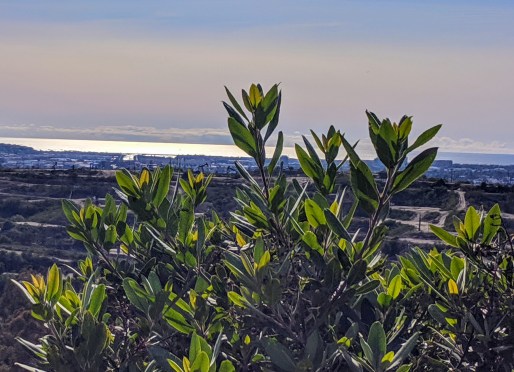
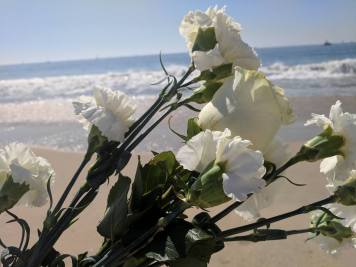
Olokun your beauty sits before me illuminating the reflection of the sun; rays penetrating your surface to nourish all of your treasures and encouraging them to grow.

Olokun your mirroring of the blue sky is so healing, your liquid skin from this vantage point so smooth.

Olokun you call my soul. I feel it stirring in my sacral womb and spiraling up and out my heart.

Olokun you are quiet, save the roar of your breath blowing on the shore as waves, yet the heartbeat of your belly, the heartbeat of the ancestors’ bones resting on your floor- vibrate in a rhythmic beat that I can hear and beacons me.

IMG_20200216_145431

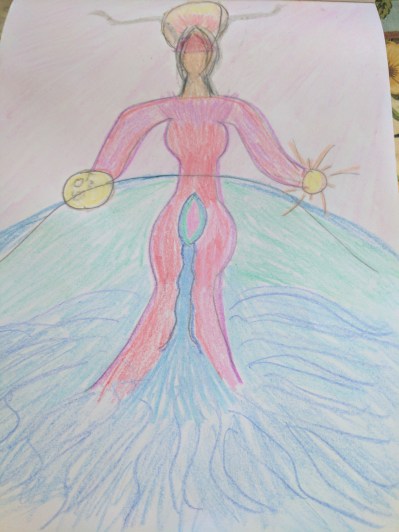
Olokun, I wish I could remember how to fly. If I could fly, I would soar over the valley and come to you, ready to dance on your glistening surface. Dance in sync with your heartbeat; the heartbeat of humanity; the dance of the rainbow warrior goddess.

IMG_20180202_083241


Homelessness, Race

Òṣun’s Mirror: Seeing Sacred Histories of the Black Experience in Los Angeles through the reflection of homelessness

This journal post is an invitation to participate in an art-based research inquiry to uncovering unconscious anti-Black racial biases – hidden in our bodies in efforts to bring their presence to consciousness for personal, group, and collective healing. This may sound painful, but this research event is being approached as a sacred ceremony to open up a safe, nonjudgmental space to engage racial biases – particularly anti-Black racial biases- by calling them forth through Black expressive art genres.

IMG_20180521_074838

Clinician Resmaa Menakem (MSW, LICSW, SEP) states in My Grandmother’s Hands: Racialized Trauma and the Pathway to Mending Our Hearts and Bodies, that understanding white supremacy is so difficult because it has become the effect of compounded intergenerational passing of wounds – leading to a visceral, physiological effect literally embedded in our mixed bloodstreams.  In fact, he prefers “White-body supremacy” to describe this phenomenon that impacts persons of all skin colors. Manakem warns,”If we are to survive as a country, it is inside of our bodies where this conflict will need to be resolved.”

13908951_1383723351642176_2655019672376857232_o

Menakem’s knowledge of the embodiment of racialized trauma is what persons of African descent who are survivors of the legacy of slavery have known for generations. To survive consistent violent acts motivated by conscious and unconscious anti-Black biases – persons of African descent have resisted and maintained resilience through expressive arts performed in community where we have been safe to express our identity and receive positive validation of being divine.

Theo's reading

In this research ceremony, up to 12 participants will hear four presentations on elements of Black cultural resilience delivered by local Black scholars. Participants will then “dialogue” with the material through the art forms of dance, song, poetry, mask-making, and free-movement performance to express feelings of resonation, discomfort, or others that may arise.  This research ceremony will occur over the course of one eight-hour day retreat.

903272_746645445346398_181555034_o

This research ceremony is focuses on those involved in the delivery of homelessness services. African Americans make up only 8 to 10% of the Los Angeles region’s population, but over 40% of the homeless population. This research assumes that unconscious anti-Black biases held by participants of the homelessness services delivery system contributes to this dynamic.  It is not with guilt or shame or blame that we seek to engage this cohort – it is with a vision of understanding our collective socialization into a system of white supremacy and its bedmate of systemic racism so that we may stop these harms, seek healing, and change outcomes.

IMG_20140817_162626

Participants for this research study must have at least two years experience in the homelessness services field including volunteers, staff, managers, directors, law enforcement, judges, property owners, clinicians, medical staff, etc. It is designed for participants of ALL racial, ethnic, cultural backgrounds – please do not just pass on to Black staff or staff of Color. We need the heal together.

This is a voluntary, non-compensated study. Participants must also be stably housed for two years and not work for a grantee or be an employee with the City of Santa Monica.

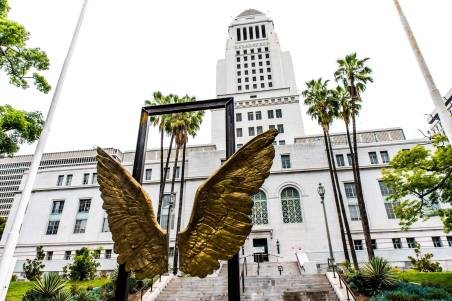
Let’s make L.A. a City of Angels for everyone.

Kindly express interest through emailing Florencealiese@gmail.com.

12973348_10154116003704806_3556664737002559885_o


Cultural Citizenship, Homelessness, Spirit of Place, Uncategorized

Bloom where you are planted

A missing component of the homelessness services delivery system is the integration of anti-racist healing interventions for survivors of trauma inflicted by inter-generational racism. In particularly systemic racism experienced by Black people experiencing homelessness that impacts recovery and establishment of a sense of belonging in newly housed spaces. Racial trauma often presents as mental illness in Black people, and perhaps it is if we consider racism a mental disease. hooks concept of a homeplace provides a framework of community based solutions that have existed in one form of another in thriving Black communities before the disruption created by the invasion of “luxury apartments” and gentrification.

Hooks described a homeplace as “the construction of a safe place where black people could affirm one another and by doing so heal many of the wounds inflicted by racist domination” (p. 42 – Yearning; race, gender and culture politics – 1990).

In 2014 inspired by hooks’ concept of homeplace and childhood memories of safe spaces I withdrew my nonprofit retirement savings and pre-paid a year’s lease for a storefront in downtown Inglewood. Like a magic seed, the storefront transformed into a literary arts cafe called Callie Rose Literary Arts or Callie Rose LA.

Theo's reading

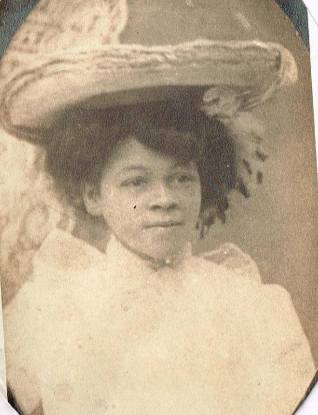
Callie Rose is a nod to my great grandmother Callie whose husband worked at EE Hughes – Memphis Florist Company where he often brought home open roses at the end of the day. Great grandma Callie was the first generation to be born free from the institution of slavery. She would represent the transition of life as a citizen of this country and the mother who then birthed a line of advocates who would fight throughout their life to secure those citizenship rights from the right to vote, to creating a business, school integration, fair housing, etc.

10003423_495389610572094_782724527_n

Through invoking my own family history, I wanted to lead by example in calling forth the memories of our grandparents and other honorable ancestors in a time when so many people are being uprooted and displaced through an invisible movement of containment and internment. So many people no longer know their grandparents, let alone great grandparents and thus believe they are whoever they come across tells them – verse knowing self from within. I believe this is an effect of systemic racism that devalues non-White culture and a symptom of this disease that can be eradicated with intention and safe spaces where such stories could be shared.

20140621_114259

A community building practitioner I wanted to create a homeplace, a safe community based space where people did not enter with deficiency labels such as mentally ill, homeless, re-entry, and other diagnosis. Ms. Jewel’s home, my former caretaker, became my inspiration.

Ms. Jewel was from Louisiana. Her white wooden home with a winding southern porch was on 39th Place off of Normandy. Inside the home one always heard a background soundtrack of soap operas like General Hospital and As the World Turns. And you always smelled food – mainly burning grease preparing bacon for a white-bread bacon sandwich or fried chicken dinner. Inside were many adults called Kin. You never knew how everyone knew each other, but to us children they were just “uncle” or “auntie” and anyone of them could spank you if you got sassy.

Outside on Ms. Jewel’s block you could see the Coliseum at one end. Across the street was a modern apartment building that stuck out on the block, but where two sisters lived who became my friends. Somehow back then, it was safe to play on the streets and neighbors did not have fences so we could run for days across many lawns with no chastisement. It was about time to go back inside when the produce and fish man came down the block announcing the specials of the day “ come get your waterrrrrrr-melon, peaches, collard greens” and the moms and grandmas came out with their carts to do their daily shopping. We would then have to go inside as dinner was prepared and the street would start to repopulate with folks coming home from work. The best memory was the candy house two doors down. When “Tee” the oldest grandson came home, he would take our rascal bunch over with our saved pennies to purchase tart apple styxs, lemon heads, candied mango with chili, and maybe a sour pickle.

In essence, Ms. Jewel’s home represented love, a sense of belonging, validation, safety, food, and hospitality. These were values that may family shared and values instilled within me that I bring to my work today as a community development practitioner with a special focus on addressing systemic causes of homelessness – including racialized land-use policies and attitudes.

20140808_204206

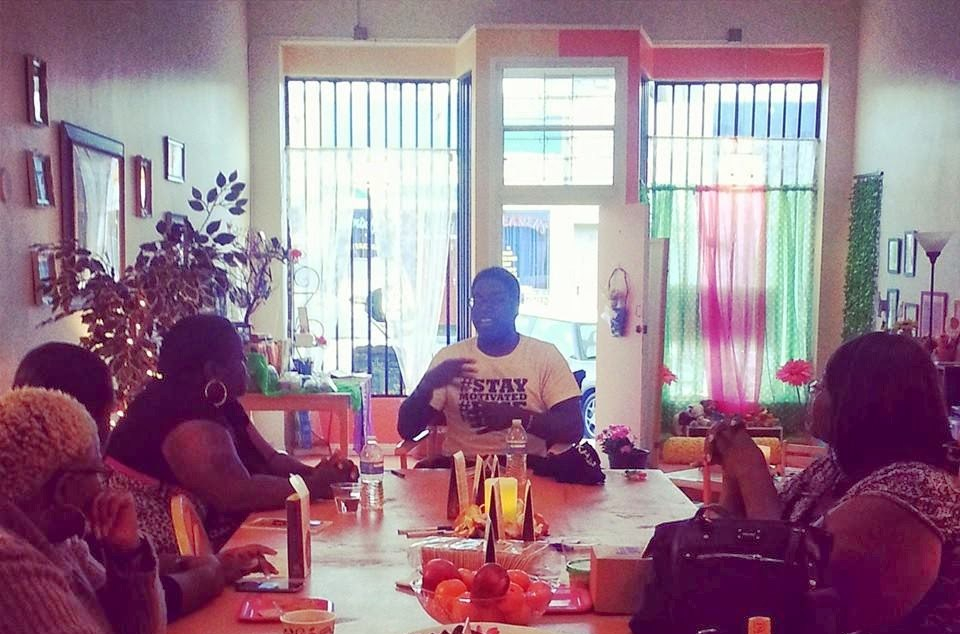
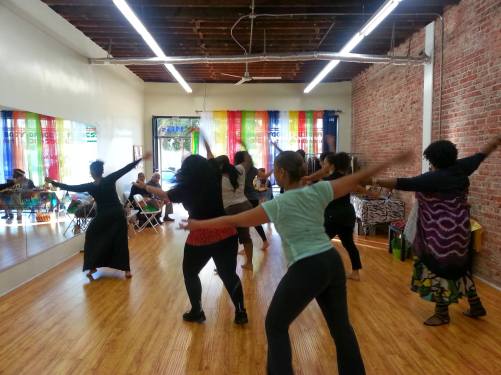
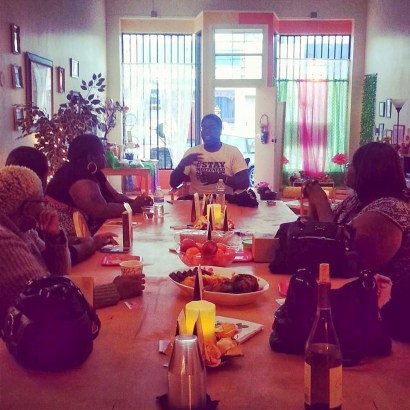
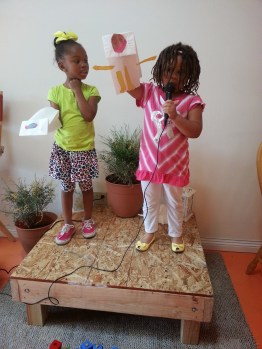
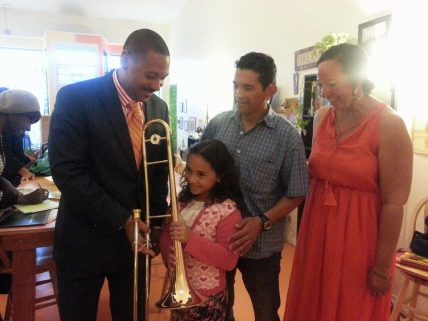
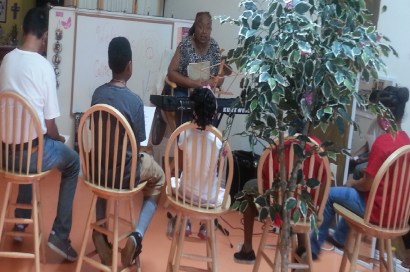
Callie Rose Literacy Arts became the manifestation of this value system. For a year, with the embracement of community members we hosted many dialogues and artistic forms to help people tap into their most authentic self through the literary arts. We hosted spoken word, book readings, films, yoga, drum circles, dinner conversations, writing classes, even genealogy. The cornerstone activity was a small stage that new guests had to stand on to introduce themselves. For many, it was the first time being seen. All of these elements achieved the goal of creating a space where people felt safe, welcomed, and that they could “be”.

20140322_114956

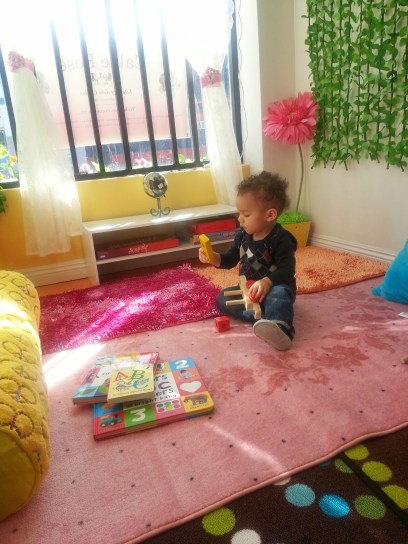
Youth from Inglewood High taught other youth chess. Parents dropped off their children for help with writing – leading to one 7 year old writing her first book on her family trip to Yosemite. We had people experiencing homelessness tutoring children after-school. I had parents with young adults living with severe mental illness leave their information in case their children came through our doors and in one case, the mom anonymously paid a stipend so her daughter could volunteer as it gave her peace of mind that her daughter had a safe place to go that she liked and was understood. Another mom of a severely medically fragile five year old often came in to allow him to play in the children’s corner where a volunteer worked with him so she could have a little break to read a book or take a nap. Callie Rose magically bloomed community where it was planted.

20140213_142601  10308902_520021148108940_5823077035564430549_n

Sadly I had to close Callie Rose in February 2015. I had run out of money and listened to the bad advice. I operated on a donation basis to sustain the value system that everyone was welcomed. Her presence was so great, I know I will reopen her again in the very near future with greater understanding of how to generate income and sponsorship. The experience taught me first-hand how cultural centers operated by cultural workers are a missing piece of our mental health and homelessness systems – particularly as a cultural informed means to have a greater impact on Black people. In cultural practices performed by Black people are not about “showing off” but about “showing in” – a total recall or mirror of one’s authentic self often made invisible or outright denied in greater society. In cultural spaces with Black expressive arts genres, Black being is not a projection to create whiteness – but an expression of a liberated form of the divine right to be.

IMG_20140823_120434

For these reasons to this day I strongly support indigenous Black cultural informed arts practices such as Urban Voices, Urban Possibility Storytelling, Skid Row Walk the Talk Parade, 3 on 3 Basketball at Gladys Park, Africa in the Americas Annual production, Vivir Brasil, FlowSkool, and so many unknown programs that are doing the work on food stamps, donations, and other sacrifices. Too many Black people are dying at the hands and consequences of the disease of racism and its spread through violence. These programs make a difference in the lives of Black people and non-Black people engaged and the greater community. My dream would be to allow these programs to be funded through mainstream services as part of all recovery programs – recovery with mental illness, substance use, and homelessness in particular. I will continue to advocate to make this change.

Today, I am heading out to Trieste, Italy with a large delegation in Los Angeles for a World Health Organization convening sponsored by the Forum Salute Mentale called ‘Good Practice Services: Promoting Human Rights & Recovery in Mental Health’. I am hoping to meet fellow advocates, consumers, and practitioners from around the world on their experience in implementing community based mental health services that support the integration of people with mental diseases and trauma verse criminalizing and isolating like we do in the States. The trip feels a little overwhelming, and yet at the same time I will be bringing a few Callie Rose seeds to plant into the conversation. I can’t wait to see what blooms.Logo2

Race

Into a Red State: How do we integrate beliefs for a more inclusive society?

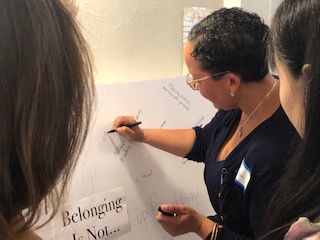
Last month, I was one of four or five panelists on a closing panel for United States National Committee- UN Women’s Los Angeles General Assembly on “Displacement and Sense of Belonging.” The day was dedicated to elevating the intersection of gender with race, immigration, houselessness, and other forms of discrimination that create social barriers in places, and minimize or obstruct a sense of belonging. The event took place in my work city of Santa Monica, a “progressive” branded city struggling with its own identity in a wave of gentrification where the demographics are increasingly becoming White and upper middle class thanks to the growing technology industry. Houselessness is also increasing as a by-product of low wage jobs, corporatizing of housing which raises costs, and a squeeze effect on middle and lower wealth populations who are wondering where shall they go.

The day was full of diverse perspective and an enriching conversation. Our panel was diverse and in fact I was touched by the opportunity to have all minority voices sharing stories that are often silenced or minimize in popular media. Whenever is there an opportunity to hear from content experts with various lived-experience who can talk to theory, practice, and day-to-day life navigation?
IMG_5260

However, as anticipated in a dream the night before, the fragility of Whiteness could no longer contain itself, and a woman, a White woman, asked the last question of the day – “why isn’t there representation of whiteness on the panel?” She said she came to hear about women and girls, but only kept hearing the conversation of “race” and that she represented “middle America” the “red states” where her family and friends felt excluded from the conversation and that there needs were being ignored.

Somehow the spirit of my ancestors spoke through me, navigating, a response so she would not shut down, but at the same time questioning her discomfort for having to listen to People of Color for 30 to 45 minutes (the length of the panel). I also reminded her (thanks bell hooks) that it was not my or any other Person of Color’s responsibility to make her feel comfortable. There is often medicine in the tension created in these situations and if she was truly concerned about building bridges, and what was blocking her from receiving stories from “the other side” – from People of Color? How often would the audience have an opportunity to hear these empowering words so that she and other audience members could better understand disparities and their impacts by race to become more informed ambassadors in speaking with her friends and family? I also reminded her that the Midwest was not homogenized. In fact my father’s family is in Omaha, Nebraska – a red state.

While many in the audience were enraged by her comments and attitude, I welcomed her presence as a gift. Instead of an attack – it signaled to me a deeper hurt and longing – FOMO – a fear of missing out. A recognition of the air of change but not so sure where would her new place be.

32128_1295532035238_7270162_n

So as I headed back to Omaha for a family gathering, I carried the wake of her words to look beyond the safe walls and love of family, to be open and present and listen in to the broader conversation – one not portrayed on the nightly news or in a Pew Poll.

Here are some initial reflections:

First and foremost, let’s debunk the myth of a White middle America and re-honor these lands as sacred places for Native Americans – Indigenous People. As we drove out to a lake to cool off from the heat, we first passed sprawling shopping malls, then new housing developments, then cornfields. I wondered how much longer would the cornfields remain? And then I caught myself remembering that these had been/continue to be Native lands and tried to imagine nature with less cultivation. The mid-western plains were stolen in the name of “progress” for opportunists seeking a better life than that given in Europe. People ironically seeking freedom of religion and liberation from a cast system murdered, cheated, lied, oppressed, and exploited the occupants of these lands for their own personal gain. Now Manifest Destiny continues – benefiting a small group of people at the cost of others. What will this road look like five, ten, twenty years from now?

img_20190720_202918.jpg

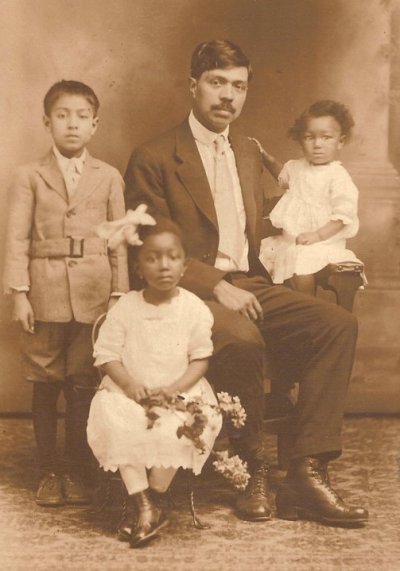
Second, the Midwest reflects our diversity and cycles of opportunity. Omaha is where my dad was born and raised before he moved to Los Angeles after the Vietnam War. Our family resettled in Omaha after Emancipation Proclamation searching for work. The men entered the packing houses and many of the women cleaned homes or raised the children. We started off with humbled roots, tilling the land and believing in the faith of God. Most of the men joined the military, serving in WWI, WWII, and Vietnam. My great-grandfather immigrated from Mexico in 1908 and received his citizenship in 1938. In between he volunteered as a Spanish translator for the courts, helping other understand their civil rights. Another great-grandfather became a policeman, and a grand uncle became a fire fighter and later integrated Los Angeles Fire Department becoming the first African American Assistant Chief. My father enlisted in the Navy, fought in Vietnam and integrated Brandeise Department store upon his return home, before moving to California. Today, the sixth generation of Orduña’s are entering this world, claiming their space on the land of our roots.
30428_1295605757081_6854409_n

While Omaha has hosted my family, it has also been a refuge for others. During my dad’s childhood, Eastern European refugees were relocated during World World II. Today, many African immigrants from Sudan and other nations are being resettled next door to  a growing Mexican and Central American community, to create a new, safe, life.

img_20190720_203406.jpg

Omaha is a homeplace, but not perfect. Yet it is a city  grappling with its racism. The local paper ran a series called 24th & Glory, outlining its legacy of racial segregation and the impacts on opportunities today. My dad confirmed many of these stories as we drove around and he interpreted the landscape through the memory of his childhood- where he could go, could not, and went anyway.
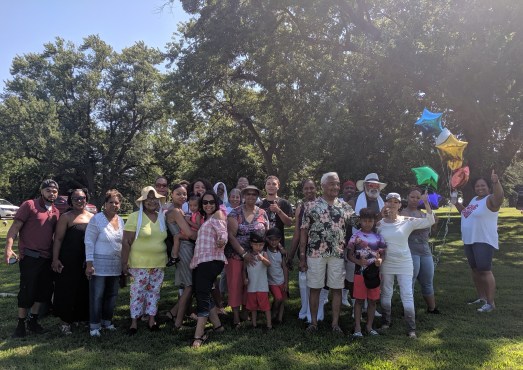
img_20190719_111430.jpg

We also were engaged in unsolicited conversations by White women (leading voter demographic that pushed Trump into the White House), about their disgust about the president’s remarks on the four Congresswoman. They believed that they were divisive at a time the country needs to come together. While they appreciated his strengthening of the economy, they did not believe they would vote for him again. We also passed a church that stated on the marquee,  “there is no place for racism.”

What I gathered from the comments is that while as a nation we have not reconciled the material effects of a distribution of power and wealth through systematic racism nor penetrated white fragility, I believe that American racial attitudes have begun to changeIMG_20190718_135128 since President Obama’s presidency. I think my nine year old nephew was on to something when he asked why do we (my dad and me) always talk about race and could we make a pact not to mention race the “r-word” for three weeks. My dad and I looked at each other and said that we would try. The ultimate challenge of course is how do we reconcile racial wounds, address ongoing discrimination, while concurrently moving forward united by ideas and values?

Finally, there is a real cultural shift happening. A wave of corporatization overtaking collective individualism. Ideas created by mom and pop/creative entrepreneurs have been appropriated by “the corporation” and re-sold back. I know Wal-Mart was the first, but I guess I continue to struggle with the words to describe the essence of this cultural shift phenomenon as I experience it. Wages are downgraded as more and more people seek work in the service sectors including hospitality, food-service, retail, childcare, para-professional healthcare workers, etc. as housing costs continue to rise. The result is hour or longer commutes for minimum wage jobs, disrupting family-time, sense of community, and institutionalizing racial/class segregation of spaces. And there is no guarantee that these jobs will be available 20 years from now as AI replaces humans.
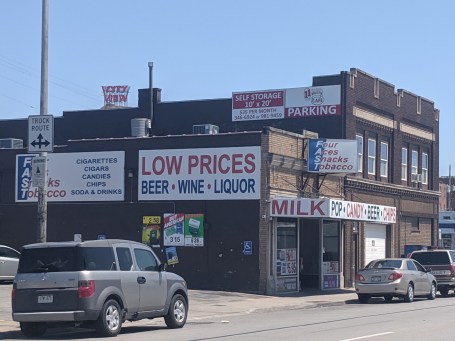
IMG_20190718_125424 (2)

Also no longer are properties sold between families, but now to corporations – foreign investment groups. Thus experiences are being commodified and made uniformed so that one can go to Whole Foods in Los Angeles or Omaha and have the same experience and standard of customer service- devoid of any local charm. My parents are vegan and in the town of steaks- we were thankful for the Whole Foods, but as I was searching for a morning cup of coffee while they shopped, I had to hear a whole pitch on the ecology of the coffee beans before I could pour a cup. The exchange wasn’t about what I wanted (or needed with the time change and morning coffee addiction), but about branding. About setting a mark of exclusivity. It made me understand the adverse effect of gentrification beyond displacement, but a shift toward a luxury, pretentious culture that fuels a service economy, but not an equitable one for can the worker afford the beans he was selling?

Additionally, housing too is now branded. Adaptive reuse of former manufacturing buildings into lofts in Old Market Omaha look the same as those in Downtown L.A. I chuckled when I even saw the construction of a “river” to flow through the downtown area. I remembered attending a Urban Land Institute conference on creating destination places and the presenters gave the recipe for creating them – most designs creating some type of waterfront. Now there may have always been a water channel in downtown Omaha, but nothing like what is about to appear. Here, it was shaping before my eyes, and yet, five years from now, what will be will look like it has always been.
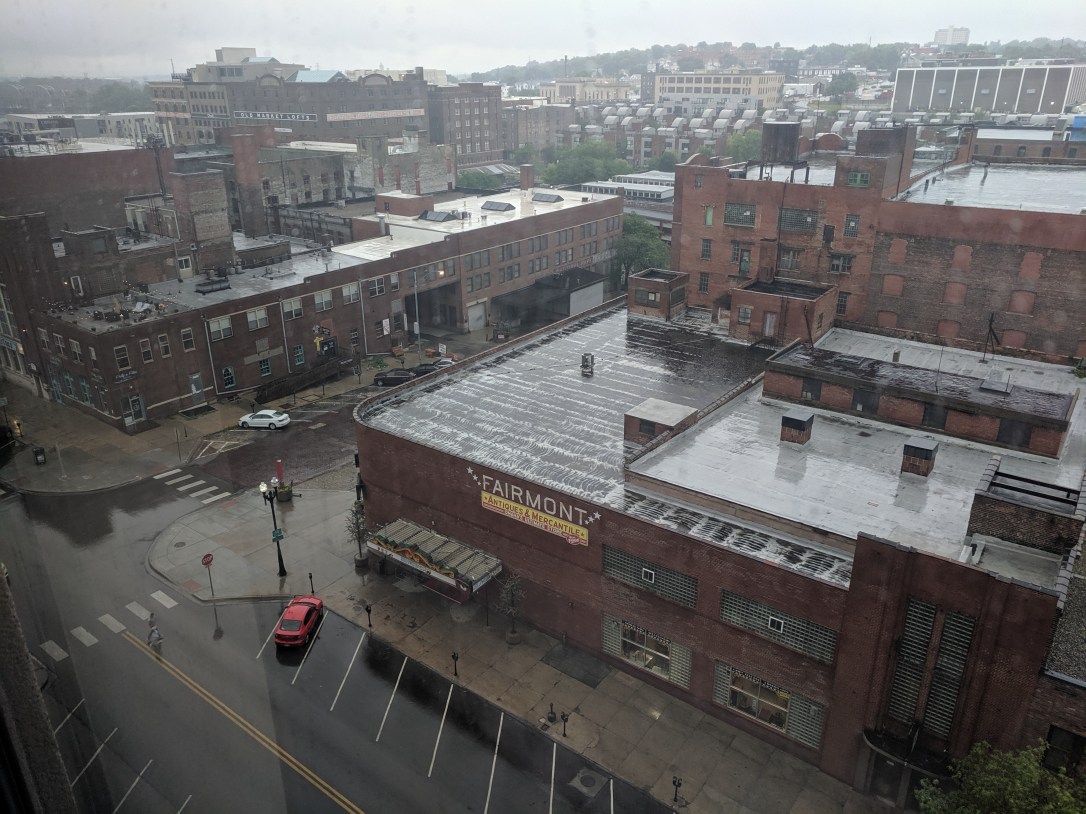
IMG_20190721_093006

In spite of the “upgrade” – the best place we visited besides my Aunts’ homes and the lake, was the Leavenworth Café. It was a true diner that had love on the walls and who knows what under the table. The best food and service, with even better conversations as it was the place that you get up and talk to your neighbor at the adjoining booth or table. And it was family-friendly with a kids’ menu with free crayons. I understand that the owner intentionally hired to create 2nd+ chances for people exiting prison and homelessness. I hope beyond hope this place is still here – the exact way it is with its Coffee News recycled papers the next time I visit. Just wished they served grits – but we were in meat and potato country. 
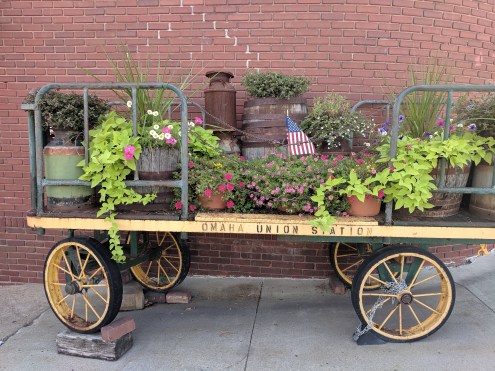
IMG_20190718_173056

Omaha is not perfect, but it is the perfect classroom for learning what is truly happening in our country in this moment. How will the nation deal with the rising poverty created by low wage jobs, rising housing costs, and long commutes that disrupt families and communities? How soon will it be before there are no more individual/family owners of property – but all an LLC or other corporate structure? What difference will it make where one lives if families are split according to affordability, and the only local nuance will be the weather? Where artifacts of American pride – mom and pop stores, dream of home ownership, and cultural assets (parks, greenspaces, local museums, historic houses) disappear or become owned by foreign investment groups? How will humans practice purpose? Or will we all tune-out through virtual reality (VR) spas? Writer Octavia Butler may have truly saw her future- our present in Parable of the Talents.

Concluding thought: President Obama was right, there is no red or blue states, only the United States. No doubt racism hurts and continues to create material, spiritual, and psychological wounds, but we can’t let the current politics of race (different from systemic racism that few are truly talking about) further divide us. There is a greater threat to humanity and our world occurring that if we do not get in front of, we as a human race will be facing extinction as earth’s temperature continues to rise, animals and insects become extinct, the landfills can no longer manage our waste,  new diseases emerge from chemical processed foods, and ecological depression sets in  as open spaces continue to become concretized and privatized – imprisoning nature, leading to more deaths by suicides.

This trip into the red zone – (politics not football) – made me realize that the 2020 election is huge. It is not about race or even healthcare or even anti-Trump. It is a test of our ability – the will of the people – to bring in a collective cohort of eco-conscious leaders who can build bridges of dialogues across 20th century borders to shift our current paradigm from absolute capitalism to a form of living that is in harmony with earth. Let’s open the pathway for these leaders to emerge by creating safe spaces of conversation and collaboration to validate new ways of human relations. Spaces where love, not ego, leads on the wind of spirit so that our ancestors help us build a new movement of being.
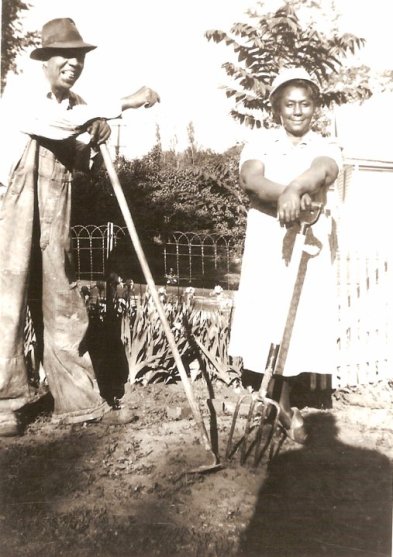
32128_1295531995237_2171182_n

I am  thankful for the sacrifices of my ancestors, for their planting seeds of tolerance in our bloodline that are now manifesting in my generation and beyond. Thank you Papa and Mama Orduña. Thank you Omaha for giving me a place to call home. May your red symbolize love of self, family, country, culture, and world.

P.S. – the woman from the UN Women’s event and I are planning to have dinner soon. Will keep you updated.
 

Cultural Citizenship, Spirit of Place, Uncategorized

“I see you”

One can learn the mysteries of life through the playing of the children’s peek-a-boo game of “I see you.”

IMG_20181117_173820

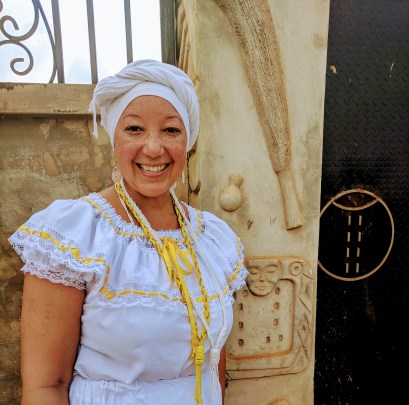
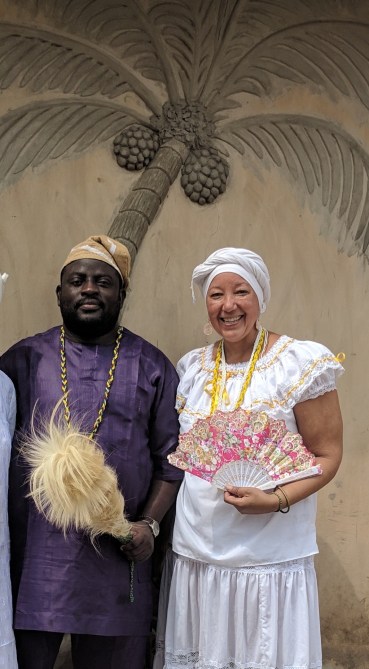
Last week I was in Nigeria on a spiritual quest to fulfill a destined step on my personal journey into the mysteries of Ifa. For many years, I shied away from traveling to Nigeria out of a colonial fear of militarization, bribes and corruption, and overall overwhelming sense of not being safe. Yet, Nigeria is the womb of my destiny, the homeland of my Ifa lineage and where I would need to go for spiritual initiation – starting with the blessings of the orishas Oshun and Obatala. So after more than two decades of mental and spiritual preparation, my turn had come to surrender and be led by faith.

IMG_20181112_143252

On the second night I asked my African American Babalawo why were there no memorials for the Trans-Atlantic Slave trade like one finds in Senegal and Ghana? I was to ask a friend of our our Oluwo – but never had the chance. Later on, in the week, Baba, his daughter an Iyanifa, and myself had a deep discussion on why it is our tendency to always begin Black American history with the slave trade. Why must that part of history be the seed of our conception? This experience awakened in me the deepness of our sense of self – Africa never left us. Like patient and forgiving parents, she lay dormant inside of us, waiting for us to acknowledge her. Nigeria does not need to memorialize the slave trade. Within her bloodstream we were never separated and she knew we would eventually come back home. Instead of memorializing our separation, she honors our return.

IMG_20181112_145741

This story is not about the process of initiation but about the Divine feminine energy of the landscape that embraced me and supported me as soon as I set foot onto her belly. These words are shared through the nano-micropad of time and space and people encountered on a nine-day journey from Lagos to Ibidan to Oshogbo to Ode Remo. They can in no way represent truth, only my insight and reflection.

IMG_6101

After decades of turmoil and violence, Nigeria seems to be in a place of peace where co-existence across faith lives. In the pre-Dawn hour, I awakened on more than one morning to the sound of the Adhan and Iqam – calls for Muslim worshipers; light drum beats and soprano pitches of Christian morning service; and rich voices of the Iyas winding down a series of call and response after a night of praying over me. In that moment, the day was full and rich – a gathering of the ancestors, spirit, humans, and all beings – celebrating life together.

IMG_20181112_130842

This was far difference from the divisiveness, segregated landscape, and echoes of hate talk and violence experienced at home in the U.S. In fact, the day I left there was a mass shooting that killed 12 people enjoying music at a Thousand Oaks bar, 2 to 3 wild fires sparked by global warming – one of which destroyed an entire town killing at least 60 people and many animals, and the President standing by the execution of a journalist. And which is the uncivilized nation?

IMG_20181118_112758

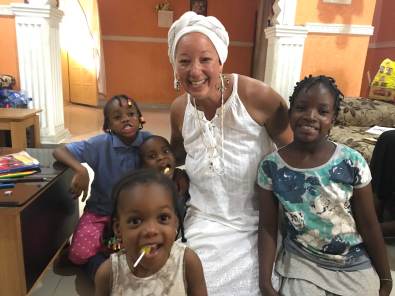
For a week I entered a vortex of time into a clay womb, where the woman was honored, where men embraced the feminine within and took pride in their role as fathers, community leaders, healers. One of the most precious moments was when one of my youngest teachers – a three year old girl whom I played a game of ” I see you” with earlier in the day, woke up crying in the middle of the night. Not sure if I should get up to check on her, I rose up grabbing my robe when suddenly I heard the deep, yet soft voice of Oluwo- her uncle, assuring her that she was safe and to go back to sleep.

Digital Camera

How many little girls, little Black girls in the U.S. yearn to hear the warmth of their fathers’ voices affirming them in their moment of need. Fatherhood is an African tradition and through embracing the feminine, we can guide our men back to their roots to regain the knowledge and redefine Black masculinity in the U.S. today.


Digital Camera

Gender relations in Nigeria are going through a cultural adjustment. As women gain greater responsibilities out of the home, there is concern by some of Western cultural  influences and the impact on family structures and shifts in traditional roles.

IMG_20181112_114626  IMG_6208

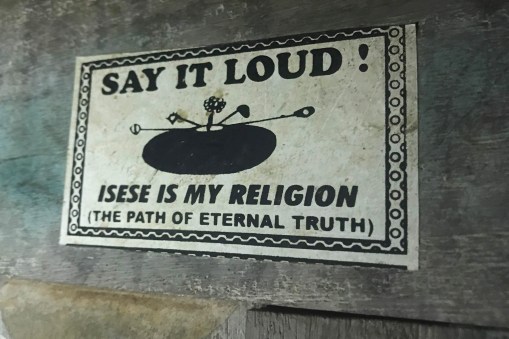
I think though the answer is more present- at least in the practice of Ifa – Isese- the tradition I practice. Through the eyes of this tradition, I observed women, older women  – the Iyas – priestesses of the community in Ode Remo- hold the space of ritual and tradition with strength and prestige with nods from the powerful male Babalawos (priest of Ifa). Each respected the others role in the tradition and yielded the space to perform those roles without competition or intrusion. Like a dance performing the balance of a living eco-system, the men and women accepted and performed their roles with pride and respect for their respective callings. There was no anger, insult, of dehumanization – only mutual appreciation. Instead of looking outward in competition, they look inward into the the soul guided by the wisdom of their Odu’s – life paths- and gifts given by the Orishas, primordial ancestors and energies of the universe that help sustain the lifeforce for continuous regeneration and rebirth.

IMG_20181112_142208

Within this experience I relearned the value of relationships – that they are not about finding the most handsome guy or smartest teammate, or other external factors – but seeking out a mate who complements my essence and call to duty in this life for the work will get done when there is a balanced energetic force behind it.

img_6097.jpg

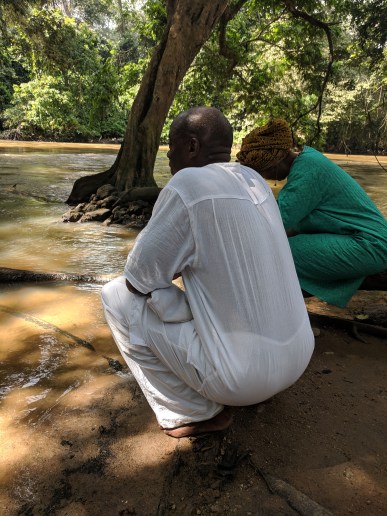
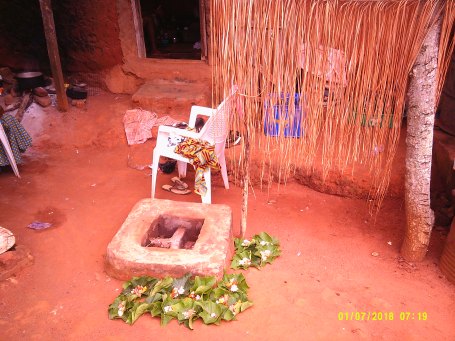
The feminine face of nature also was present in the offerings that we gave to the land in honor of our ancestors. Beautiful flowers and leaves filled with sweets and other essences that were quickly absorbed by a natural predatory eco-system of ants, flies, chickens, goats, hawks, and the unknown. I thought how foolish some of our traditions in the U.S. have become when we clog up our rivers with perfume bottles and lipstick – seeking favor from the Goddess – an earth-based Goddess – of the earth and thus shouldn’t also be her gifts? Why do we seek the most exquisite clothes to mark our worth, when the wisest people I have ever met were bare-breasted women with goat eyes who saw the mysteries of this world and beyond? What material mind taught us shame in being close to the earth? It is this skin that truly catches our blood, our tears, our excrement and turns this waste into fertilizer to nourish rebirth of crops that feed our bodies and our soul. Earth is the greatest orisha and why have we gone against our natural intellect to treat her so wrong. She is the most forgiving, but even the most patient mother wears down. How can we look to traditions like Ifa, humbly ask for the medicine needed to reawaken the divine knowledge latent within? How do we act with urgency so that she does not withdraw her wisdom into the earth – for it will be us humans who are unable to survive.

Digital Camera

IMG_20181112_142214

Many people think of initiation as a final step of destiny. I was one of those. Yet on the other end, I realize that this current mile-marker was just an entrance into a study hall where the desire to learn was ignited. I pray for the resources to return for 3 to 6 months. To sit, assist, observe, hold space in the sacred circle of the feminine as was held for me. It is my duty and responsibility.
IMG_6251

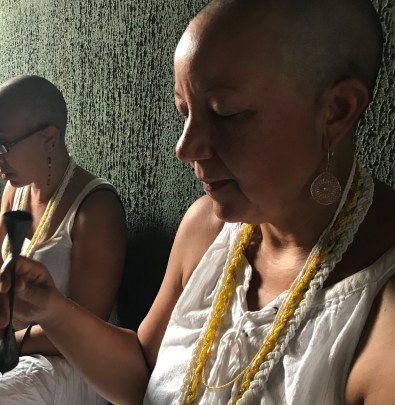
I am honored how I am now called:  Iyalorisha Oshunfunke- she who is to be supported.
IMG_20181118_112607

img_20181118_110912-e1542902047402.jpg

Nigeria, I see You. I am inspired by your struggle and your fight. I now respect your pride. I honor your traditions. May you support your Indigenous practices – the world  needs the medicine.  I see you in me, and I see me within you. I am thankful that we are made of the same earth. To our future together . . . IMG_6227

Cultural Citizenship, Spirit of Place

Made in L.A. – Black Angelinos’ Self-Determination to Stay

Black Angelinos- Black people born and raised or whom have resettled in Los Angeles, are suffering at a deep, collective psychic level – holding on to a life saver ring to resist the current of gentrification and displacement. Holding on to the threads of family, health, community, sense of belonging, and sense of self.
Homelessness; personal, interpersonal, and community violence; mental illness; chronic health condition, low-wage jobs; high wage housing – all symptoms and conditions of systems that disproportionately impact Black lives at every level of the socio-economic level. Black wealth is only 1/20th of white wealth in 2018.
This has been a rising tide. I remember my mom and step-dad moving from L.A. in the early 1990’s to transplant to Tennessee where they bought land, relearned nature, and even opened a cat fish farm. A first-generation Angelino – I also remember telling my mom I would not move back to Cali, it was too depressing.
Yet, the spirit of L.A. called me back home. It is still depressing yet it is in the shadow that we must work and stand strong with a plan to stay so that our sanded footprints in the creation of the L.A. we have today – contributions to the film industry, music, architecture, shape of neighborhoods, government services, and overall diversity – are not erased in the sweeping of an evening breeze.
Yesterday I was inspired by South Central artist Lauren Halsey at a talk about her exhibit – “Space is the Place” in a curated conversation by artist, activist, founder of Dignity Now, and co-founder of Black Lives Matter – Patrisse Cullors. In her piece, artist Halsey owns her space, her right to being, through capturing her stories, life events, relationships, and aspirations of the future in her art installation – a “transcendent space” cast resembling a mausoleum to stand the test of time. It reminded me of mausoleums in a cemetery that i visited in Jacmal, Haiti where a little extra, extra was stored to sustain and protect the soul of community.
In her opening remarks Artivist Cullors shared her story how she was a 4th generation Angelino. That her great-grandparents fled the South to come her for liberation and new opportunities. And yet, with intense – and far too many times lethal -engagement with law enforcement, Black Angelinos are fleeing L.A. to northern and southern So Cal regions or out of state all together. She, however, has made a commitment to stay. So resist. To create. To “recolonize” space and organize community to remind folks of the right to be.
Found throughout the surface inside and out of the installation are images of Halsey’s “love affairs” with the city where she was born and raised. She remembers the names of the women killed by the Grim Reaper, she captures the low riders, hair styles, children preparing for the future, and more. She gives hopes and honors those whose lives were cut short too soon. This is a temporary piece part of the Made in LA 2018 exhibit- up until Sept. 2. A permanent piece will be installed along the Crenshaw line in the next two years.
As I grabbed an uber home, the driver – a single Black father, shared the difficulties of raising a young Black boy in L.A. today. The story was a painful one and the outcome is grime. Yet I thought of the intention behind Lauren’s work and its meaning took on a new sense of urgency for me. In a fight for survival, we must create community reflections of our footprints, our stories, our relationships, our cultural icons- for these are breadcrumbs- icons- on a path toward survival. I encourage all to see this exhibit and take a young one.
In the meantime, during these times, pray for your connection to a higher power. Do not mark your value in comparison to something here on earth. We each have the opportunity to fulfill a unique destiny- we just must cultivate our own head so that our head and feet are in alignment to guide our path. In Ifa, we call our head- not just the physical but the crown chakra – our Ori. We pray so that our Ori’s are strong and in alignment with our higher power. We also pray for the Ori’s of our children and love ones so that they too may be strong. One of my favorite Ori prayers is:
“Ori mi ye o, ja ja fun mi. Eda mi ye o, ja ja fun mi. Ase” – ” Inner Spirit pleace fight, fight for me. Creator please fight, fight for me. May it be so.”
May we fight for our space in the L.A. ecosystem and the protection of our place to Be.
Spirit of Place, Uncategorized

Ode to Orisha Aya, Mother Earth

Initiation is a starting point with intention. An opening to new knowledge. To begin any process of decolonization, a popular word today in the dialogue around equity, one must begin with identification of the colonizer within oneself.

This process is an iterative process, as encounters with life events raise new levels of consciousness, unpacking layers of subjectivity – programmed by friends, family, religion, language, culture, traditions, society.

I am currently on a journey toward a spiritual initiation that will open up new mysteries to me about the Divine feminine energy of Oshun, a manifestation of earth/water energy in the Yoruba tradition of Ifá. Each day on this journey brings new lessons. Today’s began with a sense of restlessness – possibly the space movement of the recent lunar eclipse and planetary retrogrades – creating a desire to journey onto “Native” land. Native land being a magical place in my imagination.

A few weeks ago, a Tongva Clan Mother opened a workshop on racial equity. While her words were gracious as she told the stories of her people and how she and other Elders are sustaining survival through retaining language, customs, participation and presence, her words haunted me. In all of my work on social justice and action, I recognized my own failure of not seeing my hometown of Los Angeles as sacred, Native Land.

I have recognized the seduction by the Queen of Angeles as she captivated the imagination of the Spaniards and others who have settled on these lands in search of freedom of expression and its shadow in the thin line between financial opportunity and exploitation.

I have even celebrated and honored Queen Calafia, a Black Warrior Amazon Queen that came in a vision to another Spaniard of Moorish influence and for whom that state of California is named after.

Yet when it comes to the First Nations – the Tongva and the Chumash – I segregate their presence in a glass box of time/space separation and objectification. This is even as the constant vision of Cahuilla Clan Mothers weeping in the reeds along a dried riverbed walks with me and the sound of their crying never ceases. And even as the Tsalagi blood of my great-grandfather runs through me, confirmed by my 10% Native American blood by my Ancestor.com DNA.

I never had access to my direct Native heritage outside of family stories and given prejudice toward Blacks within Native communities and shaming of appropriation by Blacks  – associated with complex ideas of racial denialsim – claiming linkages to Indigenous identifies has been risky and taboo. Thus my own cultural biases have objectified the beings of First Nations, romanticizing them in my imagination, yet segregating them in my psyche and creating a cognitive dissonance between what I feel and believe and how I act.

The way I see and how I walk in World has been distorted. No wonder why I tippy-toe verse walking flatfooted with confidence – walking unsure whose maternal belly am I intruding on, whose blood fills the underground waterstreams that nourish the food I eat?

This revelation into the biases of self both appalled me and blessed me. At the same time manifested new meaning to a recent DafaIfá divination reading – that said Aje, Mother Earth is supporting my spiritual journey and I must foreibale – touch my head to the earth – to thank her each and everyday.

In my work as a practitioner/researcher in the area of Black Homelessness Studies, I have held space in my writings for deeper emergence into the understanding of harm created by man-made borders and boundaries on the skin of the Earth. Concretized rivers, barbed wire fences, highways that cut off the migratory flow of neighbor conversations, plastic fauna choking our oceans and the respiratory systems of the fish and mammals who survive off of marine eco-systems, riverbank homes for those experiencing homelessness – marginalized from society – reflect a cultural ignorance of man’s predatory nature.

That predator is within me – unless I use new learning to guide and transform a new vision of how I see the world and a new sense of touch to reimagine how I walk with each step intentionally honoring the sacredness of the space supporting my footsteps.

To this end, I walked with intention this morning to reframe my neighborhood state park into a sacred space – a place of Native land. I realized that I do not have to travel to Joshua Tree, Cuba, Honduras, or Palm Springs (although I dearly love each of these places), in fact I do not have to travel outside of me. Like a spider – Alatakun – sacredness is within me.

Today, I began my journey into Kenneth Hahn State Park with the intention to let Ajalaiye – the Winds of Earth – transform my neural pathways to improve my vision of self – allow me to see through sensuality- not my subjectivity.  Walking with beginner’s mind – taking each step full of awareness and feeling.

The biggest lesson that the Walk-about- taught me today, is beyond every place being sacred space – like a womb, nature records our actions. She is forgiving and in a constant place of change and rebirth. Earth is the lifeforce that sustains us, and will continue to survive even if humans destroy the balanced ecosystem that sustains human life. There is a patiki- praise-song/story of when Oshun – the only feminine energy and the Goddess of creation, rebirth, beauty, fertility – was shunned by the male ironmule – the patriarchy- she left the Earth and went back to heaven. In her absence, the earth perished as crops died, there was no rain, people became famished and began to die en mass, the temperature became unbearably hot. The male leaders rushed to heaven to have an audience with Oludumare – the Supreme Being – to partition his advice. Oludumare responded simply- where is Oshun? At this the men realized their mistake in disrespecting the Divine Feminine and rushed back to earth to call on Oshun’s return and ask for forgiveness.

Humans live in an eco-system of balanced Divine Male and Feminine energies. When one is too great, human life will perish.  We must re-learn how to respect the Mother. we must redevelop our City of Angels as Native Land and reconcile history and present through asking permission to be here.

Below is my a photo-journal of the journey.

Race

Finding Love in Fear

IMG_20180521_074838

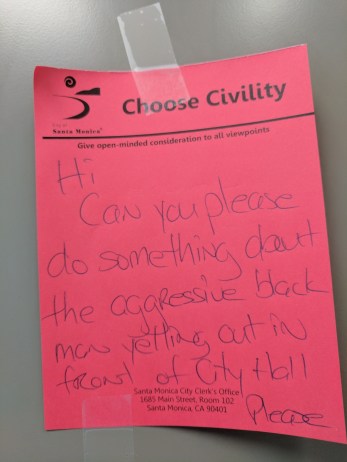
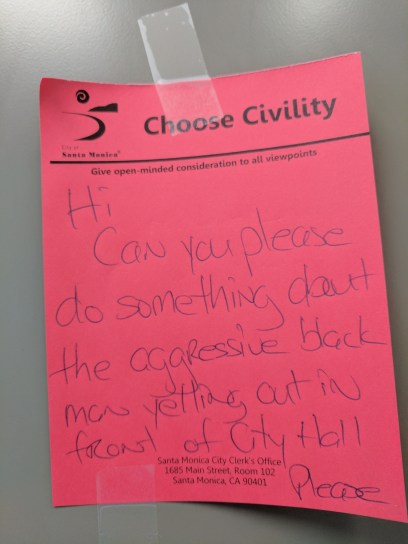
I found this note on my desk on Friday. When I read it, all I could interpret it as was a noose, a symbolic image of the innate fear that many people have of Black people, and Black men in particularly – especially in white spaces like Santa Monica.

Santa Monica has a long history of racial segregation – designating space for workers and “the help” – but for the most part protecting the edges of its hamlet against racial integration.

Implicit bias against the Black stranger invites and attracts what the unconscious most fears. Many Black men, from Skid Row, right out of jail in their black plastic gear, Venice, and communities around the country – stop through Santa Monica as a place of refuge from the violence, gangs, substance use in search of sobriety, and exploitation – especially those whom seek safety in the mist of untreated mental health crisis.

The reaction on the part of locals is a sense of intrusion – an invasion that needs to arrested, contained, criminalized. A sentiment that “these are not our own” and that they must be displaced elsewhere.

So yes, many Black men (and others) are hyper-vigilant, defensive, and will speak up when unwelcoming gazes pierce their flesh with hatred and disgust. This particular person is a veteran with PTSD who wants a home of his own so he can start a family. His behavior represents that of so many others who are protecting the boundaries of their being with what often is all they have left to maintain a connection to their earth – protecting the one place left where their feet touch the ground which given the serial displacement of Black male bodies – is often only where they are in that moment- fighting hard for the liberation “to be.”

Imagine though if in being literally the last train stop before one enters the ocean, and a retreat town where ole St. Monica calls many for respite from mental illness and healing (I am sure our pier is up there with the Golden Gate bridge if you know what I mean) – we responded with a trauma-informed community safety-net that understood how to respond to hyper-vigilance? If we had quiet safe places- public homeplaces like Callie Rose that welcomed people and allowed them to breathe, reassess their current position, and then offer a connection to services?

This morning I was thinking the most successful mental wellness model for Black men in America has been the Nation of Islam. Say what you will in other areas of their work, but when it comes to addressing historical trauma and rebuilding self-esteem and confidence, no other intervention has worked at the scale of Farrakhan’s model. That gives me pause.

In the meantime, we must overcome implicit racial biases to have empathy toward those suffering from mental illness regardless of their skin color. It is unacceptable that the majority of People of Color living with mental illness are treated in our jails and criminal justice system – and not in community based settings or psychiatric settings (although I prefer Indigenous models compared to institutions) where there are connections to treatment and family support.

The succession of mass-shootings show that no one is immune to the collective- mental decomposition of our society. Everyone is impacted. We must stop scapegoating and responding with borders and criminalization. We must understand that we are all hurting in this outlandish, hostile climate, yet privilege prevents some of us from going over the edge – privilege of faith, family, friends, access to health care, loving relationships, nature. So, let’s stop responding with fear and build empathy.

And for the record, besides having a human to human conversation (which I had on my way in and he demonstrated no harm to self or others- was just talking loud), the only thing I will do with this “aggressive Black man” is let him be.

P.S. – After a second note, found out who wrote it. The staff person was expressing the tension of other staff standing in fear in the face of mental illness and implicit biases of Blackness. Had a great conversation and transformed this situation into a beautiful teaching moment. Everyone in City Hall now knows his name and he is still unhoused, but connected to a clinical team who are patiently building trust to best serve his needs. 

Spirit of Place

Honduras: Trust, Nature, Place, Restoration

 “If I had to say what I found here, it would be peace, love, and self-confidence. I may not always be able to express myself in the best way to say what are my skills and contribution, but here a smile or tip were appreciated and made a difference. Would anyone miss me if I did not come home tomorrow, but stayed here? . . . I need to feel a sense of belonging, appreciation and contribution. Honduras has helped renew my soul in these areas. ” (Honduras, 9 July 2008)

After ten years, I returned to Honduras out of the blue in May 2018. The spirit of place called, made me restless, beckoned me to return – a homecoming of sorts, although Honduras is not my home, at least not in this lifetime, or perhaps not yet. So I went for a three-day weekend before the New Moon.

IMG_20180511_171905

While in Honduras, my friend George Roatan, encouraged me to move out of my comfort zone. We had been talking about ideas that I would like to manifest, but have felt stuck, as if some internal fear is blocking, making my drive forward stagnate.

BesiIMG-20180513-WA0000ds being a long-time friend who has quietly been there during some dark times, George is an amazing professional tour guide (more info) who uses a connection to nature as a tool for healing, confidence building, and frankly, helping get “unstuck.” George is a natural teacher with a real gift of connecting to people and reconnecting people to place. 
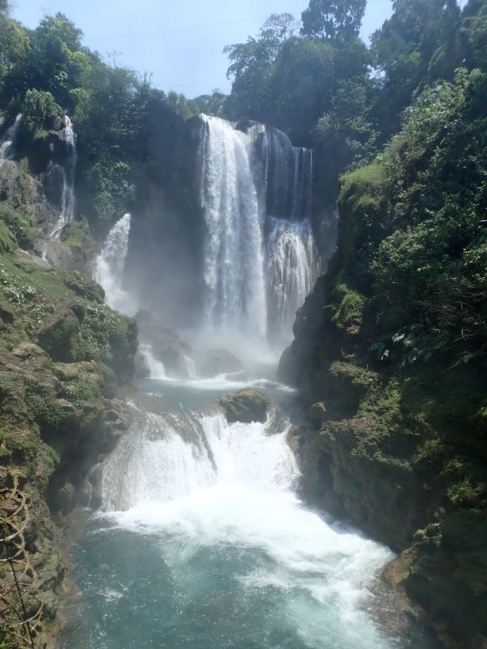
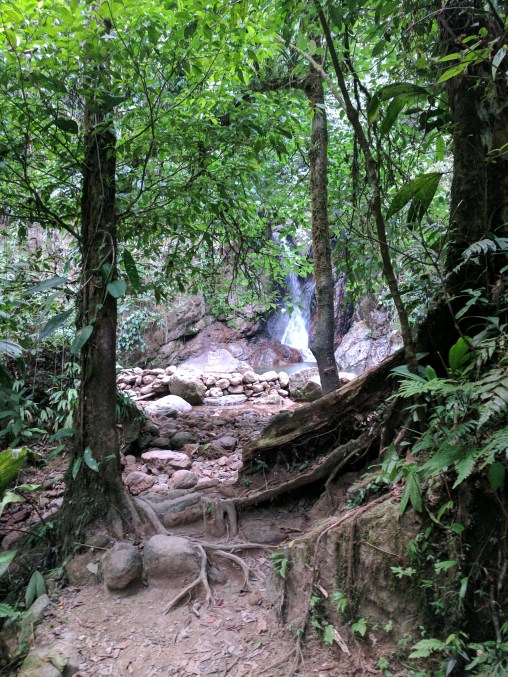
George suggested that we visit Cataratas Pulhapanzak, a nice size waterfall that has a fierce flow, even in the summertime. A place where one meets nature head on. As part of the tour you are guided behind the waterfall, weaving in and out of caves with natural pause spaces to sit, rest, and even stand so that the water droplets ricocheting off the main downpour fall on you like snowflakes.  It is funny, in my spiritual tradition of Ifa, we are always warned to keep a cool head to help build good character. Well, George kept saying, go stand on the rock and look up to “cool your head”, not knowing the connection to Ifa. He is a diver so it reminded him of being under the sea.

IMG-20180505-WA0004

Me, I have a slight fear of heights and am claustrophobic (perhaps Trans-Atlantic Slave Trade memory). I tried it, carefully navigating the slippery boulder and hugged a wall of ancient stone and faced upwards. It felt like little stars rushing toward me. The profoundness of the moment caught me by surprise. What world had I entered? I was not sure if I was supposed to breathe or hold my breath; was I on land or under the sea? I kept wanting for someone to turn the waterfall off – just for a moment so I could re-orient myself. But this was impossible. So I went to sit back in a slight cave on a rock- claiming my safety ground as the sheets of rapid white-water roared in front of me.  While waiting for other members of our tour go off with the guide and explore another cave, I watched George so freely play under the droplets. He was calm, cool, in prayer. Me, I was fighting the flight/fight syndrome, resisting the urge to jump through the waterfall and into the river below. In that moment, I just wanted to be freed from the confinements of space and enter into the waters below where – if I survived the rapids – could just swim on my own terms.

Well, jumping obviously was not a rational choice. George sensed something and walked back over to me and patiently led me to focus on my breathing; encouraging me to  meditate, and stay present in the moment. At the same time, I learned how to put up my boundaries – knowing just how far I could stretch out of my comfort zone. By the end of the experience, I experienced balance. A safe, but not always comfortable place.

IMG_20180511_174804

As I think of the depth of homelessness (a profession that has called me) and its roots in an attachment to psychic drives for racial segregation (at least here in the U.S.), this experience taught me that I must find a way to hold the tensions of my fears so I can continue to move forward, not play small, push the edges of my comfort zone, and trust that I will know the boundaries of what is “too much.” Working with a phenomenon like homelessness that triggers so many personal and collective shadows and trauma, is not always comfortable, in fact more uncomfortable and challenging than not, but this is my destiny. I must walk in confidence- even if I am not sure if I am standing up or upside down, on land or under water,  as I’ve got this. This trip was great medicine for the next leg of this life journey.

Thank you George and all the earth-workers helping reconnect us lost souls back to the land. You have a special spiritual gift of helping re-member the divine within nature and ourselves and teaching us how to become better earth-keepers. Only in harmony and balance with the nature within, as well as that surrounding us, can we fulfill our destinies. Blessings!

IMG_20180516_220513_318
PANACAM – National Park, Honduras


Uncategorized

Why gentrification hurts

To understand the emotion of those impacted by gentrification and its weapons of rising housing costs and eviction practices;
 
to understand why communities impacted by gentrification are concentrated by race/ethnicity – especially those in and around environmentally impacted geographies (i.e. semi-industrial zones before artist live-work spaces and lofts were hip and actual toxic industries were vibrant and polluting);
 
to understand dis-connected workers – those not even looking for work, and those that tried to take advantage of public education but where local taxes were so low these schools tried to make the best with inexperience teachers, outdated text books, limited extra curricular activities to build character;
 
to understand embodied anger generated when one is tied to place not by choice by by means of social control and public policy;
 
we must understand institutional racist biases in our nation’s housing policy instituted since the post-Reconstruction period after the Civil War.
 
Here is one link to get started in learning:https://www.mappingprejudice.org/what-are-covenants/
Learn more on racial segregation in Los Angeles – recommended books include:
L.A. City Limits – African American Los Angeles from the Great Depression to the Present by Josh Sides
Fire This Time – The Watts Uprising and the 1960’s by Gerald Horne
Bound for Freedom – Black Los Angeles in Jim Crow America by Douglas Flamming
Right Out of California – the 1930’s and the Big Business Roots of Modern Conservatism by Kathryn Olmsted