Uncategorized

Osun: Return of the Feminine to the Human Soul (published Oct. 12, 2022)

https://www.flipsnack.com/florencealiesenetwork/osun-whispering-of-wisdom-from-the-waters/full-view.html

Through my magic golden mirror, in the future I look back to the time when Obaluaye walked the earth and the women in the village of women returned the feminine back to human consciousness.

Do you remember?

Since crossing the seas, the sacred body of Olokun – the god.goddess of psyche and mystery in the Yoruba tradition, humans have evolved with amnesia of the sacred feminine inside of them – tilting the universe out of balance.

Halt – says the cosmic policeman. Esu. The one who sits at the top of the Babalawo’s Opon – the crossroads between heaven and earth; past and future. The one who sees it all and reports to Olodumare, the Supreme being.

Hearing the whispers of Ogboni, the universal court of justice, Esu conjures up the rainbow warrior tribe of Oya – the shemale who wears a beard and dances in a skirt weaved of rainbow scarves and bones as she simultaneously dances across the landscapes of earth and multiple universes bringing about sudden and transformative change. 

Esu commands Oya and her rainbow warriors to carry the sun’s breath in the fabric of their mighty winds stirring the sands carpeting the earth’s desert floors. On contact, their kiss of cosmic breath vibrates into the cracked, dry, droughted earth, sending tremors into the underlying fault lines, causing lands to quake and rivers to overflow and flood.

Birds pause and fly upwards, returning to Orun- heaven; animals seep into the velvet curtain of the deep forests and oceans; sacred plants immolate- catch themselves on fire – to protect their seeds for future generations; and great leaders fall into a deep sleep leaving only their footprints as evidence of their time on earth.

The cacophony of the chaos reaches down into the bellows of the earth’s soul where Baba- the one who spreads the pox – lies sleeping bored with social isolation and banished by human’s fears of his power, medicine, and being.

Jostled from his slumber by the desperate cry of the universe, Baba grabs his staff and palm fronds and manifests into humankind, hoping to awaken consciousness in the hearts and minds of humans destroying earth with hunger, greed, rape, exploited labor and power, pollution, homelessness – led by selfish leaders with broken character- violating the pact of coexistence between humans and Onile- Mother Earth.

The King of Earth was enraged and prepared to defend his Mother, Protector, and our sacred Orisa.  

Oya rides with Baba, applying her winds to spread medicine hidden in his palm fronds that dispersed into the air like dandelions seeds as he danced. Baba’s medicinal motion intoxicates every community he enters, shapeshifting arun – the ajogun of illness – into airborne structures that lodged into life sustaining passageways blocking the flow of air to lungs and clotting bloodstreams, commanding attention by stopping humans from breathing.

The pounding of grave digging for burials of bodies piling returning to the womb of earth, weakened the psychic membrane suppressing historical secrets of inequities, rising them to the surface like festering wounds needing to be healed. Historical archetypal energies of racism and patriarchy embolden in the chaos, seek to resist the change Baba and Oya are bringing to the world.

Tensions rupture in the climax of George Floyd’s cry for his mother as he labored through his last breaths under the knee of one possessed with past karma circulating since the first colonial ship. George’s cry vibrates across the universe. As his Mother comes forward from the ancestral realm to grab his hand and carry him home, women in the village of women too heard his call and ran to the river to see what was happening down below.

The women in the village of women ran away many moons ago as an act of defiance to the changing traditions that switched the energy of the world from feminine to masculine. They are women warriors – who escaped death on earth and in their isolation became keepers of the traditions and protectors of the future. They fought men who tried to enter their kingdom until the men found ways to exist without them and stopped trying to bring them home. Through time they forgot about earth and without their energy feeding the soul, their legacies on earth forgot them too. That is until dreams of remembrance of another way, began seeping into consciousness as their off-springs sought to navigate through these turbulent times through the calling of their ancestors.  

With guilt and fear, the women of the village of women looked deep into the river and saw the havoc on earth and saw Mother earth’s womb filling up with bodies piling up on top of decaying trash.

And then they saw him – the king – Obabaluaye – walking the earth, shaking his palm fronds – with illness and death falling in his wake.

Where is Osun they cried? Where is Yeye – Mother? Had she left earth again? remembering the time Osun left earth in Odu Ose-Tura, when as the only female irunmole she was ignored and disrespected so she left and earth began to die, only agreeing to return when she gave birth to the male energy of Esu.

On cue Osun appears out of the water with a cadre of women, dressed in white. Women who had been praying since the first breath of the sun touched the earth. Women who held the faith of Osun’s love and protection of humanity. Women like Iyalorixa Mainha da Bahia, a daughter of Oxum and mother to many communities the world over – for whom when the world leaned into fear and violence, continued to pray and lead with love.

Osun spoke to the women in the village of women in a stern, yet loving voice – “it’s time. It’s time to return back to earth. We must return with confidence and self-love, ownership of our own sensuality, respect for one another, willingness to tend to the wounds of the earth and protect her from new injury. We must learn how to forgive and re-enter into relationships with men – those that through all of this are willing to redefine their manhood in harmony with earth. It is time to burn the village of utopia and return to love ones in the present – bringing our Black queen magic to the alchemic pot in the creation of a new consciousness of love.

The women in the village of women returned to earth. The ways of the Ancient Mothers rose out of darkness into the public square through dance, song, ritual, initiation- aloshuada- our coming together. The feminine is back. It is inside of you, me, us. We thank our Elders the keepers of the tradition for preserving this knowledge so we can learn to become better caretakers of self and world.

Uncategorized

Race & Violence within me

A personal reflection of growing up in L.A.

Being in a state of prayer and purpose on Monday at Pastor Jean-Marie Cue’s “Where do we go from here?” interfaith memorial for the mass shooting victims in Buffalo, Laguna Hills, and Uvalde, I found myself questioning how has violence shaped my own life and identity, and how am I contributing to its continuation? The response came through this elongated essay recounting my personal experience from childhood in 1975 until approximately 1995 when I graduated from grad school. During this journey I learned to navigate multiple forms of violence including community, racial, and global. Interconnecting all is a white supremist, patriarchal practice of capitalism.  

I can’t recall my first experience with guns or gun violence. I grew up around gangs during the 1970’s, crossing Bloods and Crip territories between my house in Inglewood and my babysitter’s house over on 39th St. off Normandie. Over there everyone, including me, feared my “cousin” Tee. The entire street was our playground and when we would go out of bounds – like going pass 3 to 4 houses, the apartment building across the street, or heaven-forbid turning the corner- and saw Tee, we ran faster than  if we saw my Mom. There was a code of the street and respect for where one called home and for the safety of children. While there were always stories of a gun used in a robbery, in those days the boys just fought – fist to jaws, stomach, or chest. A dirty fight was when other jumped in and on occasion someone pulled out a knife.

I learned from watching the boys the culture of “heart” – of being always prepared to fight. For whatever reason, initial running was never an option. You could “wolf,” you could dance and not throw the first punch, you could get beat up, you could use anything as a weapon if you were losing, but you could not run. I also learned the vulnerable places where one could be jumped – walking around the corner and school bathroom stalls – so always be prepared.

I internalized this culture. As a girl, my first act of violence against another person was a classmate around the age of 6. A girl I barely knew was taunting me on the playground and I told her to leave me alone. She didn’t, so I kicked her in the stomach. I didn’t feel good afterwards and probably cried more than she did when I got home. The vibration of my contact to her felt icky. Later, on the school yard a few years later around the age of 8, while in the cafeteria line waiting for lunch, I was challenged by “my friends” to see if I had “heart”. To pass this rite, you had to stomp up, roll your body into the face of your opponent (eyes and neck did their own roll), and prepare your right fist to swing, just in case the person pushed or swung back. I think my friends were surprised I knew the ritual, and all fell out laughing with nods of respect– I was in.

After this experience, I was bussed from South L.A. to the Valley and had to learn how to fight racism – not through my body, but through my mind in balance with remembering myself. I had to adopt to new rules such as lining up for everything – To go inside the classroom, to go outside for recess, to sit down for lunch, to come inside, to go to the bathroom, to check-out a ball, to check-in a ball, and to get on the school bus to go back home. I actually got written up for cutting the line to return my ball after lunch one day, as I feared being late to class more. I also experienced for the first time a White person, our teacher, thinking that we were “less-than” based on where we were from and of course the color of our skin. While Mr. Vaughan was the best math teacher I ever would have, I never forgot how he made me feel.

For the fourth grade, I transferred to another school in the Valley where my mom worked. Most of the teachers were Jewish and leaned “left.” However, things were different among the students. When we were all out on the playground, it felt like there was a fair representative of Black students, however inside the classroom, there was only 1 to 2 of us. Consequently, “friends” became those who you spent the most time with and most of my friends were thus white. This was the closest moment in my life where I was able to pierce the veil of wealth and class culture. It was vicious and often made me question my own sense of self as I compared myself to those around me. When I first arrived, my mom made sure that I knew the Black students, most of whom were older than me, and they would check on me during lunch breaks. Students of all races spoke with one another in class and in the hallways, but students tended to stick to each other by geography and this was a proxy of race.

The upper-income Valley kids hung out together, the Canoga Park kids hung together, and students bussed in from L.A. tended to hang out together. I was kind of in no-man’s land by being the daughter of a school administrator. In this space, I quickly learned the violence of “cliques” and “mean-girl” culture. In the circle of my White classmates, words like “stuck-up,” “snob,” and “ho” were flung around like daggers and someone for whom we were all friends with the day before, suddenly were banished from the clique and the fear of also being banished by association re-enforced the marginalization of the person. It was vicious because the ruptures seemed spontaneous. It also erased intimacy among friends because you never knew who was going to turn against you. At my home school, I realized our rituals were tests to see who would have your back.

Here, I didn’t trust that anyone would. In fact, I began to feel more and more isolated. Among my white “friends” my difference was noticed through round-about comments and eerie desires to touch different parts of my body: “are you legs really that brown or are you wearing stockings?” “Can I touch your hair? It is different than most Black girls.” “What are you? You can’t be all Black” “You are so tall; your parents must be tall.” In these exchanges I learned the meaning of light-skin privilege because I noticed that we did not hang out with my darker skin classmates at lunch, nor were they invited to birthday parties and weekend sleepovers. As Black girls we would try to hang out, but I think the daily survival in a white world prevented us from getting close or building authentic relationships. Recently I ran into a Black classmate from this period, and she absolutely did not remember me. She had even spent the night at my house for a graduation party sleep-over. It made me sad. At an age where children start to develop crushes, I noticed that white boys did not find me attractive, and the Black boys thought I was stuck-up because I hung out with white girls. I could not win.

In this school environment, I began to learn the subtle differences of class among white folks. I was paired with a group for a science project. We went to one of my classmate’s homes after-school to work on the project because her mom did not work and was home to help us. She lived in an upper-income neighborhood in the West Valley. The assignment was to protect an egg from breaking, so we went to the second story of her home with our concoction to drop it from the second-floor balcony off of the “playroom.” I could not fathom a whole room dedicated to my classroom and her siblings – not to sleep, but simply play. When I got home that evening and looked around our 2-bedroom home, which was nice and even had a pool, I felt different. I felt ashamed. My refuge during these years became my dance and drama teacher, an African American woman – Mrs. Greer. Inside of the characters from the Wiz and Oliver Twist – I was able to just be me.

Shortly after this moment, on a trip to Ensenada, in Baja California, Mexico, the memory of my classmate’s playroom made me think that the brightly colored tiny homes along the hillside were dedicated to children. I remember saying something to my Mom like “I wish I lived here so I could have my own house to play.” My mom looked at me confused and asked me to explain more. She then understood and then shared that those were not homes for children, but entire families who were poor. 

I re-entered the Black world for junior high school when my mom remarried, and we moved to Pasadena. There was a lot going on in our home with the merging of two families, so school became a refuge. Our school was diverse, and I found the greatest sense of safety and acceptance among other Black students. We could talk without needing cultural translation. Among my new friends, my identity was never questioned, instead I was just “thick,” “redbone” and had “good hair.” While these cultural expressions of Blackness were understood, I remembered the lesson from my former school that these were also considered privileges in our social-cultural hierarchy that placed me in closer proximity to whiteness. The older girls and my step-siblings- who had only gone to private schools – thought that these features could be vulnerabilities that may get me jumped, so I learned how to always be ready to fight; carrying a box cutter under my sleeve when I had to go to the bathroom during class, a rubber band around my wrist in case I needed to pull my hair up into a ball, and earrings that could quickly slide off. I soon learned that most girls fought over boys, so tried to get the full scoop on anyone that I was attracted to or was attracted to me before “talking.” I also just practiced being humble and cool with most folks.

Thankfully I never had a fight in jr. high or high school, and to think of it, most of my friends did not fight either, maybe an argument, but not a fight. We had a sense of pride of being from the same school – like kin. We also had other outlets to work through competition and find purpose like sports, drill team, the Girls Club, Salvation Army Basketball League, summer camps, parents (that many of us were afraid of), and morning bagging sessions.  

The summer after my first year in junior high school, the entire region was held in terror by Richard Ramirez- the Night Stalker. To this day I do not sleep with any doors opened and only windows that I know one cannot reach from the street. I will never forget the moment of watching the news the day community folks in South L.A. captured him and beat his behind, holding him down until the police came. We were so terrorized by his killing spree that the death of a popular coach and student were initially thought to be victims of the Night Stalker, until it was found out they were killed by another student as allegations of sexual molestation began to surface. At that time, white coaches provided alternatives for youth, particularly boys from going into the system – but no one ever spoke about the potential of abuse and exploitation given the racial/class/age/gender power hierarchy in some of these situations. This truth was hard to talk about as everyone knew of coach, and some guy friends had hung out at “coach’s” house, especially youth going through hard times. To this day, I am not sure there was anyone around to help students process all that had just happened; coach was dead, period. This was a moment that I learned to normalize trauma against Black boys and youth and respond with silence.

While we were processing these specific incidents of violence, we soon were to be immersed in a rising wave of global violence, although it felt local at the time. War in Central America, mostly El Salvador, was continuing to escalate. I remember seeing images of the war on the nightly news, waiting for a favorite t.v. show to come on. At the time, my family lived off a street where a Marine base was located. My bedroom looked over this street and I still remember the fear when the base must have been doing drills or moving equipment and I saw military-style vehicles were advancing down the street. All I could think of was that the “Gorilla War” was near, and we better learn “how to fight.”

This would not have been my first exposure to global violence as most of my childhood was impacted by threats of the Cold War with Russa and the Iran Hostage Crisis that propelled Regan into the Presidency. But this was different. It was real with real bodies showed on the news. I just did not know how close the war was beyond my imagination until I began overhearing classmates share stories of family in El Salvador and in a few cases, becoming fearful when markings were made on family members’ homes here in the States.

Around the same time, other classmates started talking about “rocks” – crack cocaine. Like all generations before us, I and others had already experimented with cigarettes, alcohol, and marijuana by junior high, but we looked down on other drugs. Not because of Nancy Reagan’s “Just Say No” campaign or sizzling egg commercials that alluded to your brain on drugs, but because we all had heard stories of someone sniffing or smoking a joint laced with Angel Dust and trying to fly off a roof or other crazy apparatus and didn’t want to look like a fool. It wasn’t until much later that I began to see the impact of crack cocaine on users of the drugs, but immediately I began to observe the social price of drug sales. Differences among us began to stand out based on dress, what shoes you wore, if you drove a car – Suzuki Jeeps the most popular – had a beeper, and other subtle effects defined by a “cool factor.” Friends became more secretive. I remember showing up at weekend house party and one of my big brothers saw me and firmly told me to go home – I didn’t need to be there. Sure enough, the party ended with someone shooting (no one hit) and the Sheriff’s coming to shut it down. But why did he stay? Soon afterwards we started having a school police officer on campus, locker searches, and then no lockers to reduce storing of drugs on campus.

Community violence began escalating as there suddenly seemed more access to guns. Where in the past you may have heard of a liquor store being stuck up or someone robbed at the bus stop or even a home invasion robbery like the one that killed my dentist Dr. Strong, the use of guns had not been that common. It started afar with threats of drive-bys during away football games, especially as our teams climbed in CIF and we had to play teams across gang and ethnic lines and who won. I was a “manager” on the varsity football team – a glorified taper of stinky athlete’s feet, along with a few friends and we always traveled with the team. A male friend from NCCJ Big Brother/Big Sister Camp attended Gardena. He was the kindest person and had to survive the world around him. I remember it felt like crossing the Berlin Wall to meet at the end-zone during half-time to say hello. The consequences for him being seen with me in my white jersey with red lettering would have been worse for him than for me.

Long-time tensions between Blacks and Mexicans, especially neo-Nazi Mexicans in San Bernardino and different sects of gangs (that would sometime fight each other) were now backed by guns. It was a time of disassociation. Around this time, I was selected onto the swim meet. I remember distinctly a meet against Chino Hills. With all the rumors of Mexican Nazis, I didn’t know what to expect and was a little nervous, although my white team members had no clue. Once in the water though, we were just swimmers. The Chino team was the only all-Brown team that we competed against and after a few laughs and words of encouragement at the start, I remember wanting them to win as they swam their hearts out. It was a moment when I thought it strange that I was taught to fear people that I looked like.

After a major local drug entrepreneur was arrested, it seemed like violence really escalated. I remember when a woman driving down the street was shot and killed while driving. I did not know her, but the impact of thinking about her last moments induced a new fear in me. Later, I started losing people who were closer and closer. First was the boyfriend of a close friend, then the cousin of staff who worked at the Girls Club, and the son on of one of my mom’s friends while sitting at a bus stop in L.A. Violence across the region escalated to epidemic proportions where the L.A. Times began running a series outlining the stress and despair among children who were starting the fear that they would not make it to 18, and had to dream more about their funerals than weddings. Comparisons were also starting to be made about the life span of an American Black Youth with that of men in poor countries with limited healthcare and economic opportunities such as Bangladesh and Haiti.

While we were learning how to straddle a world of “normal life” of sports, activity and cultural clubs, student government, falling in love, Homecoming Queen Elections, Spring Dances, Proms – with increasing violence; relations with law enforcement also escalated. Many of us lived in unincorporated County so were serviced by the Sheriff Department. I had an uncle who was a Sheriff, one of the first high ranking African Americans, however he was honest that racism was rampant in the department. He explained that Sheriff officers were trained in the County Jail before patrol on the streets creating a bias that everyone, especially Black and Brown males, were criminals. They were a normal pain for showing up at house parties first with their helicopters and bright lights (most parties occurred in the back yard), and then lining the streets with all the lights off of their patrol cars, startling us as we piled out of the party. But for others, they were far worse. I remember hearing the painful story from one of my male friends after he was taken up to Angeles Crest Highway and let go after being stopped by the Sheriff. We could not even figure out who could we tell. There were also rumors that it was the Sheriff who started local gang wars by shooting in one area and blaming a rival gang.

In Los Angeles, the police department started deploying militarize weapons including the batteram to knock down doors on “drug” houses, although some were homes of regular folks based on bad intel. Piloting first with LAPD, the federal government began supplying local police departments with military style equipment through grants under the “War on Drugs.” As many have documented, communities, including Black and Latinx communities, were led to support tougher anti-drug and anti-drug trafficking laws including the infamous three strikes law, leading into the era of mass incarceration.

My own interaction with Pasadena Police came when a pair of officers began spraying mace as they walked through a local hamburger hang-out place called Lucky Boys. We had just attended an all-star football game and were gathering as one of the last events before most of else either left for or returned to college. It was actually a quiet night and things were calm with lots of laughter. As the police officers walked by, we all started choking and eyes started burning. We realized what had happened so went up to the officers and asked what they were doing, and they just responded that “it was time to go home.” Thankfully one of my friends got a badge name. My mom gathered our parents at my going away party and invited the NAACP. My party became a testimonial with myself and friends sharing what happened. Afterwards the NAACP and our parents filed a complaint. Through a family member who worked in the department, I heard that discipline action was taken, but this did not always take place. Shortly after attending college, the video of Rodney King being badly beaten by LAPD flooded news stations across the nation giving some form of proof to stories told by Black and Brown communities for years. A few days after the video was released, 15-year-old Latasha Harlins was killed by a local store owner over an allegation that she stole a bottle of orange juice. In the end, neither the police nor the store owner (after being convicted) were held accountable for these crimes leading to the 1992 Civil Unrest. 

During high school, Big-Brother/Big-Sister Camp and their Youth Leadership Program sponsored by the National Conference of Christians and Jews (NCCJ) provided a safe refuge while helping us build leadership skills to facilitate life-affirming human relations. My mom supported me as she dropped me off to mee fellow NCCJ staff and participants as we participated in a large protest against Apartheid in front of the South African Embassy in Los Angeles. We intuitively knew there was a stronger connection to what we were going through in the US with our South African Brothers and Sisters so felt we had to stand in solidarity. Through NCCJ, I became part of a team to help build dialogue between Asian and Latinx students in a neighboring school district as gang violence between male members of these communities erupted. With my NCCJ mentor support, I also was selected to serve on the local Youth Advisory Council were we successfully advocated for the Department of Recreation to run a midnight basketball league as a safe place for youth to go overnight. Finally, with the support of NCCJ, I received a scholarship to go to college at Xavier University of Louisiana with a promise to develop programs for Black youth, particularly males as a violence prevention approach. Dr. Antoine M. Garibaldi, Vice President of Academic Affairs at Xavier was writing about the crisis of young Black men at the time at the national level and agreed to oversee my work. I am not naïve to think that these efforts stopped the violence, but they shaped my thinking around the power of community-based alternatives and interventions.

In college, I started to learn more about the interconnectivity between all of the forms of violence I had experienced directly or as a witness by the age of 18; inter-group, community, racism, poverty, war, law enforcement.  I went to college at Xavier University of Louisiana, an HBCU in New Orleans, hoping in some ways to be able to decompress from the background noise of community violence. I was told by many that New Orleans did not have gangs and most violence was inter-personal, between people who knew each other and were caught up in love triangles or bad debts, etc. This may have been true, and it was also true that New Orleans was experiencing its own flood of drugs including cocaine and crack and guns. In many HBCU towns around this time, tensions grew between out-of-town students and the local community. Xavier created a number of community engagement activities with the surrounding community to mitigate these tensions, but every now and then at a party, the guys from New York and New Orleans would fight. By our junior year however, the violence escalated. I remember attending a house party when shots rang out inside of the house and my friend pushed me into the fireplace until the shooting stopped and we got out of the house. In all my time in L.A., I had never been that close to a shooting. Later one summer, a mentee was killed execution style after being set-up over drug turf. His death was crushing as I knew when he shifted toward distributing and I never had a conversation with him. In fact, he was the dealer that we all trusted buying weed from. He sold more than weed, however I have had to accept being complicit in his death by staying silent. The only way I could reconcile this was to stop smoking weed, testing other drugs was never of interest. This mentee also came from a wealthy family of professional parents. His story taught me that drugs, guns, violence, etc. were not an issue of class or education or geography, but more related to a toxic culture of “fitting in” and earning respect through death. Too many Black youth were dying at the downside of the global drug supply chain, and I wanted to understand who was feeding drugs and guns to our community? Later Congresswoman Maxine Waters held Congressional hearings exposing the link between Iran-Contra scandal where the US sold guns to Iran while siphoning off funds to support the Contras in Nicaragua who also funded their purchase of weapons through the sell of crack cocaine to dealers in the United States.

College was a time of protest. President Bush (senior) invaded Kuwait in what became the Persian Gulf War. Male classmates who had signed up for the reserves to pay for college, were being called to active duty. We raised up in protest. Not too long after this, David Duke, a white supremist and Grand Wizard of the Knights of the Ku Klux Klan (KKKK), ran for Governor of Louisiana. We raised in protest. When policemen were found not guilty in the beating of Rodney King, we marched in protest in solidarity with our Sisters and Brothers in Los Angeles. When Rep. Avery Alexander, an elder Black statement, was placed in a chokehold by Louisiana State Troopers during a protest against David Duke, as student body president at the time I partnered with the student body president from Dillard to hold a press conference denouncing this action on Xavier’s Campus. About an hour before the press conference, the Fruit of Islam from the local mosque showed up – sent by Minister Louis Farrakhan himself for protection. I had not even thought of the potential for retaliation from white supremist organizations. President Francis later shared how Xavier provided hospitality and refuge to the Freedom Riders one summer, in the face of threats from local white supremist. We were continuing a tradition.

We moved through these events with the support of many elders including Baba Dick Gregory, Kwame Ture, Malikah Shabazz, Dr. Ni’am Akbar, and I think Kwanzaa Kunjufu with many others. They helped us put all that was happening in the world into context. I also had the opportunity to intern on Capitol Hill with the late Honorable Mervyn M. Dymally who at the time was the chairman for the Subcommittee on Africa. I learned under fire with support from the Subcommittee staff and Congressional Research Office, in being tasked with developing questions for public hearings about the concepts of terrorism, bilateral and trilateral aid agreements, the World Bank, International Monetary Fund and how to think critically as I read information from a U.S. government perspective. Mr. Dymally was from Trinidad, and he understood structural inequality between the allocation of resources between what we then called the developed world and developing world. He was determined to make sure that myself and my other intern colleagues learned not to read at face value, but how to see in between the lines and identify the true effects of policy on Black and other populations of color. Through this opportunity, I also learned about the Horn of Africa, rising cases of HIV (in some cases transmitted through reusing of immunization needles) and the Southern African drought and its threat to food security across the continent. In looking back, I realize now that the seeds of war and mass migration were sprouting during this time in what has now become a full bloom of climate crisis and human displacement.

After this experience I studied abroad in Kingston, Jamaica the fall semester of my senior year, 1993. Through classes on the campus of the University of the West Indies and an internship with the Kingston Restoration Company, I learned how to see the world from the perspective of the Global South, an experience that I can only relate to what it must feel for astronauts to look back on earth from outer space. I learned new language like US Imperialism and structured adjustment. I had a teacher who was a communist and another who was present during the U.S. invasion of Granada. I was introduced to the Caribbean scholarship of Walter Rodney, Eric Williams, C.L.R. James, Hilary Beckles; writers Jamaica Kincaid, Jean Rhys, and Rex Nettleford (who we met), and even introduced to African American scholars like Derek Bell and Manny Marble.

Through my internship I learned how political parties exploited the poor by feeding gang leaders with guns and cash during the election season for the votes, escalating community violence. I worked with a group of young men from the community. We created a literary arts program focused on writing and centered on storytelling as a form of expression, problem-solving, and goal-setting. In seeking to connect the youth to local professionals who I met while out and about, I learned that internalized prejudices ruptured cross-class collaboration so that no matter how smart one was in school, where they lived determined their education and access to job opportunities. My students also taught me how this community protected one another. One day while walking the few blocks from the main office to the community center where we met, I was robbed. Normally one of the students would meet me but on this morning no one did, and I had been in Kingston a little over a month by now so felt comfortable. While crossing a vacant lot a young man walked up to me and started a friendly conversation. I thought I had seen him before so let my guard down when suddenly he put his hand in his pocket like he had a gun and asked me for my money. I threw a few Jamaican dollars at him and ran to a nearby business yelling – “thief, thief.” The security guard ran out and let me in and then flagged down a car to give me a ride to the center. Once there, the center director noticed that I was shaken so asked what happen. By time I got it out, the young man who robbed me walked down the street. The director then stepped to him, exchanged words and I got my money back. When the students found out, they were upset and wanted to find the person. By the end of the day, one of the local leaders came and asked me to walk with him to find the person as he was upset that people would try and harm a friend. As we were walking, I saw the young man again, but seeing the terror on his face when he saw me walking with this leader, I didn’t say anything. In this space of extreme poverty where people turned up music because the tin walls were so thin; where we shared curried chicken backs and rice and peas for lunch; and where family members had to take food and blankets to incarcerated and hospitalized loved one – a sense of community and belonging existed that I have yet to see in more affluent neighborhoods.

Finally, to round out this experience, following in the footsteps of Mr. Dymally and my dad, who had traveled there about a decade before, I found a way to get to Cuba. It was a time when many faith-leaders risked their freedom to break US law to travel to stand in solidarity with the Cuban people. It was also a time Russia had withdrawn resources with the collapse of the Soviet Union, and food and other scarcity was prevalent to the point the government had to ration all food and basic supplies. Standing in line was part of the norm of navigating the city, even for tourist. I was only there for a weekend, but thankfully we connected we local Cubans so got to see the city of Havana through their eyes and daily experience, a perspective most tourists did not get to see. I left conflicted. On the one hand the people’s pride was so great that collectively they found a way to make it through, sharing even the little with us; and I saw advancements there in healthcare and the way they took care of persons living with AIDS that was much more humane than the stigma and ostracization that I witnessed in the states. Yet, on the other hand I witnesses anti-Black racism as people with brown and darker skin were not allowed to work in the hotels – a policy going back to the US occupation a century earlier; and the stifling of gathering and laughter as more than a few times we ran into military officers patrolling the streets and everyone became somber.  Creating a “new path” beyond our democratic capitalist model was complex.

My study abroad experience broke my hymen and gave me a greater perception about the world and the effects of US government and culture’s perpetual hunger for domination and consumption on the lives of non-white land-owning men, worldwide. I returned to the states transformed. I now had a stronger framework in which to see the attitudes, policies, and practices that were negatively impacting Black communities across the U.S. like Los Angeles and New Orleans, but also impacting Black communities around the world like Kingston, Havana, and cities within the Horn and across the Southern Region of Africa. I did not quite know what to do with all of this information. I needed guidance on how to channel these learnings and awakening passion. After speaking to a few people at a graduate school fair on campus, I applied to the University of Pittsburgh’s Graduate School of Public and International Affairs (Pitt) and was accepted.

My experience at Pitt was another learning inside of a formal academic program. As a majority white school, it was quite different from the nurturing environment of Xavier University and HBCU experience. Whites were also more conservative and patriarchal – men and women – than I experienced at white elementary schools in Los Angeles. By this time the crack cocaine and its negative impact on families, communities, and public safety had emerged into the academic discourse. I will always remember the exact moment in a public policy class as we were discussing HIV and access to healthcare, a white male student blurted out, “if Black women stopped smoking crack and having sex, we would stop the spread of HIV.” How do you respond to that?

Our program was a collective of public administration, public policy, international development, and security studies. People either had been or wanted to go into the Peace Corps or other international development organization like United Nations Development Program, while others the CIA or State Department jobs, and the more practical persons amongst us wanted to work in local or state government. You could imagine our class discussions on the continual fall of Russian currency, invasion of Somalia and Haiti, rebuilding after the Kobe, Japan earthquake, and other global events. We also had a large international student body, many the children of ranking diplomats and government leaders in their own countries, and others as part of U.S. Agency for International Development and other “capacity building” exchanges. This was the first time that I met and had an opportunity to socialize with white Latinos from Central and South America. Their perspectives of me and global issues was very different that mine; conservative, pro-US, and anti-poverty in the sense of criminalizing the behaviors of poor people who were majority Black and Brown in their own countries.

I had one Afro-Nicaraguan classmate who introduce me to the African presence in Central America. Through him I researched and drafted a report on Corn Island, Nicaragua and the communities of African descent who had been marginalized by even the communist government. This place is still on my bucket list to visit. For the most part, I bonded and later lived on a block of student housing with many African and Caribbean immigrants who were graduate students in my program and others across Pitt. There I found community. The men loved to cook and us as women would host study groups and social parties to shake-off the rigorousness and pressure of being in such a competitive and racists academic setting. A friend from Barbados introduced me to the concept of self-care when one day she brought me a stack of paperback romance novels to read instead of the heavy philosophical geopolitical works of Fanon, James, Williams, and others that I was reading and would want to discuss with the whole block. Those books probably saved my life.

Despite our differences, the Oklahoma City bombing bonded us together. I will never forget the day it happened. I was in the administrative office seeing if I could opt out of a class and graduate early when someone turned on a television for a breaking news report. Someone had bombed the Alfred P Murrah Federal Building in Oklahoma City. Over a hundred people died. At first the news media thought it was Middle Eastern terrorists and by the end of the day it was clear that it was done by domestic terrorism, a white supremist named Timothy McVeigh. The one thing we all had in common was a desire to leave Pitt by entering a distinguished career in government. The bombing could have impacted any of our future selves. This was a pivot in our journey. Things got real.   

In my 50 years I would go on to witness many more acts of violence in community and the world. During this life journey, I lived through the cultural pivot from social justice movements advancing civil, women, and gay rights to an individualized pursuit that hooks observed as “Americans were asked to sacrifice the vision of freedom, love, and justice and put in its place the worship of materialism and money[1].” Her antidote is the reclamation of love. I agree.


[1] hooks, bell. All about love. William Morrow, New York: NY 2001
Uncategorized

Osun: Whispering of Wisdom from the Waters

On this Memorial Day when we poignantly remember the loss of so many lives from all forms of violence including war, hate, insecurity, and rage, it is important to make self-awareness a part of our daily practice so we can command our emotions and not feed into the destructive mood that swirls around us.

Here is a small inspirational e-book – Osun: Whispering of Wisdom from the Waters – dedicated to the medicines of the waters to offer a focal point to pause and get in tune with yourself and how you are showing up today.

Enjoy!

https://www.flipsnack.com/florencealiesenetwork/osun-whispering-of-wisdom-from-the-waters.html

Uncategorized

DANCING WITH CANCER UNDER MY MOTHER’S EYEZ

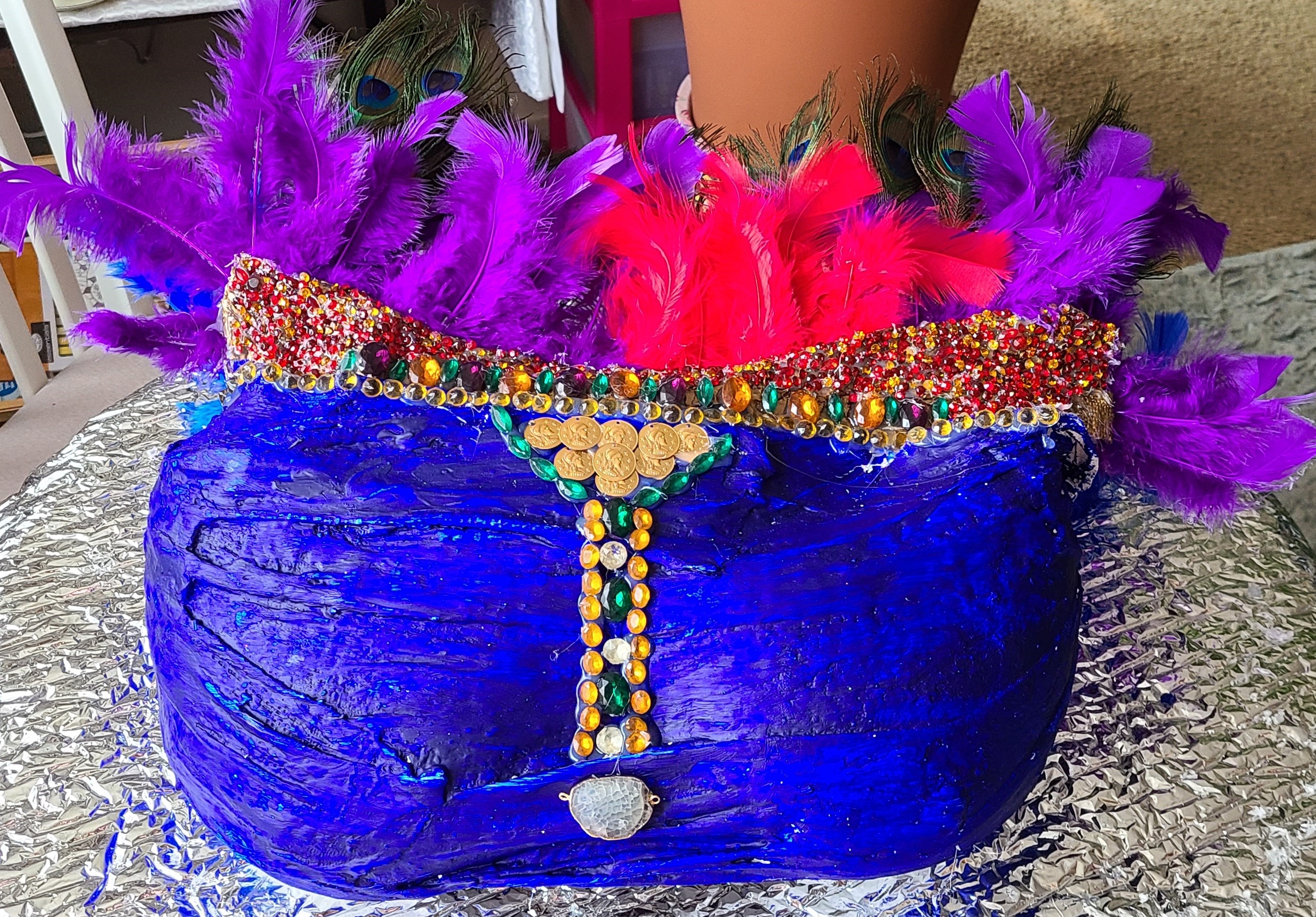
A cast of my birth breasts made before surgery and transformed into new armour.

On September 20, 2021, I received a call from Kaiser stating that a recent breast biopsy confirmed a malignancy in my right breast – invasive lobular carcinoma. The left had an atypical lobular hyperplasia – a form of pre-cancer that also needed to be removed. I was in my new office, having just posted a photo on IG filled with pride that my consulting firm had earned enough over the past year to pay for an office outside of my living room. I was also just beginning to integrate who I was after completing an 8-year journey to finish my PhD this past February. I was shocked, but not surprised.

Today the world ended. Tomorrow it begins again. Each sunrise is a beginning and an end. Today, yesterday, tomorrow. (Mom’s poem – date unknown)

Breast cancer dis-ease has impacted three generations of women from my maternal lineage. My grandmother, uncle, and mother all succumbed to this disease. Another aunt survived, and I am now the third first-cousin to also survive. Was this an inter-generational curse? A recessive gene? A common denial of an aspect of our voice and femininity?

Someday, you’ll know me. Perhaps long after our lives have drifted apart, either because of life or death. Someday, maybe you’ll understand, after satisfying your own search for you. Maybe you’ll find me. Maybe you’ll find love. Maybe you’ll find peace. (Mom’s poem circa 1966).

And if I am honest, since my Mother’s passing in 2002 until the moment of the diagnosis, I had been carrying this fear of breast cancer. It was like the actor of Death in the Brazilian film Black Orpheus – lurking in the shadows of joy, vigilantly preparing for an attack with annual mammograms, ultrasounds, and biopsies. It was as if I were born with this black pearl nestled in my breasts – a ticking timeclock- waiting to erupt.

I love to live; I live to love. I plan to live. I don’t plan to die. Death comes, we don’t have to plan for it to happen. Live goes on. (Mom’s poem – circa 1998)

Having internalized the rawness of this disease after witnessing its attack against my Mom as her primary caretaker, its presence guided most life decisions for the past 20 years. In some cases, it gave me courage – ‘I might as well do it now as I don’t know about the future’ and in other cases it was an inner voice that denied myself certain pleasures – including close, intimate relationships for fear that I may disappoint a beloved through the burden of a cancer care journey. I actually married by late-ex-husband out of a sense that he would be a caretaker in my last days, rather than waiting for someone I truly was attracted to and perhaps would have loved, as well as being there for each other as we aged. I worried about who would hold my hand on this future journey.

I dreamed about you last night. Well, it wasn’t really a dream. I heard you call me like you do when you come to the bedroom door, ‘Mom!’ I woke up and answered “what?” – then I realized I had to have dreamt that you called. (Letter from Mom – NCCJ Camp, June 1986)

So, when the diagnosis came, there was a sense of relief. Early advanced- HERS negative – estrogen and progestogen-positive- breast cancer – a non-aggressive slow-moving cancer (although it had metastasized to my lymph node raising the staging from 1 to stage 2). I finally had a chance to face this fear and pull every internal and community source of strength to transform it into a life-affirming awakening of sorts.

After consulting with a close friend who is one of the top breast cancer specialists in the country, I opted for a double mastectomy as an aggressive treatment for the current cancer.  An exact month from the diagnosis, I had breast removal surgery on October 20th – a full moon and perfect time of release.

I hope that you didn’t think I was taking your stress lightly. I understand how you feel but I probably have more confidence in you than you have in yourself. You have landed on your feet- ready to go into every situation you faced and not only have made the best of it, but rose to the top. God has given you special talents and has us in making the right decisions. (Letter from Mom – Grad School, Circa 1994)

Circles of women – and some men – from various aspects of my life came together in prayer, warm thoughts, meals, social visits, sending flowers, and offering more personal supplies when constipated and could not shower for 3 weeks. I was held in such a gracious way that not only defrosted my fear but shifted the energy of my relationship to cancer. It wasn’t evil, nor a curse, nor something to fight. It was more of an awakening call from my maternal Ancestors asking me how was I integrating the lessons from the first half of life to have the strength, courage, and joy to fully BE as I approached the next and final half?

You won’t realize the significance of the words ‘Happy Birthday’ until you past through a few more years and recognize that the greetings are meant to wish you happiness in accepting each stage of life as it comes and encourage the continued seeking of good things that life brings. This came to me on one of the late thirty-something birthdays when I woke up and realized I was celebrating the last of the ‘young’ and moving toward ‘middle’. . . I realized that I had to make it happen on that day and every day. (Letter from Mom on my 25th birthday – June 15, 1997)

Nearly 2 months to the day of the diagnosis call, another full moon and partial eclipse – I received good news that I would not need chemo, only hormone therapy for the next five years. And, even more good news, based on the oncotype risk analysis, there was only a 13% chance of the cancer returning in the next 10 years. 13 – the number of facing death and rebirthing to spirit, the number of the Divine Feminine, a confirmation that this experience was indeed an initiation of sorts that marked the transition from the stage of Motherhood (although I am not a Mom) to what one of my godmothers calls ‘Baby Eldership’ – an early stage of being a Crone. Ase!

Do you think you are different from who you are? I see a mosaic and as life progresses all the colors and shapes have their place and depending on the focus, certain parts will shine. You have added new dimensions. Later. Love ya, Mom (Email, April 13, 1992)

Awareness, early detection, and advancement in medical technology and understanding of the various forms of breast cancer became tools to survive and cancel cancer as an auto death sentence. For far too many women though – we wait. Putting everyone else’s needs above our own – waiting for disease to advance before screening. For others we put off due to fear. Trust me, there were years in between that I did not want to be bothered – did not want another poke, smush, or scar. And for many of us, when we are diagnosed, we hold the information inside – not wanting to burden family and loved ones with our news. And finally, as professional women, we may not want to appear weak, vulnerable, or unreliable among work colleagues so we try to ‘push-through’ instead of taking the time to heal and nourish not just our bodies but our souls.

Having not had a serious illness, I never knew what an uplifting feeling it is to receive a card in the mail, a phone call or flowers as a reminder that someone is thinking of me. But more than that, your payers made me feel that I was in God’s hands. When I received the diagnosis, I felt that it was not the time for panic or pity, but prayer for the strength to withstand whatever may come. Going into surgery I thought about individuals and church groups that had prayed for me. I relaxed and went to sleep thinking, ‘His Eye is on the Sparrow, I know He watches over me.’ (Holiday Greeting letter from Mom, December 1997)

Working my way to the other side of this disease in a moment of global awakening as we continue to try to advance to a recovery stage from the Coronavirus pandemic, I believe that we must change the narrative guiding our lives.

There will be many more rivers to cross. Let the spirit of those who have made the crossing guide you and give you the courage to keep going. Mom-me (December 1998)

Here are two lessons that I therefore want to share as seeds of hope for anyone facing cancer, supporting someone with cancer, and even grieving the loss of someone close from this disease:

1) Cancer can be a muse – inspiring us to pause our auto-pilot norm; take time to come back to our bodies; re-member the stories stored in the body from when it has kept score of every life-event; decision; and emotion to date, and rewrite our own end of life story; and

2) Don’t go it alone – Most women I know who have been diagnosed with breast cancer are caretakers and in some cases have imprisoned their own femininity and dreams as a sacrifice to support those around them. Changing who we are and how we show up in the world can be difficult, but I am convinced that positive outcomes are possible when we don’t face this disease alone. Tell people. As an Elder told me – let people help. Don’t be ashamed – don’t feel it is a burden. In telling people – the universe will bring forth people to care for you and pour back into you all that you have given to the world – even those small acts of giving that you thought no one saw. God saw and will redress your wounds in golden light brought forth by angels to renourish your soul and motivate you through a vision of your inner-desires as a pathway to healing.

I don’t know what the future holds, and for the first time don’t really care. Right before my last biopsy, I was at a retreat in the mountains and standing with friends, we saw a shooting star. It was so close that I felt as if it shot through me, touching my heart and mind like a tap on the shoulder from the Divine. I remember thinking – it isn’t about ‘what’ I can or need to do in the future, not even about ‘seeing’ a future. It was only about the present. Taking time to see what was right before my eyes and what the collective soul wants me to see.

Happy Valentine’s Day to my Princess who is getting it together so her reign will be peaceful yet forceful. Love you, Mom! (Circa 1992)

Uncategorized

Breastless Womyn

Musing. . .

When a wide-eyed woman cuts off her breasts; discarding the source of nourishment for her womb’s creation as sacrifice for her own libidoty- what does this signal to the world?

Mino, Aje, Amazonia, Califa, Iyaami.

Deep into the dark forest web of interlocking branches erecting on her path, she enters- seeing from the courage of her heart; rememoring and entangleling with the mysteries of her own womanhood; ripping apart the veneer of the Anima painted on by society to liberate her wild-woman soul from the concretized prison of her expected role and  stepping out of tired cloth narratives written by expectations- not her truth.

She thrust herself against the jagged edges of the wandering tree branches, grinding down the calluses of old wounds so new skin can grow.

When the raven harkens she . . . stops . . . still . . .  in . . .  the . . .  silence . . .  of . . .  the  forest.

A humming emerges within and she sees the reflection of the inner glow arising inside of her from the wellspring of her being.

In the darkness, naked, breastless, scrubbed clean, she sees herself as a mature, graying, radiant woman for the first time.

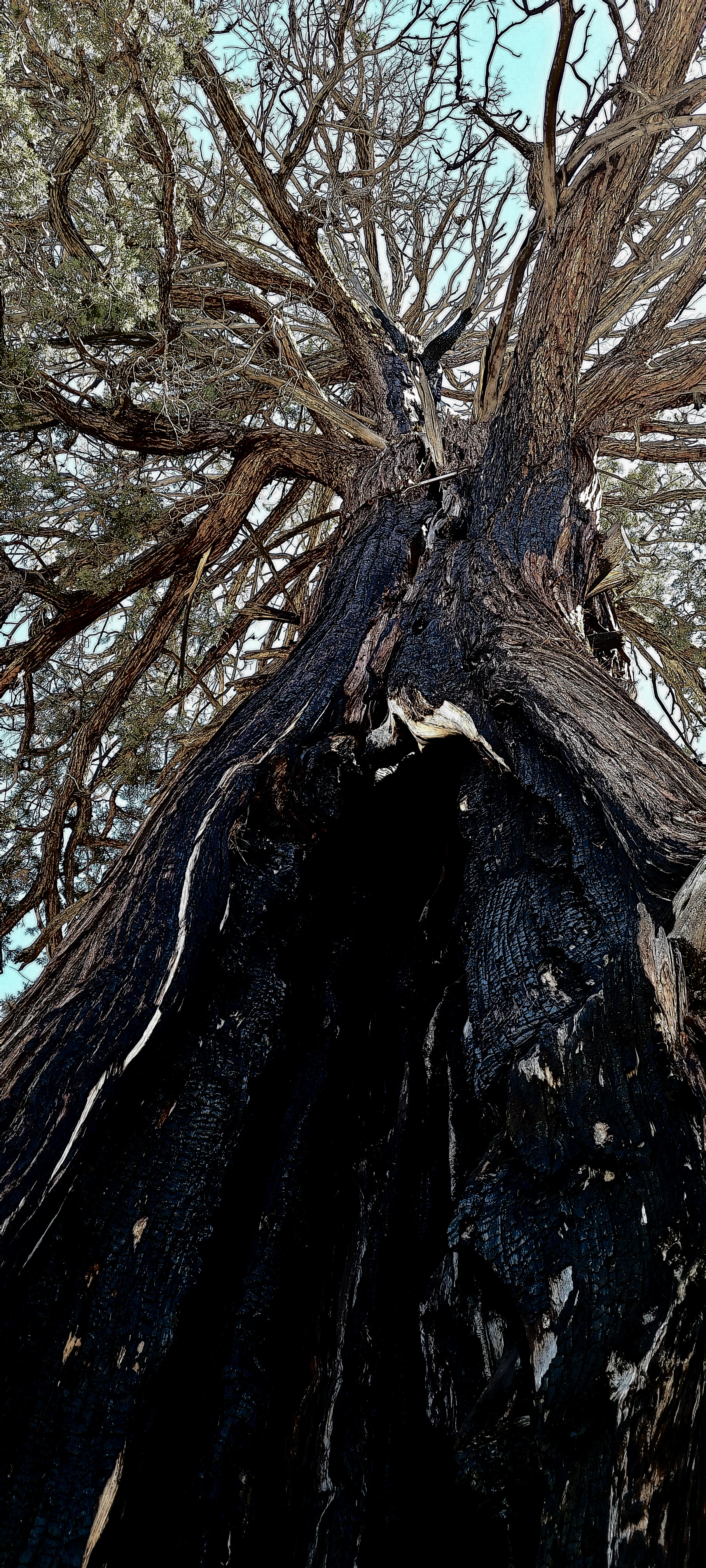
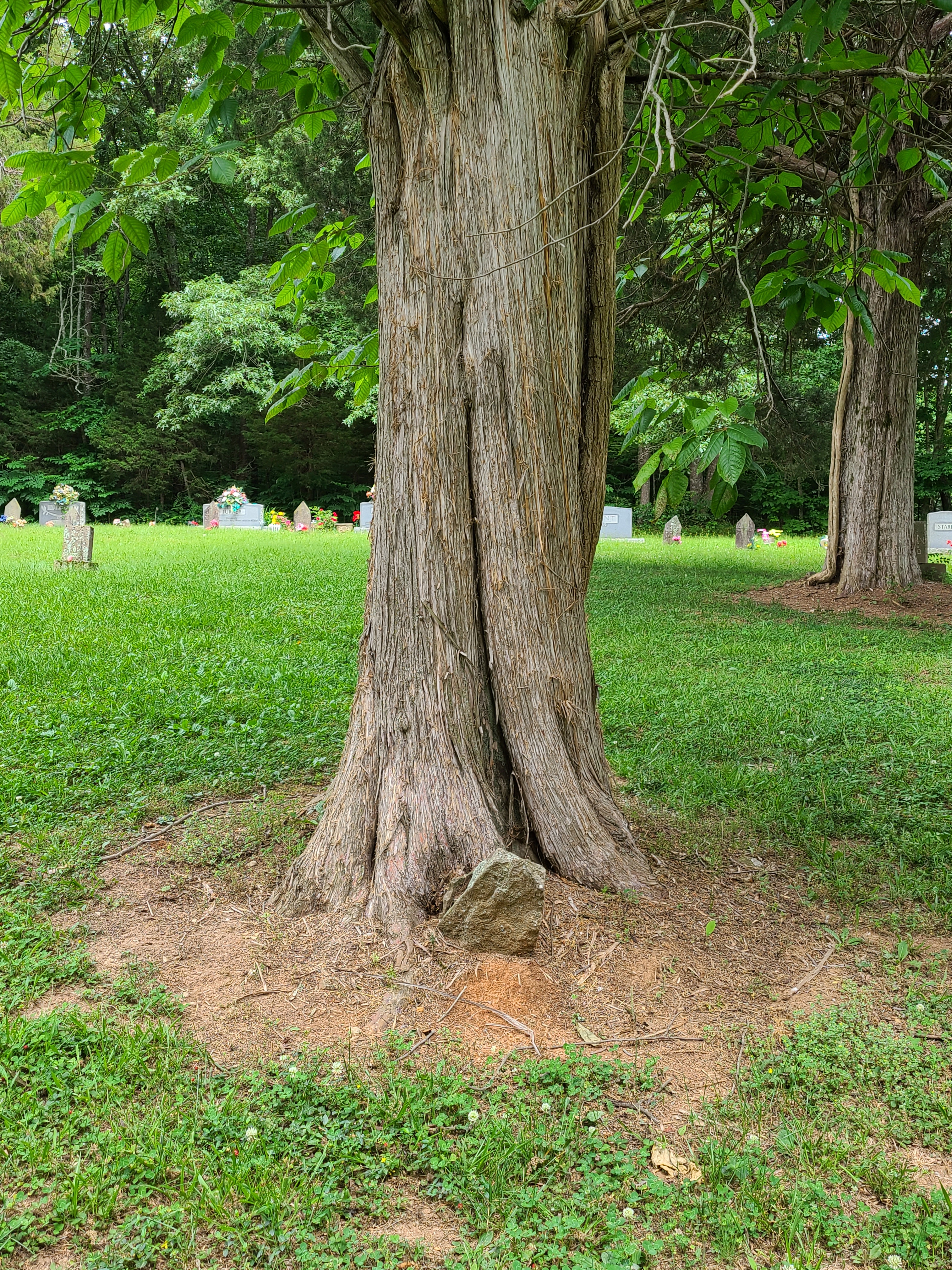
Mother Tree at Big Bear Retreat Center

Uncategorized

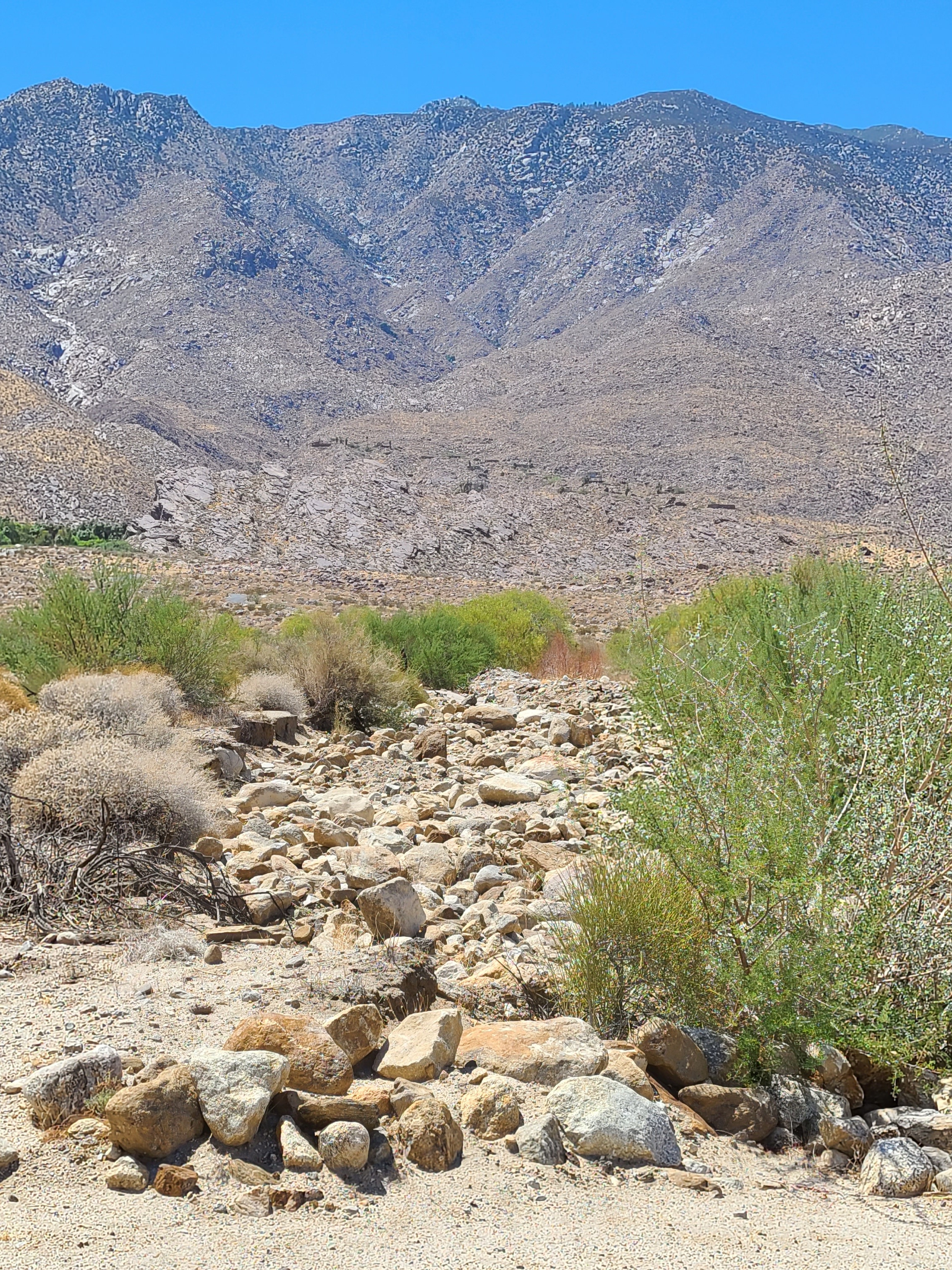
Dry River Beds

Dry river beds are more potent than flowing rivers for one has to pause and notice the flourishing fauna surrounding them to know water loves to hide when unappreciated.

Dry river beds call upon an unimaginable faith to see through the unseen to see the nourishment in the sediment of the river’s floor and power up the imagination to see abundant currents flowing once again.

Dry river beds make you face the possibility of death without life; an Esu juncture of what story will you spin by the sensing you take in.

If I only had 24 hours to live I would stretch those hours into 72 and travel to Morocco to dance to house music in Fez, shop in the Marrakech marketplace, and sleep like a Bedouin on the Sahara floor; I would charter a boat with friends and take sage to the Santa Cruz islands; I would learn to grow the powerful and healing yet finicky lavender plant; I would find my soul mate and do tantric yoga until ecstasy; and then I would take the sweetest hot-honey bath and put on the finest golden threaded gown that stuck to my honey-wet body and lay down on a sunflower bed surrounded by jokes and laughter and cussing by love ones until I fell asleep to rest before coming back again.

See dry river beds that create the circulatory system of California cause all here to dream, to reimagine, to endure the most hostile of climates with the sweetness of the Golden poppy and sting of the honey bee.

Full Moon Musing in Osun’s lap who pets me with unconditional love and hope.

Originally posted on author’s Instagram account on September 20, 2021

Uncategorized

Go into the storm daughter: Grandmothers’ wisdom

Clarksville, Tennessee, the night of a storm

Go into the storm daughter. Go into the winds. Find your safe house – the tower of your dreams, the cabinet filled with your medicine.

Don’t fret the storms daughter. The winds and rains and lightening across the night sky are necessary to keep movement; to stir the stagnate, to toil the earth and pollinate the seeds of life, of future.

Dance into the storms daughter. Feel the roots beneath your feet. Touch the earth skin and move across the spot where the Mothers have outlined your sacred space for you and you alone. Do not be moved. You are protected. Do not be shaken, you are loved. You are anointed with your own unique crown.

Smiths Grove, Kentucky

Embrace the storms daughter. You are not alone. Your Grandmothers are dancing with you throughout the circle of life.

Clarksville, Tennessee, the afternoon after the storm

Forest reverie – June 2, 2021

Uncategorized

I am an Afrompessimist; And southern ramblings on how I came to this assumption.

Finding solace and resonation in the words of Frank Wilderson III’s Afropessimism, I awoke this morning trying to recapture my twilight thoughts on the difference of White Northern (Western, Progressive, Liberal, Radical Leftist, Socialist) and Southern (Moderate, Conservative, AltRight) cultures that I was too tired to write last night as I drifted off to sleep.

I am in Clarksville, Tennessee. A town of goddesses that I met attending an annual Memorial Day Retreat called Sacred Waters. Clarksville is north of where my maternal Tennessee roots are located, but a place where I am seriously thinking of relocating. There is peace, and the NAACP, and a Delta Alumni Chapter. I am at that point in life where I have less years ahead than behind, and as I age I realize the importance of being in close proximity (no more than an hour plane ride) to close friends and extended family.  

I often hide behind my mid-western roots – Omaha/Chicago- the places where my parents were born and spent many of summers growing up. But truth-be told, it is only a rouse, a safe zone, one-degree north or so of the Mason Dixon line and a badge of courage that my family “escaped” the grasp of Dixie Culture that legalized their ‘Being’ as the perpetual property of others for eternity.

Now, I feel the gentle wind of the ancestors calling me back to the land that they poured their prayers into for over 200+ years.

My ancestral roots are planted in tobacco, wheat, corn, and cotton on the plantations of triangle south – Kentucky, Tennessee, and Mississippi. Although most of my ancestral bones have been plowed over in the fields, it is this blood that runs through me. It is even in my inherited freckled, wrinkled, large hands that have toiled the lands I write from, and the DNA memories that generated the backbone of this nation’s agricultural economy positioning its dominance in the world (at least up into the end of the last century).

So here I am. A daughter returned, to seek understanding of the past, heal a broken link, pay the karmic debt so future generations can be spiritually and psychologically free from the race burden. At this crossroads moment, I imagine standing on the Indian mounds seeing in all directions, waiting for the tornado winds of Oya to bring sudden change; creating chaos out of calm, and prepared to see whatever is unearthed that was hidden in the fields in the name of progress. There are missing pieces of my story of being and I am determined to find them, to feel whole.

With feet back on the floor, as I prepared the Keurig (I miss my old skool coffee pot) for my morning cup of coffee I look out the kitchen window of my airBNB and stare through the cracks of light of the white mini-blinds into the rich tapestries of greens composing a small docile forest in the back yard for inspiration.

I am still halfway processing my trip to Kentucky a few days earlier, where I went to witness the community my great, great, great grandmother Mary, my great grandmother Bessie’s Mother, lived enslaved, the land she toiled, the place where she met her husband and had 12 children, and disappointingly searched for the place where she died (could not find her grave). My guide that day was a local, a White historian who knew so much about my family because he understood the culture as his family had owned slaves. It was a day of contradictions – of learning, of disgust, or heartfelt connection to distant relatives whose spirits still walked the land.

In search of her story, I pierced a veil into the greater culture she lived through outside of the safe confines of her home and family. The boards that constructed the framing of Whiteness in the stream of consciousness of the Mid-Southerner’s imagination provided new understanding of the greater shared beliefs of this mytho-narrative that so many call the culture of white supremacy.

First, I heard in the storytelling of family roots, genealogy begins at the moment of contact on this land, a rebirthed of identity and sudden amnesia of any ties to any place other than here.

Next, the pedestal of their ontological narrative base social status and hierarchy based on property ownership (land, animals, slaved –social death non-humans), including only allowing fellow property owners to participate in the rule-making.

Finally, American culture is composed of 1 race – Blackness. Whiteness is universal, divine. Blackness is the mirror that allows Whiteness to exist; the Black flesh the pedestal of which the White micro-world stands.

In the midst of this experience, I formally graduated from Pacifica Graduate Institute with my PhD. Dr. Bayo Akomolafe was our graduation keynote speaker. Dr. Bayo asked, “what does it mean to graduate at the end of the world when what it means to be human is not understood?” He then referenced the book Afropessimism by Wilderson. While killing time before I could check into the AirBnB, I visited a local bookstore where I found Wilderson’s book. For the past two nights, I have not been able to put it down, with his personal narrative style and critical theorist approach appealing to all of my senses.

Wilderson’s work and Bayo’s questions helped frame the emotions I was processing from my visit South way to begin to reconcile them with this deep longing to “return” here to establish a home as a base to live out the second act of life (I will be 50 next year).

So in my own way of processing live events and in integrating the learning from these two scholars, I pondered questions around finding a place for Blackness amidst the conversations of whites as the sudden attention on racial equity and justice seems to be focusing on. Is there such a space? Or are we delaying, diverting, and distracting from the work of forging our own path of liberation by participating in promises of transformative change? Am I too an Afropessimist?

To test it out, I reflected on my experiences of Northern and Southern White cultures. 

In my experience in Northern cities as diverse as Boston, D.C., New York, Los Angeles, Santa Monica, Pasadena . . . liberal white culture is constructed based on an imagined society that performs certain stated values and principals like equity, tolerance, social justice, but is wedded to illuminating them through the colored lens that spotlights them and their good deeds. Many liberal careers (writers, arts, nonprofits, academics) are made off of the suffering and continued subjugation of Black, Indigenous, and People of Color suffering. Exceptional Blacks are allowed to speak-back in structured spaces like a fundraiser dinner or before a policy body in advocacy of legislation that will help or hurt the White middle class.

Like 1950’s tin soldier figurines, the non-White others AND Blacks, are strategically placed like landscape ornaments to appear as if they have achieved utopian success – an imagined micro-world that makes them feel good, righteous, safe, and in control.

Concurrently, I surmise that Southern conservative white culture lives off the harvest planted in the realized dream of the American Revolution, and outlined in the expansive image of Manifest Destiny painted across the Western landscape (that being west of the Appalachian mountain range).

The place of the “Other” is understood in the social hierarchy of their world – “the way things are”-  without any critical moral assessment on if the concept of freedom exists for non-Whites. Instead, the Black others is an eternal servant and mirror to the Southern White of his perceived social position.

The Other Non-Black is a perpetual foreigner amongst the Brotherhood of Whiteness. It doesn’t matter if his lineage in the US is older than the date his place became a state; the intensity of his service to the building of the nation (like mining or placement of railway lines); the amount of blood spilled in honor of American ideas in world wars; nor even if at some point of entry, he was allowed to claim “white” on his port-of-entry documents. He is an unknown in this micro-world and held at the margins with a promise, but always just out-of-reach of full acceptance.  

These rigid social classes are not the White Southerner’s fault. He simply is fulfilling the operational plan of the Constitution that the God-like fathers designed in the founding of this experimental micro-world. As descendants, they simply are valiantly defending the ideas of their ancestor.  

I guess I am an Afropessimist. I have no faith that Black liberation will come out of debates between Northerners and Southerners whose dialogue is rooted in a shared agreement of Whiteness. From those who cashed in memory of European ancestry for perpetual positioning at the top of the American social hierarchy in exchange for a lifetime commitment to the protection of its privileges.

Like a Charley Brown movie, arising out of the speeches for racial justice in capitol chambers everywhere, I hear womp, womp, as cousins code switch words seeking to still answer Jefferson’s question in Notes on the State of Virginia, “what to do with the Negro” especially when they continue to claim a right to be?  

I now can return South, Mid-South, Midwest with clear conscious. I do not need to be burden by the politics of Whites, just understand enough for safety and protection. Just as Whiteness is a construct of a micro-world, with true knowledge of self, ancestral roots, and deep spirituality, I too can construct the world I choose to live in no matter where it is. I can be cautious, but not live in fear. I can know the stories of history and still meet people on their own merit just as I want to be met. I can be, I can be, I can be.

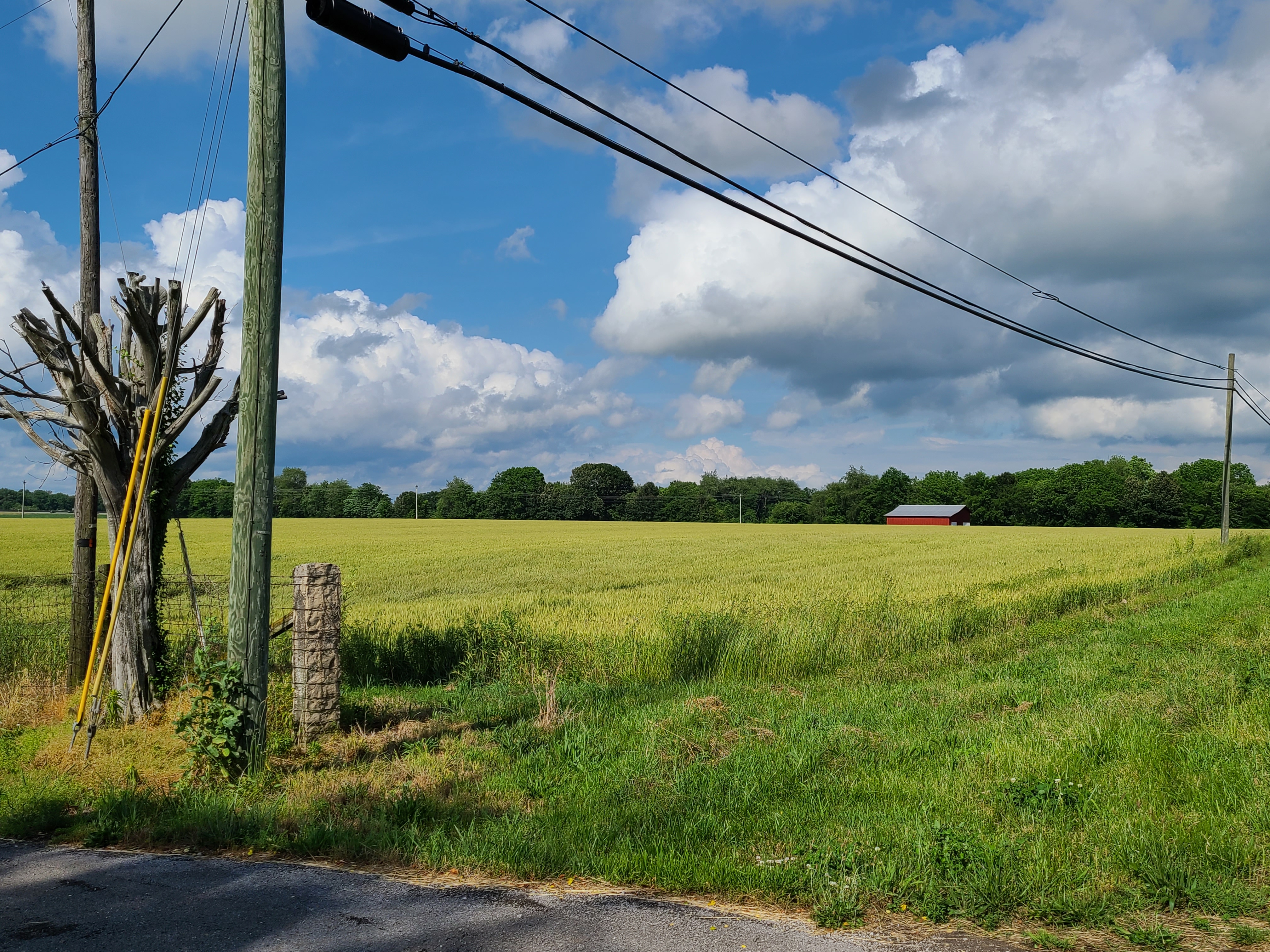
I admit that I am a little anxious about this calling back home after being gone for two generations. But being the woman standing on the open plain – perhaps in a hip-high field of golden wheat – I stand with eyes and heart open – ready to surrender to the rainbow winds of sudden change that the goddess Oya is whispering; I just ask with grace and ease.

My advice to those on their own path of Black liberation: Learn your history from your family; Explore the places where you have roots and listen in to the stories they tell; Discern; Open your heart. Seek your life purpose and resist the comfort in the role others have positioned you in for their self-gain.

Blessings!

Mary’s Land, Smiths Grove Kentucky

Uncategorized

Reflection on purpose in the celebration of Indigenous People’s Day

“If we wish to serve God and love our neighbor well, we must manifest our joy in the service we render to Him and them” St. Katherine Drexel

On Monday, the nation celebrated Indigenous People’s Day to honor the original caretakers of this land, and acknowledge our continued occupancy in their home. This is also a celebratory day as I am reminded that even with all the historical tragedy, many Native American communities are still here, just as I, a descendent of enslaved Americans, am still here and so are you. It is learning from our history of resiliency that we must focus on to guide our pursuit of human liberation.

Since graduating from Xavier in 1994, I have pursued a vocation in the field of homelessness services and policy, rising from frontline staff to senior advisor to elected officials in major cities including Philadelphia, Pennsylvania and Los Angeles, California, my hometown. Through this tenure, I have developed front-hand knowledge of the intersection of homelessness and systemic racism in the creation of the phenomenon of Black and Native American people experiencing homelessness.

Homelessness experienced by Black and Native American people today is a compounded effect of centuries of serial displacement, racial discrimination, and applications of social control including the use of law enforcement and criminalization of Blackness. Today in Los Angeles, for instance, 34% of the nearly 70,000 people experiencing homelessness are African American, yet Black people only make up 8% of our region’s total population. While American Indians represent only 1% of Los Angeles’ total homeless population, 91% experience homelessness unsheltered, living on the streets and in other places not meant for human habitation.

Yet, despite these grime statistics, I maintain hope. For one, we are finally talking about racism as a contributing factor of homelessness instead of just blaming individuals and judging personal choices.

Second, my experience at Xavier taught me that you never give up. You always strive for excellence in whatever you do. Our Founder, Saint Katherine Drexel is a great example. In her founding of the Sisters of the Blessed Sacrament, Mother Drexel embodied an unapologetic commitment to the upliftment and liberation of Black and Native American people. Perhaps it was a call by God who one night whispered this mission into her ear, for she stubbornly developed the conviction to illuminate her own path through the dark violence of Jim Crow in pursuit of justice. She used her racial privilege and platform to mitigate racial harm through the provision of safe spaces where Black and Native American children could not only learn and thrive, but where they had a place to belong, and where their lives mattered. Her efforts created opportunity for each of us, generations later.

The disruption of the global Coronavirus pandemic has brought our nation to the cusp of significant, transformational change. COVID-19 has not only surfaced systemic causes of underlying health conditions – including homelessness – that continue to place Black, Indigenous, and People of Color communities at risk of severe infection and death, it has also unearthed deep racial divides that had been glossed over in the safeguard of a post-racial, colorblind nation. No more. The awakening of our racial consciousness has created an opportunity for social change and healing justice. It has created an opportunity to leave a legacy behind. Are we ready to take the baton of our ancestors and lead forward?

So Xavierites, why were you born when you were to be here now, as a witness to this moment? What purpose has God whispered into your ear, and are you pursuing it with the unwavering conviction of Mother Drexel? How will you apply your skills, gifts, and talents in crafting the rebirth of our nation to create a fairer, just, and sustainable world as our legacy for the generations to come?

Repost from “On the Human Spirit” – a newsletter of The Center for Equity, Justice & the Human Spirit at Xavier University of Louisiana – https://mailchi.mp/8150ea10d7b4/welcome-to-on-the-human-spirit-5849545?fbclid=IwAR2UfJNJuqGw46p8uhj2DXhS2lWV2wEvI4EFJoecLlHG7Ykeu0jq4l5Cj-M

Uncategorized

Somos Cubanos: Afro-Cuban Resistance and Adaptation, 1902-2002 (abbreviated)

The following is a copy of the ‘Introduction’ to a Master’s thesis (a program in Bilingual/Bicultural studies that I actually never completed) written in 2011 seeking understanding of anti-Black racism in Cuba society. This was written before I had the opportunity to travel to Cuba as part of a dance program to understand how Afro-Cuban culture was embodied in dance and other Afro-Cuban Folkloric cultures, so some ideas have since evolved. However, Trump support out of Florida in the recent election made me reflect on this study and wanted to offer it to others seeking understanding, particularly when African Americans and Latinx often talk about building cross-cultural political alliances.

“In the nation beloved by me I would like to see born the nation that can be without hate, and without color. In the generous game of limitless thought, I would like to see building the house, rich and poor, black and white” (qtd.in Kirk 130). In October 1889, José Martí, a leader of Cuba Libre, the insurgent movement to fight for independence from Spain, spoke these words to express a vision of a new patria built on equality where citizens would not be identified by race, heritage, class or religion, but by a common Cuban national identity. Motivated by his words and a promise of emancipation from slavery, thousands of Afro-Cubans took up arms in support of the Cuba Libre movement.

During this time black men such as Antonio Maceo, “the Bronze Titan,” were able to rise through the ranks of the military based on their skill and achievement and were not excluded based on the color of their skin. In this post-Haitian revolution era, European colonists were fearful of additional slave revolts and would not arm blacks under any circumstance; Cuba was a rare exception (Helg 4). Afro-Cubans participating in the liberation movement understood the significance of fighting alongside white mambises and began to believe that a free Cuba could meet Martí’s social promise of a new racially united nation (Helg 119). In the article “ ‘Race and the Cuban Revolution’ Review of Castro, the Blacks and Africa by Carlos Moore,” Lisa Brock and Otis Cunningham explain that “because the Cuban fight for independence and abolition from slavery shared the same historical stage, there developed an ideological congruity between the fighting for equality for blacks and against colonialism” (n.pag.).  Sadly, Martí was killed on the battlefield in 1895. However the war with Spain continued under the passionate leadership of the Cuba Libre revolutionaries to create a Cuban society under a new social paradigm in alignment with his ideal nation. 

After many years of fighting, United States intervention brought an end to the war and ushered in the political transition of Cuba as a new nation-state. Cautiously optimistic of the U.S. post-war on-the-ground presence, many Afro-Cubans still believed that their sacrifice and efforts in the fight for independence would be recognized and honored through executing the promise of Martí’s ideal nation (Peréz 160).  In addition to their military sacrifice during the wars of independence, slavery had been abolished and blacks had begun a process of emancipation.

Metaphorically, the Cuban national narrative embraced an image that the new nation would be racially democratic and built on the principles of Martí’s vision of a “race-less nationality” (Ayorinde 33).  In reality, during the first quarter of the 20th Century a social hierarchy based on preferences of ancestry, class, and race that mirrored colonial society was instituted.

Having undergone three significant national transitions during the first hundred years of nationhood; Independence, the 1959 Revolution, and the Special Period, and facing a fourth in the millennium with the transfer of power from Fidel to Raul Castro, there is a growing sense that the aforementioned social hierarchies will no longer be accepted. In his article “Recreating Racism: Race and Discrimination in Cuba’s ‘Special Period’ ” Alejandro de la Fuente states, “as in previous transitions, blacks will not quietly acquiesce to displacement or exclusion from a nation they helped create” (n.pag.).

Frustrated by the continued exclusion from the nation building process, blacks in Cuba have sought various strategies of resistance and adaptation to hold the republic accountable to promises made during the time leading up to its founding (Planas 89).  In this thesis, I will examine strategies applied by Afro-Cubans in response to national leaders who during periods of political transitions, failed to deliver on the colonial promise of “one” nation; raceless and non- discriminatory. 

Chapter one entitled “Cuba Libre,” will examine the construction of the conditional promise of freedom in exchange for Afro-Cuban participation in the Wars of Independence. Cuba had been fighting for independence from Spain since the 1830’s.  In 1868, Manuel Céspedes, a wealthy Creole sugar mill owner, organized a massive rebel movement that included his slaves who he freed to help with the insurrection. This led to the Ten Years War. The rebels were defeated, however, the spirit of independence continued along with growing international pressure to end the slave trade in Cuba and to emancipate all slaves. Approximately 500,000 slaves were imported to Cuba between 1812 and 1865.  In the 1850’s, the combination of Afro- Cuban freemen and slaves made the black population over fifty-six percent (Benson 26-27). Due to Haiti’s recent independence caused by a slave rebellion, many plantation owners were fearful of slaves overtaking the island if freed and therefore; were reluctant to emancipate their slaves (Jiménez 37-38). Through an agreement with the British, Spain abolished slavery in 1886, at a time when sugar profits had begun to decline and the nation was experiencing an economic depression.

During the time period of 1878 to1895, José Martí, a young writer, journalist and activist travelled to the United States to leverage support for the independence movement within the Cuban exile community (Kirk 48-49). While traveling around the United States, disgusted by the discriminatory treatment of blacks, Native Americans and Chinese, Martí was inspired to design a new social paradigm in his patria that would support social equality without regard to skin color or national heritage (107).  Upon his return to Cuba, Martí gained support for his vision of a free, united Cuba and was elected party leader of El Partido Revolucionario Cubano (the Cuban Revolutionary Party). Martí was killed in 1895 before his vision was realized. In 1898, the United States joined in the Cuban Independence War after it was believed that one of its naval ships, the USS Maine, was attacked by the Spanish, although later it was discovered that a boiler on the ship had exploded. In three months, the eager, young, U.S. navy had defeated the Spanish and gained ownership of Cuba, as well as Puerto Rico and the Philippines (Thomas 369). Cuba had traded one colonial master for another, as the U.S. did not formally grant sovereignty to Cuba until 1902 after integrating the Platt Agreement into the new nation’s constitution. This act allowed the U.S. military to occupy the island according to certain terms and conditions, one of which was the exclusion of Afro-Cubans in decision making capacities.

In response to their exclusion from the nation-building process by the new Cuban government, Afro-Cubans, especially veteran leaders from the independence wars, formed their own political party, the Partido Independiente de Color (PIC), in 1908 (Andrews 129). In 1910, Senator Martin Morúa Delgado, a mulatto, sponsored an amendment in the Cuban Congress to outlaw political parties composed of a single race. The general consensus in the literature regarding Morúa Delgado’s motivation is that he believed racial distinction in the new nation-state would only continue to fragment the social structure and impede “up-ward mobility” among Afro-Cubans (Helg 122). Others in the government simply viewed the organizing of a black political party as a potential threat to national security (Thomas 227). Consequently, over two hundred PIC party members were arrested and imprisoned (Andrews 129). In protest, remaining members of the PIC party planned an armed demonstration in Oriente Province in 1912 to overturn the Morúa Amendment. Militia of the Cuban government met them with a “campaign of extermination” and several thousand Afro-Cubans were killed, including most of the PIC leadership and rank and file, as well as bystanders, around 3,000 in total (Andrews 130). This event influenced social integration strategies later pursued by Afro-Cubans that ranged from public school integration campaigns to subversive expressions of African heritage through religion, dance, and music. 

            Chapter two, “Race and Revolution,” will focus on Fidel Castro’s rise to power on a wave of anti-Batista sentiment and his leveraging of Afro-Cuban loyalty in support of his “new society” (Strug 14). Ruben Fulgencio Batista Zaldívar seized military power of the Cuban nation on September 4, 1933 through the Revolt of Sergeants where he overthrew the government of Gerardo Machado (Sierra, “Batista” n.pag.). A mulatto from Oriente province, Batista offered an initial glimmer of hope for Afro-Cubans. However, even as President he faced racial discrimination, as he was not allowed to enter certain public and private facilities. The fact that even the President of Cuba encountered racial discrimination dampened the hopes for the realization of Martí’s dream of a Cuba based on the equality of all it’s citizens.

During his presidency, Batista was known for using brutal force against his opponents. In David Strug’s article, “Why Older Cubans Continue to Identify with the Ideals of the Revolution”, Alicia, a seventy-eight year old Afro-Cuban who participated in his interview, lived near a police station during the Batista era and recalls the “cries of jailed political prisoners”(n.pag.). She stated that “one felt the pain of these people being tortured. It was horrible”(n.pag.).  It is no surprise then that she and her neighbors were fearful of going out at night, especially if Batista was traveling through, “If you were caught on the block, they [the police] would round you up” (n.pag.). Living conditions among Afro-Cubans and others were also poor prior to the 1959 revolution. “Forty-five percent of Cubans had never been to school and half of them were malnourished to some degree. Most dwellings lacked running water, and most homes had dirt floors” (Strug n.pag.). The island’s elite were also frustrated with Batista for his on-going governmental control, brutal force against anyone who spoke out against him, the shutting down of the University of Havana after many student protests, and his preference for U.S. investors and members of the U.S. mob in opening large-scale gambling enterprises. Instead of re-investing revenue back into the economy and the nation’s general fund, Batista pocketed many corporate kick-backs for himself and members of his inner circle, enriching the quality of life for very few Cubans (Sierra, “Batista” n.pag.).

            Fidel, the son of a wealthy Spanish sugar planter and the former maid of his father’s first wife, became interested in social justice issues while pursuing a law degree at the University of Havana (A&E T.V. Network 1). Later a follower of former senator Eduardo Chibás who fought against government corruption within the Cuban political system, Castro began to shape his ideas about Cuban nationalism, anti-imperialism, and socialism (1-2).  In 1953, Castro “attacked the Moncada Army Barracks in Santiago on July 26” in his first attempt to overthrow Batista (Sierra, “Batista” n.pag.). Having failed, Fidel and several of his accomplishes were sent to prison while others were killed. Freed in 1955, Fidel and his brother Raúl went into exile in Mexico where he met Che Guevara and organized an insurgent plan. After a second failed attempt in 1956, Fidel and Che escaped to the Sierra Maestra Mountains to further organize. Finally on January 1, 1959, they triumphantly entered the streets of Havana. With some skepticism, most Cuban people were ecstatic that Batista was no longer in power.

Within his first hundred days of office, Fidel immediately implemented a Proclamation Against Racism and amended the laws to abolish racism, specifically outlawing racial discrimination and segregation. According to Sara Lobman’s article, “How Revolutionary Gov’t Outlawed Racist Discrimination,” blacks were now allowed to go into public spaces such as beaches, parks, pool clubs, schools, and hotels alongside of whites (n.pag). In a speech delivered on March 22 1959, Castro addressed the nation:

…are we a small people who need each other, need the effort of all, and are now to be divided into white and black?… Are we to be weak and also divided by color?…We have to uproot the last colonial vestiges, conscious of making that phrase of Marti a reality: he said it before, we have to repeat it now, that a Cuban is more than white, more than black, and we are Cuban. (Robaina, “20th Century”102-103)

Clarence Luanes observes that the new law also minimized racial distinction by blacks, “any effort at expressed racial group consciousness for blacks as well as white Cubans, could and would be determined to be racist”(76).  Fred Quintano states, “… for Cuban blacks, with their grievances declared addressed by Fidel Castro, this meant that their claims for distinction was a threat to the regime and repressed” (11). The consequences of the suppression of grievances expressed by Afro-Cubans would become evident throughout Castro’s reign, particularly through economic disparities. However, immediately following the revolution, many Afro-Cubans interpreted Castro’s new order as an opportunity for them to achieve the social mobility they had been denied historically. For example, Carlos Eire’s shares an exchange with his Afro-Cuban housekeeper a few days after Fidel came to power when she says to him, “pretty soon you’re going to lose all this. Pretty soon you’ll be sweeping my floor. Pretty soon I’ll be seeing you at your fancy beach club, and you’ll be cleaning out the trash cans while I swim” (4).

Fidel launched an island-wide social campaign funded by the government that included compulsory education, healthcare, food and nutrition, public housing, and full employment. In education alone, “black educational advancement was most impressive … Afro-Cubans capitalized on the opportunities created by the post-1959 revolutionary government to such a degree that racial disparity in education almost disappeared” (Andrews 163).

Castro’s swift actions to modify the law to reflect his vision of Cuba proved that he had the power and the commitment to fulfill his promises for creating a new nation built on the principles of José Martí. In response, the Afro-Cuban community joined the revolutionary movement taking full advantage of Fidel’s social programs, active engagement in military affairs, and participation in the various unions of the Confederation of Cuban Workers. Gonzalez and McCarthy frame this exchange as a “social compact” that “the state promised to deliver a better life to its citizens in return for their support and devotion to the Revolution” (7).

Chapter 3, the “Soviet Withdrawal and its Impact on Race Relations” will analyze the negative impact of the sudden withdrawal of Soviet financial resources on racial equality within the nation and the rising voice of dissatisfied Afro-Cuban youth. Castro’s infusion of state funds to subsidize critical social programs supported his elimination of discriminatory practices and helped to reduce social hierarchies. According to Dr. Johnetta B. Cole:

…the primary cause of the oppression of black people in Cuba was an inegalitarian economic system …socialism struck at the heart of that cause. When unemployment was totally eliminated, it was the single most important blow against racism as it eliminated competition between workers for what had been a limited number of jobs. (9)

Thirty years after the revolution the quality of life of Afro-Cubans had improved significantly. According to Alejandro de la Fuente in “Recreating Racism: Race and Discrimination in Cuba’s ‘Special Period;’” life expectancy among Cubans of all races (i.e. black, mulatto and white) was close to that of developed countries, illiteracy was eliminated, the proportion of blacks and mulattos who had graduated from high school was higher than whites, and blacks and mulattos were well represented in the professional labor force, including composing 31% of workers employed in the Cuban medical field (n.pag).

            Social advancement for Afro-Cubans ended when the Soviet Union withdrew financial support to Cuba in 1987 and subsequently collapsed in 1991. These events led to great economic instability in Cuba, which in turn resulted in the return of racial hierarchies. Oil, consumer goods, agricultural products and other essentials needed for daily life and production disappeared almost overnight with very few available alternative suppliers (Pérez, “Cuba’s Special Period” n.pag.). Washington Post journalist Eugene Robinson states, “the whole country, used to middle class living standards, suddenly had had to endure an awful poverty. There was no gasoline to fuel the trucks that brought food from the countryside to the cities, so people were hungry for the first time since the Revolution” (154).

To manage the nation’s rapid downward spiral, Fidel instituted an austerity program that limited the allocation of goods (Pérez, “Cuba’s Special Period” n.pag.). He also allowed the in-flow of U.S. dollars to help boost the economy through remittances and private joint-ventures between the state and non-U.S. nationals (Fuente, “Recreating Racism” n.pag.). This process created a severe class distinction as whites, with greater ties in the Cuban Diaspora in Miami and others cities, tended to be the recipients of remittances (E. Robinson 35).  Fuente states that Afro-Cubans could not even benefit from paladares, restaurants inside of private homes, because many of them lived outside of the tourist routes in predominantly non-white housing projects that were deteriorating and had higher crime rates (“Recreating Racism”n.pag).  Quintano concludes, “the bifurcation of the Cuban economy in the early 1990’s into dollar and peso currencies and the increasing supremacy of the dollar in the Cuban economy has effectively created the conditions for the marginalization of black Cubans” (15).

In addition to the a new system to create private wealth, the government also faced no choice but to defund many of the social programs that had given Afro-Cubans a fair opportunity to advance such as adequate healthcare, education, housing, and guaranteed employment. Fuente notes that the commitment to racial discrimination also ended in the workplace as in the fury to attract foreign investments, particularly in the tourism industry, the Cuban government turned a blind eye as foreign firms only hired whites and very fair skinned mulattoes in hotels and casinos (A Nation, 321). A 2002 study by Cuba’s Center for Anthropology states that “whites accounted for 80 percent of the personnel in the tourist industry, compared with 5 percent for blacks” (Gonzales and McCarthy 58). 

With limited access to dollars to purchase basic goods such as fresh fruit, toilet paper, and appliances, Fuente states that Afro-Cubans fought the growing economic disparity through active participation in the emerging black market (A Nation, 326). Older Afro-Cubans like Alicia, “believe it is important for parents to teach their children about the energy and sacrifice on the part of her generation that went into building the revolution and sustaining it through difficult times, including the special period” (Strug n.pag.). However younger Afro-Cubans who were born after the revolution are waning in patience with the revolution’s motto of self-sacrifice while it ignores inequities. Eugene Robinson states:

Like it or not, the Cuban Revolution had produced, and now would have to deal with, a hip-hop generation- a cohort of young people who had no memory of life before the Special Period, who know all about the promises the Cuban Revolution had broken, and very little about the promises it had kept. (255)

Using the same social channels as the black market, Afro-Cuban youth in Alamar, one of the largest housing developments outside of Havana, began writing, performing, and recording hip-hop (E. Robinson106-107). Influenced by the African American sound that they heard over the airwaves from Miami, Afro-Cuban youth found a vehicle to express their frustration with failed government promises (E. Robinson 107). Raps like “¿Quién Tiró la Tiza?,” “Who threw the chalk,” by Clan 537 opened public dialogue about growing racial disparities as it asked the audience who would the teacher blame for throwing the chalk, the white son of a prominent doctor or the unknown black son of a sugar cane laborer (E. Robinson 205). Eugene Robinson further notes that, “Cuban hip-hop sounds as if it isn’t really about the music at all, but about the screwed-up present and the uncertain future of the nation” (107).  The government eventually tried to control the hip-hop movement after an incident at the Eighth Annual Alamar Rap Festival through the Cuban Rap Agency, however according to an interview with Papa Humbertico in “Havana Times,” journalist Yusimi Rodriguez learns that a strong underground movement still exists through social media (i.e. You Tube, Facebook, blogs) and black market export channels (n.pag). The Hip-Hop movement is even recognized in the mainstream as during the 15th Annual Arturo Schomburg Symposium, Tomás Fernández Robaina, a researcher and professor in the National Library of Cuba credited the youth hip-hop movement with opening up new space for dialogue about race in Cuba (“The African”). 

 The transfer of power from Fidel to brother Raúl in 2008 symbolized yet another major transition in the continual development of the Cuban nation. More opened to private enterprise to stabilize the national economy, the government will be promoting self-employment or cuentapropistas to help keep people employed. However, without access to U.S. dollars to purchase supplies and secure necessary permits, Afro-Cubans will continue to be disadvantaged.

As one of the few remaining socialist countries in the world, Cuba is at a critical juncture as it strives to define how it will manage the transition from its “redistribution revolution that benefitted the lot of the Cuban people” and its archaic “powerful state apparatus” into a free enterprise system to sustain its economy (Gonzalez and McCarthy 5). Assumed to be complete loyalists to the revolution’s government for all of its advances, Afro-Cubans are a great topic of discussion among international diplomats and political scientists interested in the future of Cuba. According to the official Cuban 2002 census, 34.9 percent of the11.2 million population is black and of mixed race ancestry. Most Cuban academics however increase the estimation to between 60 and 70 percent black or mulatto (Grogg, Racism n.pag.). Gonzales and McCarthy state “that Afro-Cubans taken together make up close to half the island’s population should give black and mulatto representatives political clout with which to press for greater racial equality in business and government” (65). Currently however, “Afro-Cubans occupy 33 percent of the seats in the National Assembly of People’s Power, and nine of the 31 members of the Council of State” the most powerful political body (Gonzales and McCarthy 60). Furthermore, Afro-Cubans only make up two Ministers of the 40-memnber Council of Ministers, 2 out of 15 provincial First Secretaries of the Communist Party of Cuba, 0 of the 15 Presidents of the Provincial Assemblies of People’s Power, 0 of the 10 top generals or senior posts in the Revolutionary Armed Forces, and 5 of the 24- member Political Bureau of the Communist Party of Cuba (61).  What will be the place of Afro-Cubans in a new future state?