“If we wish to serve God and love our neighbor well, we must manifest our joy in the service we render to Him and them” St. Katherine Drexel
On Monday, the nation celebrated Indigenous People’s Day to honor the original caretakers of this land, and acknowledge our continued occupancy in their home. This is also a celebratory day as I am reminded that even with all the historical tragedy, many Native American communities are still here, just as I, a descendent of enslaved Americans, am still here and so are you. It is learning from our history of resiliency that we must focus on to guide our pursuit of human liberation.
Since graduating from Xavier in 1994, I have pursued a vocation in the field of homelessness services and policy, rising from frontline staff to senior advisor to elected officials in major cities including Philadelphia, Pennsylvania and Los Angeles, California, my hometown. Through this tenure, I have developed front-hand knowledge of the intersection of homelessness and systemic racism in the creation of the phenomenon of Black and Native American people experiencing homelessness.
Homelessness experienced by Black and Native American people today is a compounded effect of centuries of serial displacement, racial discrimination, and applications of social control including the use of law enforcement and criminalization of Blackness. Today in Los Angeles, for instance, 34% of the nearly 70,000 people experiencing homelessness are African American, yet Black people only make up 8% of our region’s total population. While American Indians represent only 1% of Los Angeles’ total homeless population, 91% experience homelessness unsheltered, living on the streets and in other places not meant for human habitation.
Yet, despite these grime statistics, I maintain hope. For one, we are finally talking about racism as a contributing factor of homelessness instead of just blaming individuals and judging personal choices.
Second, my experience at Xavier taught me that you never give up. You always strive for excellence in whatever you do. Our Founder, Saint Katherine Drexel is a great example. In her founding of the Sisters of the Blessed Sacrament, Mother Drexel embodied an unapologetic commitment to the upliftment and liberation of Black and Native American people. Perhaps it was a call by God who one night whispered this mission into her ear, for she stubbornly developed the conviction to illuminate her own path through the dark violence of Jim Crow in pursuit of justice. She used her racial privilege and platform to mitigate racial harm through the provision of safe spaces where Black and Native American children could not only learn and thrive, but where they had a place to belong, and where their lives mattered. Her efforts created opportunity for each of us, generations later.
The disruption of the global Coronavirus pandemic has brought our nation to the cusp of significant, transformational change. COVID-19 has not only surfaced systemic causes of underlying health conditions – including homelessness – that continue to place Black, Indigenous, and People of Color communities at risk of severe infection and death, it has also unearthed deep racial divides that had been glossed over in the safeguard of a post-racial, colorblind nation. No more. The awakening of our racial consciousness has created an opportunity for social change and healing justice. It has created an opportunity to leave a legacy behind. Are we ready to take the baton of our ancestors and lead forward?
So Xavierites, why were you born when you were to be here now, as a witness to this moment? What purpose has God whispered into your ear, and are you pursuing it with the unwavering conviction of Mother Drexel? How will you apply your skills, gifts, and talents in crafting the rebirth of our nation to create a fairer, just, and sustainable world as our legacy for the generations to come?
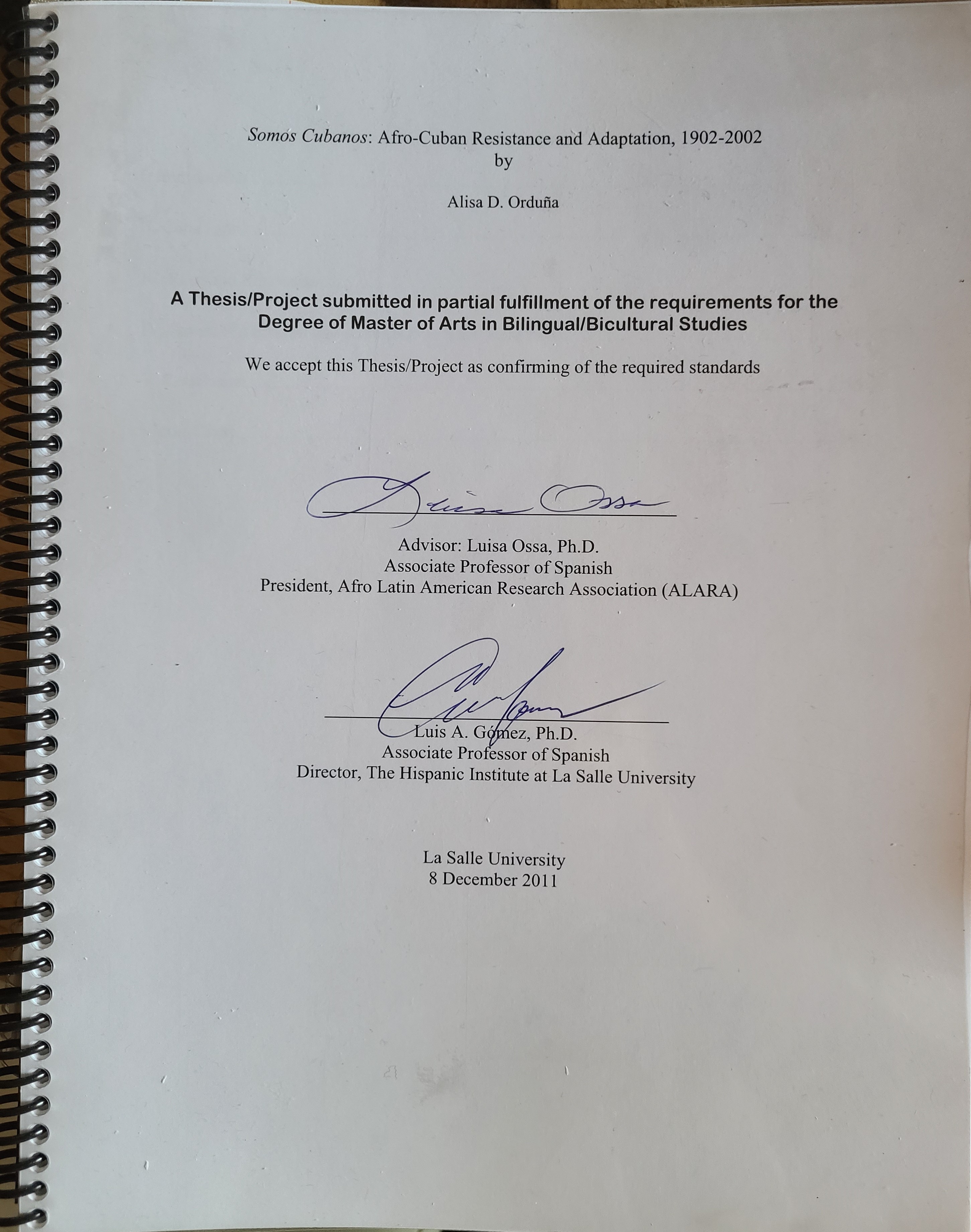
The following is a copy of the ‘Introduction’ to a Master’s thesis (a program in Bilingual/Bicultural studies that I actually never completed) written in 2011 seeking understanding of anti-Black racism in Cuba society. This was written before I had the opportunity to travel to Cuba as part of a dance program to understand how Afro-Cuban culture was embodied in dance and other Afro-Cuban Folkloric cultures, so some ideas have since evolved. However, Trump support out of Florida in the recent election made me reflect on this study and wanted to offer it to others seeking understanding, particularly when African Americans and Latinx often talk about building cross-cultural political alliances.
“In the nation beloved by me I would like to see born the nation that can be without hate, and without color. In the generous game of limitless thought, I would like to see building the house, rich and poor, black and white” (qtd.in Kirk 130). In October 1889, José Martí, a leader of Cuba Libre, the insurgent movement to fight for independence from Spain, spoke these words to express a vision of a new patria built on equality where citizens would not be identified by race, heritage, class or religion, but by a common Cuban national identity. Motivated by his words and a promise of emancipation from slavery, thousands of Afro-Cubans took up arms in support of the Cuba Libre movement.
During this time black men such as Antonio Maceo, “the Bronze Titan,” were able to rise through the ranks of the military based on their skill and achievement and were not excluded based on the color of their skin. In this post-Haitian revolution era, European colonists were fearful of additional slave revolts and would not arm blacks under any circumstance; Cuba was a rare exception (Helg 4). Afro-Cubans participating in the liberation movement understood the significance of fighting alongside white mambises and began to believe that a free Cuba could meet Martí’s social promise of a new racially united nation (Helg 119). In the article “ ‘Race and the Cuban Revolution’ Review of Castro, the Blacks and Africa by Carlos Moore,” Lisa Brock and Otis Cunningham explain that “because the Cuban fight for independence and abolition from slavery shared the same historical stage, there developed an ideological congruity between the fighting for equality for blacks and against colonialism” (n.pag.). Sadly, Martí was killed on the battlefield in 1895. However the war with Spain continued under the passionate leadership of the Cuba Libre revolutionaries to create a Cuban society under a new social paradigm in alignment with his ideal nation.
After many years of fighting, United States intervention brought an end to the war and ushered in the political transition of Cuba as a new nation-state. Cautiously optimistic of the U.S. post-war on-the-ground presence, many Afro-Cubans still believed that their sacrifice and efforts in the fight for independence would be recognized and honored through executing the promise of Martí’s ideal nation (Peréz 160). In addition to their military sacrifice during the wars of independence, slavery had been abolished and blacks had begun a process of emancipation.
Metaphorically, the Cuban national narrative embraced an image that the new nation would be racially democratic and built on the principles of Martí’s vision of a “race-less nationality” (Ayorinde 33). In reality, during the first quarter of the 20th Century a social hierarchy based on preferences of ancestry, class, and race that mirrored colonial society was instituted.
Having undergone three significant national transitions during the first hundred years of nationhood; Independence, the 1959 Revolution, and the Special Period, and facing a fourth in the millennium with the transfer of power from Fidel to Raul Castro, there is a growing sense that the aforementioned social hierarchies will no longer be accepted. In his article “Recreating Racism: Race and Discrimination in Cuba’s ‘Special Period’ ” Alejandro de la Fuente states, “as in previous transitions, blacks will not quietly acquiesce to displacement or exclusion from a nation they helped create” (n.pag.).
Frustrated by the continued exclusion from the nation building process, blacks in Cuba have sought various strategies of resistance and adaptation to hold the republic accountable to promises made during the time leading up to its founding (Planas 89). In this thesis, I will examine strategies applied by Afro-Cubans in response to national leaders who during periods of political transitions, failed to deliver on the colonial promise of “one” nation; raceless and non- discriminatory.
Chapter one entitled “Cuba Libre,” will examine the construction of the conditional promise of freedom in exchange for Afro-Cuban participation in the Wars of Independence. Cuba had been fighting for independence from Spain since the 1830’s. In 1868, Manuel Céspedes, a wealthy Creole sugar mill owner, organized a massive rebel movement that included his slaves who he freed to help with the insurrection. This led to the Ten Years War. The rebels were defeated, however, the spirit of independence continued along with growing international pressure to end the slave trade in Cuba and to emancipate all slaves. Approximately 500,000 slaves were imported to Cuba between 1812 and 1865. In the 1850’s, the combination of Afro- Cuban freemen and slaves made the black population over fifty-six percent (Benson 26-27). Due to Haiti’s recent independence caused by a slave rebellion, many plantation owners were fearful of slaves overtaking the island if freed and therefore; were reluctant to emancipate their slaves (Jiménez 37-38). Through an agreement with the British, Spain abolished slavery in 1886, at a time when sugar profits had begun to decline and the nation was experiencing an economic depression.
During the time period of 1878 to1895, José Martí, a young writer, journalist and activist travelled to the United States to leverage support for the independence movement within the Cuban exile community (Kirk 48-49). While traveling around the United States, disgusted by the discriminatory treatment of blacks, Native Americans and Chinese, Martí was inspired to design a new social paradigm in his patria that would support social equality without regard to skin color or national heritage (107). Upon his return to Cuba, Martí gained support for his vision of a free, united Cuba and was elected party leader of El Partido Revolucionario Cubano (the Cuban Revolutionary Party). Martí was killed in 1895 before his vision was realized. In 1898, the United States joined in the Cuban Independence War after it was believed that one of its naval ships, the USS Maine, was attacked by the Spanish, although later it was discovered that a boiler on the ship had exploded. In three months, the eager, young, U.S. navy had defeated the Spanish and gained ownership of Cuba, as well as Puerto Rico and the Philippines (Thomas 369). Cuba had traded one colonial master for another, as the U.S. did not formally grant sovereignty to Cuba until 1902 after integrating the Platt Agreement into the new nation’s constitution. This act allowed the U.S. military to occupy the island according to certain terms and conditions, one of which was the exclusion of Afro-Cubans in decision making capacities.
In response to their exclusion from the nation-building process by the new Cuban government, Afro-Cubans, especially veteran leaders from the independence wars, formed their own political party, the Partido Independiente de Color (PIC), in 1908 (Andrews 129). In 1910, Senator Martin Morúa Delgado, a mulatto, sponsored an amendment in the Cuban Congress to outlaw political parties composed of a single race. The general consensus in the literature regarding Morúa Delgado’s motivation is that he believed racial distinction in the new nation-state would only continue to fragment the social structure and impede “up-ward mobility” among Afro-Cubans (Helg 122). Others in the government simply viewed the organizing of a black political party as a potential threat to national security (Thomas 227). Consequently, over two hundred PIC party members were arrested and imprisoned (Andrews 129). In protest, remaining members of the PIC party planned an armed demonstration in Oriente Province in 1912 to overturn the Morúa Amendment. Militia of the Cuban government met them with a “campaign of extermination” and several thousand Afro-Cubans were killed, including most of the PIC leadership and rank and file, as well as bystanders, around 3,000 in total (Andrews 130). This event influenced social integration strategies later pursued by Afro-Cubans that ranged from public school integration campaigns to subversive expressions of African heritage through religion, dance, and music.
Chapter two, “Race and Revolution,” will focus on Fidel Castro’s rise to power on a wave of anti-Batista sentiment and his leveraging of Afro-Cuban loyalty in support of his “new society” (Strug 14). Ruben Fulgencio Batista Zaldívar seized military power of the Cuban nation on September 4, 1933 through the Revolt of Sergeants where he overthrew the government of Gerardo Machado (Sierra, “Batista” n.pag.). A mulatto from Oriente province, Batista offered an initial glimmer of hope for Afro-Cubans. However, even as President he faced racial discrimination, as he was not allowed to enter certain public and private facilities. The fact that even the President of Cuba encountered racial discrimination dampened the hopes for the realization of Martí’s dream of a Cuba based on the equality of all it’s citizens.
During his presidency, Batista was known for using brutal force against his opponents. In David Strug’s article, “Why Older Cubans Continue to Identify with the Ideals of the Revolution”, Alicia, a seventy-eight year old Afro-Cuban who participated in his interview, lived near a police station during the Batista era and recalls the “cries of jailed political prisoners”(n.pag.). She stated that “one felt the pain of these people being tortured. It was horrible”(n.pag.). It is no surprise then that she and her neighbors were fearful of going out at night, especially if Batista was traveling through, “If you were caught on the block, they [the police] would round you up” (n.pag.). Living conditions among Afro-Cubans and others were also poor prior to the 1959 revolution. “Forty-five percent of Cubans had never been to school and half of them were malnourished to some degree. Most dwellings lacked running water, and most homes had dirt floors” (Strug n.pag.). The island’s elite were also frustrated with Batista for his on-going governmental control, brutal force against anyone who spoke out against him, the shutting down of the University of Havana after many student protests, and his preference for U.S. investors and members of the U.S. mob in opening large-scale gambling enterprises. Instead of re-investing revenue back into the economy and the nation’s general fund, Batista pocketed many corporate kick-backs for himself and members of his inner circle, enriching the quality of life for very few Cubans (Sierra, “Batista” n.pag.).
Fidel, the son of a wealthy Spanish sugar planter and the former maid of his father’s first wife, became interested in social justice issues while pursuing a law degree at the University of Havana (A&E T.V. Network 1). Later a follower of former senator Eduardo Chibás who fought against government corruption within the Cuban political system, Castro began to shape his ideas about Cuban nationalism, anti-imperialism, and socialism (1-2). In 1953, Castro “attacked the Moncada Army Barracks in Santiago on July 26” in his first attempt to overthrow Batista (Sierra, “Batista” n.pag.). Having failed, Fidel and several of his accomplishes were sent to prison while others were killed. Freed in 1955, Fidel and his brother Raúl went into exile in Mexico where he met Che Guevara and organized an insurgent plan. After a second failed attempt in 1956, Fidel and Che escaped to the Sierra Maestra Mountains to further organize. Finally on January 1, 1959, they triumphantly entered the streets of Havana. With some skepticism, most Cuban people were ecstatic that Batista was no longer in power.
Within his first hundred days of office, Fidel immediately implemented a Proclamation Against Racism and amended the laws to abolish racism, specifically outlawing racial discrimination and segregation. According to Sara Lobman’s article, “How Revolutionary Gov’t Outlawed Racist Discrimination,” blacks were now allowed to go into public spaces such as beaches, parks, pool clubs, schools, and hotels alongside of whites (n.pag). In a speech delivered on March 22 1959, Castro addressed the nation:
…are we a small people who need each other, need the effort of all, and are now to be divided into white and black?… Are we to be weak and also divided by color?…We have to uproot the last colonial vestiges, conscious of making that phrase of Marti a reality: he said it before, we have to repeat it now, that a Cuban is more than white, more than black, and we are Cuban. (Robaina, “20th Century”102-103)
Clarence Luanes observes that the new law also minimized racial distinction by blacks, “any effort at expressed racial group consciousness for blacks as well as white Cubans, could and would be determined to be racist”(76). Fred Quintano states, “… for Cuban blacks, with their grievances declared addressed by Fidel Castro, this meant that their claims for distinction was a threat to the regime and repressed” (11). The consequences of the suppression of grievances expressed by Afro-Cubans would become evident throughout Castro’s reign, particularly through economic disparities. However, immediately following the revolution, many Afro-Cubans interpreted Castro’s new order as an opportunity for them to achieve the social mobility they had been denied historically. For example, Carlos Eire’s shares an exchange with his Afro-Cuban housekeeper a few days after Fidel came to power when she says to him, “pretty soon you’re going to lose all this. Pretty soon you’ll be sweeping my floor. Pretty soon I’ll be seeing you at your fancy beach club, and you’ll be cleaning out the trash cans while I swim” (4).
Fidel launched an island-wide social campaign funded by the government that included compulsory education, healthcare, food and nutrition, public housing, and full employment. In education alone, “black educational advancement was most impressive … Afro-Cubans capitalized on the opportunities created by the post-1959 revolutionary government to such a degree that racial disparity in education almost disappeared” (Andrews 163).
Castro’s swift actions to modify the law to reflect his vision of Cuba proved that he had the power and the commitment to fulfill his promises for creating a new nation built on the principles of José Martí. In response, the Afro-Cuban community joined the revolutionary movement taking full advantage of Fidel’s social programs, active engagement in military affairs, and participation in the various unions of the Confederation of Cuban Workers. Gonzalez and McCarthy frame this exchange as a “social compact” that “the state promised to deliver a better life to its citizens in return for their support and devotion to the Revolution” (7).
Chapter 3, the “Soviet Withdrawal and its Impact on Race Relations” will analyze the negative impact of the sudden withdrawal of Soviet financial resources on racial equality within the nation and the rising voice of dissatisfied Afro-Cuban youth. Castro’s infusion of state funds to subsidize critical social programs supported his elimination of discriminatory practices and helped to reduce social hierarchies. According to Dr. Johnetta B. Cole:
…the primary cause of the oppression of black people in Cuba was an inegalitarian economic system …socialism struck at the heart of that cause. When unemployment was totally eliminated, it was the single most important blow against racism as it eliminated competition between workers for what had been a limited number of jobs. (9)
Thirty years after the revolution the quality of life of Afro-Cubans had improved significantly. According to Alejandro de la Fuente in “Recreating Racism: Race and Discrimination in Cuba’s ‘Special Period;’” life expectancy among Cubans of all races (i.e. black, mulatto and white) was close to that of developed countries, illiteracy was eliminated, the proportion of blacks and mulattos who had graduated from high school was higher than whites, and blacks and mulattos were well represented in the professional labor force, including composing 31% of workers employed in the Cuban medical field (n.pag).
Social advancement for Afro-Cubans ended when the Soviet Union withdrew financial support to Cuba in 1987 and subsequently collapsed in 1991. These events led to great economic instability in Cuba, which in turn resulted in the return of racial hierarchies. Oil, consumer goods, agricultural products and other essentials needed for daily life and production disappeared almost overnight with very few available alternative suppliers (Pérez, “Cuba’s Special Period” n.pag.). Washington Post journalist Eugene Robinson states, “the whole country, used to middle class living standards, suddenly had had to endure an awful poverty. There was no gasoline to fuel the trucks that brought food from the countryside to the cities, so people were hungry for the first time since the Revolution” (154).
To manage the nation’s rapid downward spiral, Fidel instituted an austerity program that limited the allocation of goods (Pérez, “Cuba’s Special Period” n.pag.). He also allowed the in-flow of U.S. dollars to help boost the economy through remittances and private joint-ventures between the state and non-U.S. nationals (Fuente, “Recreating Racism” n.pag.). This process created a severe class distinction as whites, with greater ties in the Cuban Diaspora in Miami and others cities, tended to be the recipients of remittances (E. Robinson 35). Fuente states that Afro-Cubans could not even benefit from paladares, restaurants inside of private homes, because many of them lived outside of the tourist routes in predominantly non-white housing projects that were deteriorating and had higher crime rates (“Recreating Racism”n.pag). Quintano concludes, “the bifurcation of the Cuban economy in the early 1990’s into dollar and peso currencies and the increasing supremacy of the dollar in the Cuban economy has effectively created the conditions for the marginalization of black Cubans” (15).
In addition to the a new system to create private wealth, the government also faced no choice but to defund many of the social programs that had given Afro-Cubans a fair opportunity to advance such as adequate healthcare, education, housing, and guaranteed employment. Fuente notes that the commitment to racial discrimination also ended in the workplace as in the fury to attract foreign investments, particularly in the tourism industry, the Cuban government turned a blind eye as foreign firms only hired whites and very fair skinned mulattoes in hotels and casinos (A Nation, 321). A 2002 study by Cuba’s Center for Anthropology states that “whites accounted for 80 percent of the personnel in the tourist industry, compared with 5 percent for blacks” (Gonzales and McCarthy 58).
With limited access to dollars to purchase basic goods such as fresh fruit, toilet paper, and appliances, Fuente states that Afro-Cubans fought the growing economic disparity through active participation in the emerging black market (A Nation, 326). Older Afro-Cubans like Alicia, “believe it is important for parents to teach their children about the energy and sacrifice on the part of her generation that went into building the revolution and sustaining it through difficult times, including the special period” (Strug n.pag.). However younger Afro-Cubans who were born after the revolution are waning in patience with the revolution’s motto of self-sacrifice while it ignores inequities. Eugene Robinson states:
Like it or not, the Cuban Revolution had produced, and now would have to deal with, a hip-hop generation- a cohort of young people who had no memory of life before the Special Period, who know all about the promises the Cuban Revolution had broken, and very little about the promises it had kept. (255)
Using the same social channels as the black market, Afro-Cuban youth in Alamar, one of the largest housing developments outside of Havana, began writing, performing, and recording hip-hop (E. Robinson106-107). Influenced by the African American sound that they heard over the airwaves from Miami, Afro-Cuban youth found a vehicle to express their frustration with failed government promises (E. Robinson 107). Raps like “¿Quién Tiró la Tiza?,” “Who threw the chalk,” by Clan 537 opened public dialogue about growing racial disparities as it asked the audience who would the teacher blame for throwing the chalk, the white son of a prominent doctor or the unknown black son of a sugar cane laborer (E. Robinson 205). Eugene Robinson further notes that, “Cuban hip-hop sounds as if it isn’t really about the music at all, but about the screwed-up present and the uncertain future of the nation” (107). The government eventually tried to control the hip-hop movement after an incident at the Eighth Annual Alamar Rap Festival through the Cuban Rap Agency, however according to an interview with Papa Humbertico in “Havana Times,” journalist Yusimi Rodriguez learns that a strong underground movement still exists through social media (i.e. You Tube, Facebook, blogs) and black market export channels (n.pag). The Hip-Hop movement is even recognized in the mainstream as during the 15th Annual Arturo Schomburg Symposium, Tomás Fernández Robaina, a researcher and professor in the National Library of Cuba credited the youth hip-hop movement with opening up new space for dialogue about race in Cuba (“The African”).
The transfer of power from Fidel to brother Raúl in 2008 symbolized yet another major transition in the continual development of the Cuban nation. More opened to private enterprise to stabilize the national economy, the government will be promoting self-employment or cuentapropistas to help keep people employed. However, without access to U.S. dollars to purchase supplies and secure necessary permits, Afro-Cubans will continue to be disadvantaged.
As one of the few remaining socialist countries in the world, Cuba is at a critical juncture as it strives to define how it will manage the transition from its “redistribution revolution that benefitted the lot of the Cuban people” and its archaic “powerful state apparatus” into a free enterprise system to sustain its economy (Gonzalez and McCarthy 5). Assumed to be complete loyalists to the revolution’s government for all of its advances, Afro-Cubans are a great topic of discussion among international diplomats and political scientists interested in the future of Cuba. According to the official Cuban 2002 census, 34.9 percent of the11.2 million population is black and of mixed race ancestry. Most Cuban academics however increase the estimation to between 60 and 70 percent black or mulatto (Grogg, Racism n.pag.). Gonzales and McCarthy state “that Afro-Cubans taken together make up close to half the island’s population should give black and mulatto representatives political clout with which to press for greater racial equality in business and government” (65). Currently however, “Afro-Cubans occupy 33 percent of the seats in the National Assembly of People’s Power, and nine of the 31 members of the Council of State” the most powerful political body (Gonzales and McCarthy 60). Furthermore, Afro-Cubans only make up two Ministers of the 40-memnber Council of Ministers, 2 out of 15 provincial First Secretaries of the Communist Party of Cuba, 0 of the 15 Presidents of the Provincial Assemblies of People’s Power, 0 of the 10 top generals or senior posts in the Revolutionary Armed Forces, and 5 of the 24- member Political Bureau of the Communist Party of Cuba (61). What will be the place of Afro-Cubans in a new future state?
Many Americans are often perplexed by political support among Latinx and Hispanic-American voters for candidates who often demoralize and create anti-immigration policies, closing the same passage ways that they or their family members came through over the last few decades, with exception for those families for whom the Southwest United States has always been home.
The relationship between the US and Latin American countries geographically dispersed from Mexico to South American and the Caribbean, is long and complex. It follows the sails of a dream called Manifest Destiny, whereby White American property owners and presidents have looked South as if gazing down the rolling hills of the National Mall, toward these countries, not as sovereign nations, but as extended plantation fields for the extraction of natural resources and labor exploitation since the South’s loss of the Civil War.
Modern American politicians have an equally long history of coercing Latin American leaders through trade deals, military support including training by the School of Americas, and even funding intra-regional conflict including regime changes. Examples for further self-study include critical analysis of the creation of the Panama Canal; the 1980’s wars in El Salvador and Nicaragua; Iran-Contra Affair; NAFTA and the creation of the maquiladoras; the World Bank’s Structural Adjustment program; drug wars in Columbia; the 2009 regime change in Honduras; and of course the infamous Bay of Pigs off the coast of Cuba.
Like a mathematical quotient, these nations (and the Caribbean) have been unduly impacted by American foreign policy, creating winners and losers, and a driving force for members of both group seeking resettlement in the United States for a safer lifestyle. For some, they come in praise of a government that protected their upper-class status while in-country. For others, they come to escape the lack of economic opportunities created by monocrops, environmental degradation caused by years of over-harvesting by US companies like Dole, militarization of police and suppression of human rights, and/or to escape violence created by escalating drug wars and a rise in youth gangs as economic opportunities to make a sustainable-living continue to decrease.
In addition to arms and structured debt, American foreign policy in Latin America has also included the spread of American racism and the ideology of White Supremacy. Insecurity driven by rejection of creole generations by their European ancestral roots of origin (read Wide Sargasso Sea by Jean Rhys), many nations pursued a path of Blanqueamiento – whitening- to erase their African and Indigenous peoples’ lineages. This included strategies to increase European immigration and attempted erasures of African and Indigenous languages and culture, domination of their lands, and genocide pogroms. Resettlement of Italian and German fascist regimes escaping prosecution after World War II also contribute to an anti-Black sentiment. Finally, Latin America’s historic Catholic roots, embedded in a process to de-Indigenize and be reborn ‘civilize’ – and continual spread of Evangelism- continue to fuel alignment with America’s conservative political philosophy.
This synopsis is an over simplification of course, but offered to shed light and understanding on why many (not all of course) Latinx and Hispanic cultures align with America’s right, even when contradicting their own day-to-day best interests. It is also my intention to highlight the critical need to address anti-Black racism embodied within these cultural groups before we can strive for a utopian dream of building authentic Brown-Black political alliances.
In my next blog post, I share an introduction to a thesis paper written in 2011 as a case study in the rise of anti-Black racism in Cuba as an example of struggles found in other Latin American countries today.
As we seek to heal our nation, regardless of who wins this current election, may we take the time to have authentic and honest conversations on our histories and seek a common understanding to build empathy, open-mindness, reconciliation, and opportunity for true community building of a pluralistic nation.



 Alisa's thoughts on Beloved Communities