A running joke growing up was that nothing aged in Los Angeles because the landscape was always changing before it had a chance to age. A shadow side of this dynamic is that far too often, the stories of neighborhoods often disappear with the demolition of buildings and paving of new parking lots, or erection of new condos. It is this historical amnesia that makes the topics of gentrification and displacement lightening rod topics. In a recent housing policy seminar, the facilitators approached this topic through storytelling. In doing so, we were each able to contribute our story to create a greater narrative of the attributes of the real L.A., the one unspoken under the bright lights of Hollywood and the development boom.
The discussion invoked childhood memories of my first encounter outside of my community and how this early experience called me to the field of community development.
When I look around today, I often wonder if I was just imaging of the Black Los Angeles of my childhood. Things have changed so much, yet every now and then I find an old landmark or photo validating my memories.
I was born in Kaiser Hospital located in Harbor City in 1972. I grew up in a traditional Black family – traditional to us, yet not in the framework of America’s White Anglo-Saxon Puritan norms of a nuclear family structure. My parents were both from the Midwest- Chicago and Omaha – with entangled southern roots in Kentucky, Mississippi, and Tennessee.
Before the age of 8, within the mosaic landscape of my childhood that extended from Inglewood to Pasadena, Watts, Jefferson Park, Crenshaw Manor, Baldwin Hills, and Angeles Vista, my kinship network was mostly Black and middle class. Just about everyone owned a home, even if there were multiple families living there. More than housing, family homes were the center of Black life; a place where people gathered, where a sick child could stay home with an elder, where people in transition could rest, where family history was shared around the kitchen table, where tradition was nurtured, and children validated as armor to step into the world beyond.
My parents worked in the public sector; my mom an educator and dad a public administrator who worked for an elected official for many years. I lived with my mom and through her, navigated through our community purchasing goods and services from our thriving Black business community. Everyone from the mechanic to the shoe repair store to my daycare center, piano instructor, and dentist, were all Black.
Back then, my grand-uncle who experienced homelessness after returning home from World War II was cared for by the community. Whenever we looked for him, we could stop in a local barber shop or bar and someone would know where he was and go get him for us.
Within this world, there were other races, the greatest of which were Japanese. Christy was my first best-friend and she was of Japanese descent. My kindergarten and first grade teachers were Japanese as well as the gardener. As were the owners of the drive- up grocery store on Crenshaw where playing in the car one day while my mom ran inside, I accidently knocked it out of gear and made the car roll down the driveway toward the boulevard, creating a great stir.
Although there was an older White woman who lived next door to us (my mom was the first cohort to integrate Inglewood in the early 1970’s), White people were only on the periphery of this world. Maybe the librarian at the local library, the swim instructors at the Westchester Y, and the emergency room doctors (when I was stung by stepping on a bee, and when I ran through my mom’s room and stepped on a sewing needle that broke in my foot J). Then of course there was Santa Claus. Santa Claus was always White back then. I think this may have been why the myth was really hard to believe; why did we need him when everything was already provided for within our community? Weren’t there starving children in the world that needed his help more?
My proximity to Whites however suddenly changed in 3rd grade. For the first time I had a White teacher. She had the most beautiful cursive writing and I stayed in her crosshairs for having the worst. I wasn’t a great speller so purposefully learned how to write to hide my letters. At the same time that I was adjusting to this new teacher, a group of White students suddenly appeared in our class. Literally, off of the bus, as they were bused in from Pacific Palisades for a semester as part of the school district’ integration experiment. They looked so fragile and out of place. I guess I was not the only one who felt this way, as like company visiting, the school dynamics changed.
Before long, I found myself standing on an unknown demarcation line. My inclination was to be polite and welcome the new students as my mother taught me to welcome all visitors. Yet at the same time, my allegiance to Blackness was increasingly challenged as some of my friends responded by separation. As my friend Queen Leia once stated, this moment was a new test into the initiation of Black girlhood: don’t eat lunch with them. Don’t start talking like them. Don’t invite them to play with us on the playground. This was stressful.
The next semester, we had to go to their school – Marquez in the Pacific Palisades. It was out of my comfort zone. My first impression were lines. You had to line-up to go into class. You had to line-up to go out of class for recess or lunch. You had to line-up to check-out and check-in a ball (I once had to stay after school for jumping the line to return the ball so I would not be late to the line to go back into the classroom).
I also remember Mr. Vaughn. To his credit and interactive teaching style, I learned the Greek gods and multiplication. But he hated us. He did not appreciate us intruding into his space and he was not shy about letting us know this. I was in his class the day President Regan was shot. He cried. I smiled. I wasn’t happy that our President had been shot, I was just relieved that something he cared about had been harmed so that he would know how we felt by his antagonism.
I made friends through clothes. At the time Jordache, Vidal Sassoon, and Gloria Vanderbilt jeans were in style. My curves would not fit into the first two brands but my mom was savvy enough to take me school shopping at the Alley in the Downtown Garment District. She made my day when she bought me a pair of cool iridescent purple Vanderbilt jeans and matching handbag. I was Palisades cool.
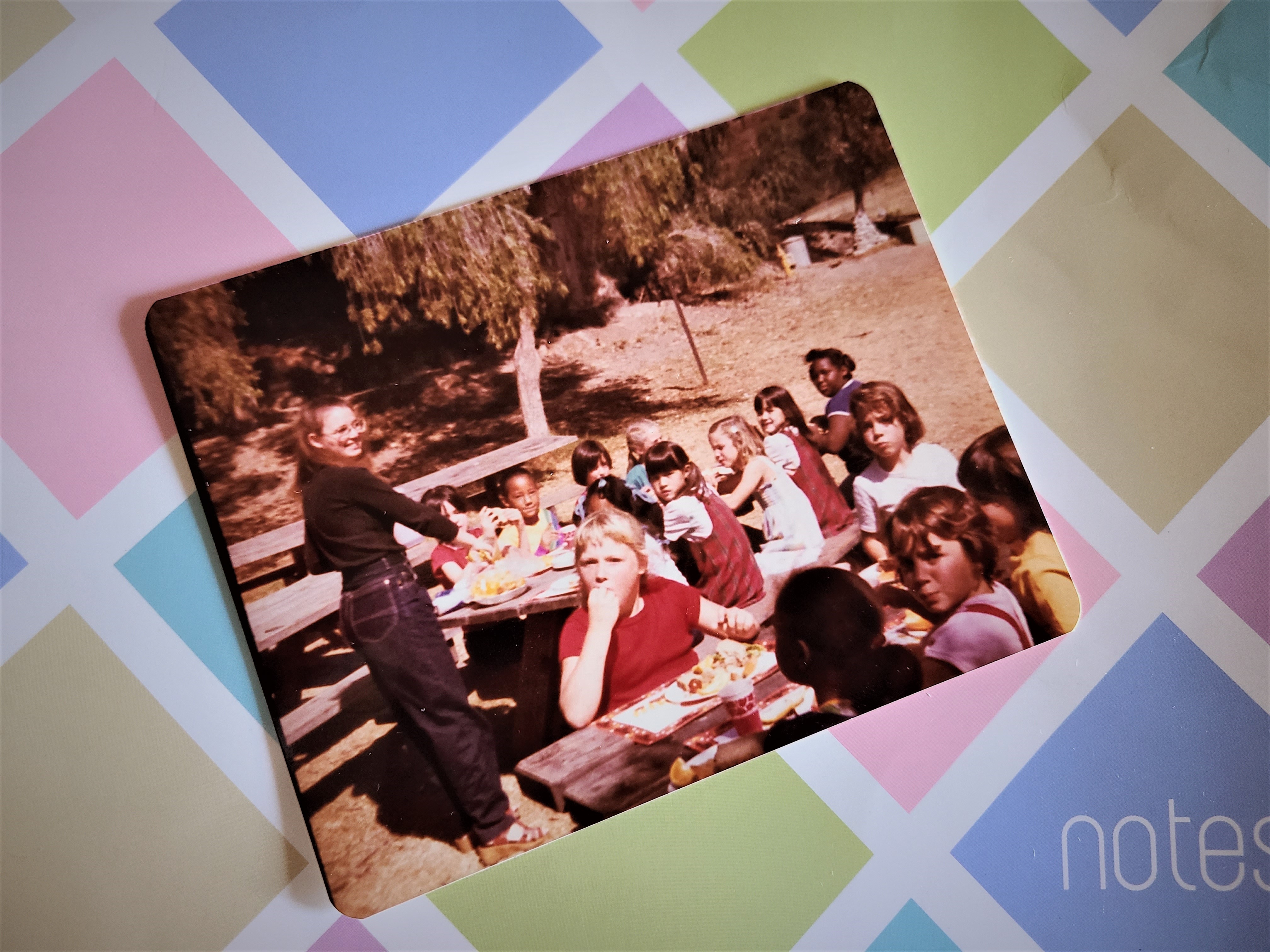
While we learned to play together on the yard, we did not socialize outside of school with few exceptions. One was the celebration of “the triplets” birthday at Will Rogers State Park showed in the photo above. The second memory is of a guy friend who was always very nice to me. Somehow we just clicked although we kind of knew that neither of our peer groups would approve of our friendship. One day he gave me a frog in a plastic juicy bottle. He had punched holes in it so the frog could breathe. It was so sweet. Our bus driver was mean though and I was so terrified of what she would do if she knew I had a frog on the bus that I think I accidently suffocated it trying to hide it, as it had departed by time I got home.
The summer after this year, my life significantly changed as my mother remarried and we moved to Pasadena. At the time she worked at a magnet school in the valley called West Valley Center for Enriched Studies. To make things easy, after passing the entrance exam, I started at the same school. It was more diverse than Marquez, but was a predominantly White space and very different than my home community. My time at West Valley CES was a further study into learning White culture. I learned of class divisions among Whites (Encino verse Canoga Park), Jewish culture, and even the meaning of “snobs” and “stuck-up”- aesthetics of mean girl culture that I later experienced in majority White spaces.
Looking back the memory of all of these experiences expanded my understanding of the multicultural Los Angeles that I lived in. I learned a deeper knowing beyond skin color to understand culture, and how it is operationalized into place through norms and behaviors. The more we are segregated, the more our norms are reified and while they provide a common way of being & sense of protection, they can also attribute to the creation or denial of a sense of belonging to the ‘other’.
My parents came to Los Angeles in search of new opportunities. Today, new generations of immigrants continue to resettle in Los Angeles in search of home; a place to reunite family, create a safe place free from violence, and manifest new opportunities previously denied.
Yet they are entering a story in motion, a movie replaying America’s unresolved systemic segregation and racialized landscape, projecting their experience of their previous situations adding new characters, making our evolution into a more equitable society more complexed and polarized.
The road ahead is steep, but through sharing stories we can bridge understanding and offer acknowledgement to facilitate healing and reconciliation of past injustices with an eye toward supporting an evolving America. Stories provide a great way to find common ground and center our efforts in humanity. What is your story?

 Alisa's thoughts on Beloved Communities