Uncategorized

School integration: Learning through crossing LA’s cultural borders

A running joke growing up was that nothing aged in Los Angeles because the landscape was always changing before it had a chance to age. A shadow side of this dynamic is that far too often, the stories of neighborhoods often disappear with the demolition of buildings and paving of new parking lots, or erection of new condos. It is this historical amnesia that makes the topics of gentrification and displacement lightening rod topics. In a recent housing policy seminar, the facilitators approached this topic through storytelling. In doing so, we were each able to contribute our story to create a greater narrative of the attributes of the real L.A., the one unspoken under the bright lights of Hollywood and the development boom.

The discussion invoked childhood memories of my first encounter outside of my community and how this early experience called me to the field of community development.   

When I look around today, I often wonder if I was just imaging of the Black Los Angeles of my childhood. Things have changed so much, yet every now and then I find an old landmark or photo validating my memories.

I was born in Kaiser Hospital located in Harbor City in 1972. I grew up in a traditional Black family – traditional to us, yet not in the framework of America’s White Anglo-Saxon Puritan norms of a nuclear family structure. My parents were both from the Midwest- Chicago and Omaha – with entangled southern roots in Kentucky, Mississippi, and Tennessee.

Before the age of 8, within the mosaic landscape of my childhood that extended from Inglewood to Pasadena, Watts, Jefferson Park, Crenshaw Manor, Baldwin Hills, and Angeles Vista, my kinship network was mostly Black and middle class. Just about everyone owned a home, even if there were multiple families living there. More than housing, family homes were the center of Black life; a place where people gathered, where a sick child could stay home with an elder, where people in transition could rest, where family history was shared around the kitchen table, where tradition was nurtured, and children validated as armor to step into the world beyond.

My parents worked in the public sector; my mom an educator and dad a public administrator who worked for an elected official for many years. I lived with my mom and through her, navigated through our community purchasing goods and services from our thriving Black business community. Everyone from the mechanic to the shoe repair store to my daycare center, piano instructor, and dentist, were all Black.

Back then, my grand-uncle who experienced homelessness after returning home from World War II was cared for by the community. Whenever we looked for him, we could stop in a local barber shop or bar and someone would know where he was and go get him for us.

Within this world, there were other races, the greatest of which were Japanese. Christy was my first best-friend and she was of Japanese descent. My kindergarten and first grade teachers were Japanese as well as the gardener. As were the owners of the drive- up grocery store on Crenshaw where playing in the car one day while my mom ran inside, I accidently knocked it out of gear and made the car roll down the driveway toward the boulevard, creating a great stir.

Although there was an older White woman who lived next door to us (my mom was the first cohort to integrate Inglewood in the early 1970’s), White people were only on the periphery of this world. Maybe the librarian at the local library, the swim instructors at the Westchester Y, and the emergency room doctors (when I was stung by stepping on a bee, and when I ran through my mom’s room and stepped on a sewing needle that broke in my foot J). Then of course there was Santa Claus. Santa Claus was always White back then. I think this may have been why the myth was really hard to believe; why did we need him when everything was already provided for within our community? Weren’t there starving children in the world that needed his help more?

My proximity to Whites however suddenly changed in 3rd grade. For the first time I had a White teacher. She had the most beautiful cursive writing and I stayed in her crosshairs for having the worst. I wasn’t a great speller so purposefully learned how to write to hide my letters. At the same time that I was adjusting to this new teacher, a group of White students suddenly appeared in our class. Literally, off of the bus, as they were bused in from Pacific Palisades for a semester as part of the school district’ integration experiment. They looked so fragile and out of place. I guess I was not the only one who felt this way, as like company visiting, the school dynamics changed.

Before long, I found myself standing on an unknown demarcation line. My inclination was to be polite and welcome the new students as my mother taught me to welcome all visitors. Yet at the same time, my allegiance to Blackness was increasingly challenged as some of my friends responded by separation. As my friend Queen Leia once stated, this moment was a new test into the initiation of Black girlhood: don’t eat lunch with them. Don’t start talking like them. Don’t invite them to play with us on the playground. This was stressful.

The next semester, we had to go to their school – Marquez in the Pacific Palisades. It was out of my comfort zone. My first impression were lines. You had to line-up to go into class. You had to line-up to go out of class for recess or lunch. You had to line-up to check-out and check-in a ball (I once had to stay after school for jumping the line to return the ball so I would not be late to the line to go back into the classroom).

I also remember Mr. Vaughn. To his credit and interactive teaching style, I learned the Greek gods and multiplication.  But he hated us. He did not appreciate us intruding into his space and he was not shy about letting us know this. I was in his class the day President Regan was shot. He cried. I smiled. I wasn’t happy that our President had been shot, I was just relieved that something he cared about had been harmed so that he would know how we felt by his antagonism.

I made friends through clothes. At the time Jordache, Vidal Sassoon, and Gloria Vanderbilt jeans were in style. My curves would not fit into the first two brands but my mom was savvy enough to take me school shopping at the Alley in the Downtown Garment District. She made my day when she bought me a pair of cool iridescent purple Vanderbilt jeans and matching handbag. I was Palisades cool.  

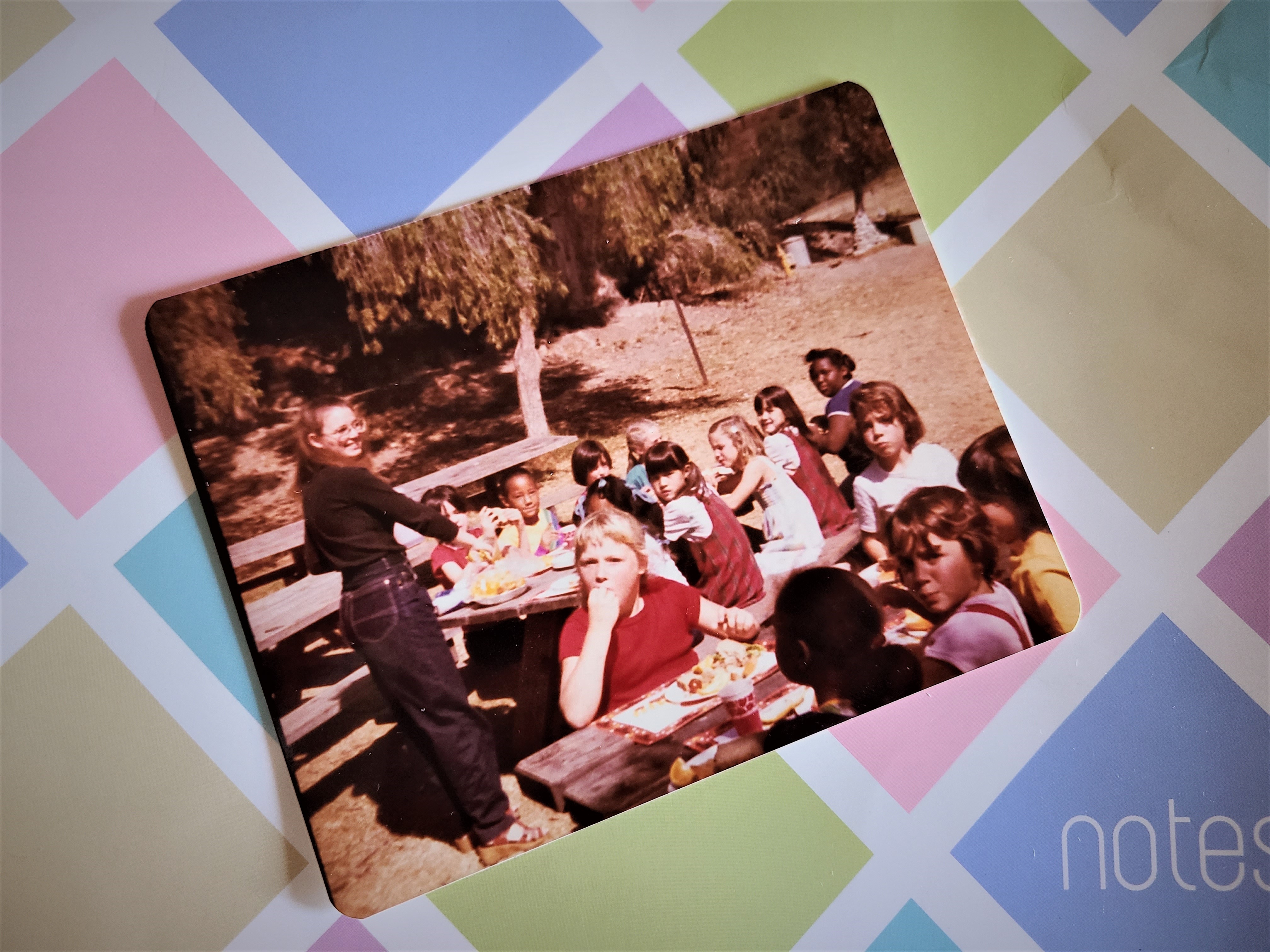
While we learned to play together on the yard, we did not socialize outside of school with few exceptions. One was the celebration of “the triplets” birthday at Will Rogers State Park showed in the photo above. The second memory is of a guy friend who was always very nice to me. Somehow we just clicked although we kind of knew that neither of our peer groups would approve of our friendship. One day he gave me a frog in a plastic juicy bottle. He had punched holes in it so the frog could breathe. It was so sweet. Our bus driver was mean though and I was so terrified of what she would do if she knew I had a frog on the bus that I think I accidently suffocated it trying to hide it, as it had departed by time I got home.

The summer after this year, my life significantly changed as my mother remarried and we moved to Pasadena. At the time she worked at a magnet school in the valley called West Valley Center for Enriched Studies. To make things easy, after passing the entrance exam, I started at the same school. It was more diverse than Marquez, but was a predominantly White space and very different than my home community. My time at West Valley CES was a further study into learning White culture. I learned of class divisions among Whites (Encino verse Canoga Park), Jewish culture, and even the meaning of “snobs” and “stuck-up”- aesthetics of mean girl culture that I later experienced in majority White spaces.

Looking back the memory of all of these experiences expanded my understanding of the multicultural Los Angeles that I lived in. I learned a deeper knowing beyond skin color to understand culture, and how it is operationalized into place through norms and behaviors. The more we are segregated, the more our norms are reified and while they provide a common way of being & sense of protection, they can also attribute to the creation or denial of a sense of belonging to the ‘other’.

My parents came to Los Angeles in search of new opportunities. Today, new generations of immigrants continue to resettle in Los Angeles in search of home; a place to reunite family, create a safe place free from violence, and manifest new opportunities previously denied.

Yet they are entering a story in motion, a movie replaying America’s unresolved systemic segregation and racialized landscape, projecting their experience of their previous situations adding new characters, making our evolution into a more equitable society more complexed and polarized.  

The road ahead is steep, but through sharing stories we can bridge understanding and offer acknowledgement to facilitate healing and reconciliation of past injustices with an eye toward supporting an evolving America. Stories provide a great way to find common ground and center our efforts in humanity. What is your story?
Uncategorized

I Am Not A DEI Consultant: So what in the world is the Florence Aliese Advancement Network?

During this time of reset as each of us continues to adjust to the evolving way of life in co-existence with the novel Coronavirus, my Iya Fayomi Osundoyin Egbeyemi (my godmother in the Ifa tradition), wrote a poetic message on the need to surrender to Spirit. Surrender to Spirit. . . This was a similar message to one I received growing up in a circle of Aunties, wise women who collectively poured into me advice passed on from our lineage. When facing decision-making moments, they would often advise – “ask God and turn your plate over.” In other words, surrender to Spirit.

Although deeply spiritual, the concept of letting go and “leaving room for God” is one that I struggle with. It contradicts the messaging from the internal critic that often complains that I am not working hard enough. So after a COVID related layoff in May, testing positive for COVID in July, and submitting a completed dissertation manuscript in September of the Phenomenon of Black People Experiencing Homelessness in Los Angeles (nearing the culmination of an eight-year journey), I found myself in a space of stillness.  What would I do next?

Collectively, the public lynching of George Floyd awakened a latent racial consciousness, igniting a wildfire across the “culturalscape” (as Iya Tirra Omilade often describes[1]) made visible in the performance of street demonstrations in urban downtown financial districts to suburban streetscapes and around rural civic squares – advancing a cacophony of chants calling for the end of police brutality, racism, and affirmation of Black Lives. Immediately, nonprofit organizations and corporations began plastering “Black Lives Matter Statements” on their webpages, reminiscent of Black owned business owners spray painted their buildings during the 1965 Watts Uprising.

It was a moment of incredible hope- and yet fear of the instability. The sudden worship or the eroticism of our pain – amplified through video replays of our deaths and paneled voices of our failed outcomes became deafening. Familiar white spaces felt unsafe. I questioned the sincerity of the sudden presence of “allies.” Where were they in 2013, 2014, 2015, 2016 (before the election)? Why now? Are they equipped to listen? Are they able to stand back and let those historically excluded from deciding their fate, lead? Dr. Mary Watkins, a community psychologist, observed, those “who think of themselves as ‘allies’ may maintain positive images of themselves as helpers to those less powerful, while failing to interrogate and redress their own excessive privilege”[2]

Soon friends and former colleagues reached out wondering if I was interested in getting involved in Diversity, Equity, and Inclusion (DEI) consulting work or Equity positions. I was curious, what did DEI mean to the organizations that sought out this work? In response I heard a consistent theme spoken through various words about a resounding need to remake white spaces challenged by contestation, safe again-  for white people. I heard a lot of shame conjuring and “cancel culture,” yet I heard little to nothing about commitments to Black liberation.

In the DEI conversations, I also did not hear any strategies to change the American social and economic hierarchy that construct the conditions making a disproportionate number of Black people so dependent on the very organizations seeking reform. I felt an immediate pointing of a collective finger to the image of the 2020 version of an overt racist – law enforcement – and not us, the marionettist pulling their budgets and performance management goals to sustain the privilege of middle class life and that kept White communities segregated. Nor was there a true willingness or recognition of need to look in the mirror to understand how nonprofits and local governments stand as border agents who guard the boundaries of our social hierarchy. Instead it felt as if people were seeking validation for being a “good person” – a privileged position over the groups of people whose lives have been violently impacted by racism in all forms across generations. Rev. Jesse Jackson and a flood of images of 1990 “Diversity” training books came to mind. Before I could assign language to my abjection to these requests, my soul gently whispered – “no.”  

In tune with my understanding of the World’s Soul, I knew that the “known” was not unraveling to develop new ways to conform to the status quo. That it would be going against Divine guidance to seek solutions that made Black people comfortable in systems that actively worked to sustain entrenched marginalization with a few more luxuries. This was not a time to wait. It was/is a time to not remain silent on a fundamental belief in scarcity where progress was only measured in ‘winners and losers’ verse a belief that the world has provided ‘enough’ for all of her children. We just needed to develop right-size solutions to help everyone meet their basic needs and joys.

It was and continues instead to be a time of re-imagination. This has to be a time of healing, reconciliation, permission, and deep listening until we begin to understand other languages long suppressed by colonial machines.

It is a time to center the protection and wellbeing of Native American and Black people at the center of extracting racism from our culture. This requires a positionality of humility to understand that the way in which we know and engage with the world in public and mainstream spaces, is based on a construction of knowledge and knowing that is centered on the privilege of whiteness. We must reckon with public policies, academia curriculums, laws, Supreme Court Decisions that assign meaning to these constructs that dehumanize Blacks and Native Americans in the general imagination of the American people regardless of racial identity. This means that as we learn, seek to undo, and redesign, that we must be open to the abandonment of institutions birthed to operationalize these beliefs of Black inferiority and Native American erasure from our predominant memory. Even if these are the very institutions, programs, and policies that we have helped built, have dedicated our careers to, and have created as the “known road”[3].

I soon knew that I could not meet the challenge(s) of the moment under the confines of any one position, organization or government entity. So it is with perspective and understanding that I gave birth to Florence Aliese Advancement Network (FAAN). It is a community advisement firm named after my maternal and paternal grandmothers to call on the protection, strength, and wisdom of the feminine from my lineage. Florence Aliese is a platform that I have surfaced from time to time, but in this moment I am prioritizing the support of its birth and development by placing my own fears of economic survival aside to let Spirit lead.

FAAN is dedicated to creating beloved communities through participatory research and evaluation, strengthening of social capital and networking, and policy development. FAAN introduces Indigenous knowledge and practices from the Afro-Feminine perspective into our work. These approaches and philosophies capture ways of knowing passed down through the Grandmothers from the Trans-Atlantic Slave Trade until now. Dr. Nuria Ciofalo describes Indigenous Psychologies as a means to “question the universality of existing Western scientific paradigms and incorporate context, meanings, values, beliefs, and locality into research designs and knowledge generation[4].” Through our services, we therefore;

  • Recognize that there are unheard, embodied stories waiting for someone to ask for them to be shared as insight into today’s concerns;
  • Recognize that time is circular, not linear, and thus the pathway forward cannot occur without reconciling injuries made in place in the past, even if no one currently present was there;
  • Recognize the credibility of life experience and life stories as critical inputs for data collection – allowing voice to stand alone without need to justify by written words published by White men or academia;
  • Recognize the empowerment of Black Literary Arts and Indigenous methodologies (i.e. listening to Elders, poetry, Walk-Abouts, spoken word, dance, song, gardening, quilting) in surfacing identities and needs of the human spirit without the projected biases of binary White/Black constructs; and we
  • Recognize that the liberation of Black and Indigenous people from the prejudice of American culture will elevate the national consciousness, and influence the freedom of others including women, LGBQT, and people of diverse ethnic backgrounds while creating global anti-oppressive strategies to liberate colonized people and the world – including the liberation of Mother Earth herself.

Florence Aliese Advancement Network’s accepts that our recognition of the African American and Native American Souls is itself a form of resistance to American culture, and therefore our work is performed outside of the boundaries of “respectability politics.” We lead with heart.

We accept the potential consequence that because of our beliefs and approach, we may be denied consideration, opportunities, and invitation. However, we stand on our history of success in many communities across the country. We stand in the faith of the destiny chosen when coming from Heaven to Earth. We stand in our power in knowing our role is not to sustain comfort, but create compassionate discomfort to lead forth sustainable and healthy cultural change.  

We are an intentionally eclectic firm standing on the shoulders of our Ancestors and their rainbow warriorness. We are what is needed to bring order to chaos, healing to deep pain, and joy in discomfort.

In writing this piece, I see a humorist irony as I have been experiencing an increasingly excruciating toothache. I have long neglected proper dental care due to shame, previous bad experiences with dentist, cost, and plain fear. However, I now accept that the remedy will be some form of extraction from the root – a root canal or tooth removal. I think many people approach or avoid confronting anti-Black and Indigenous racism like they do a toothache. We are satisfied if we can dull the pain, but it will only grow worse without radical attention. Florence Aliese is here to help organizations and entities ready to go deep and activate cultural change; that have the grit to move through this next labor pain in creating equitable and just societies. With you, we are committed to removing barriers so that Beloved Communities may bloom.  

P.S. If you still in need of a DEI Consultant, we are happy to refer you to a few in our network 🙂


[1] Tirra Omilade, Goddess Guru https://www.youtube.com/watch?v=v9n3fq8dvnE

[2] Watkins, Mary. Mutual Accompaniment and the Creation of the Commons, Yale University Press, New Haven, CT,2019

[3] Jung, C.G. Memories, Dreams, Reflections. Vintage Books, New York 1963

[4] Ciofalo, Nuria, Editor. Indigenous Psychologies in an Era of Decolonization. Springer, 2019