A missing component of the homelessness services delivery system is the integration of anti-racist healing interventions for survivors of trauma inflicted by inter-generational racism. In particularly systemic racism experienced by Black people experiencing homelessness that impacts recovery and establishment of a sense of belonging in newly housed spaces. Racial trauma often presents as mental illness in Black people, and perhaps it is if we consider racism a mental disease. hooks concept of a homeplace provides a framework of community based solutions that have existed in one form of another in thriving Black communities before the disruption created by the invasion of “luxury apartments” and gentrification.
Hooks described a homeplace as “the construction of a safe place where black people could affirm one another and by doing so heal many of the wounds inflicted by racist domination” (p. 42 – Yearning; race, gender and culture politics – 1990).
In 2014 inspired by hooks’ concept of homeplace and childhood memories of safe spaces I withdrew my nonprofit retirement savings and pre-paid a year’s lease for a storefront in downtown Inglewood. Like a magic seed, the storefront transformed into a literary arts cafe called Callie Rose Literary Arts or Callie Rose LA.
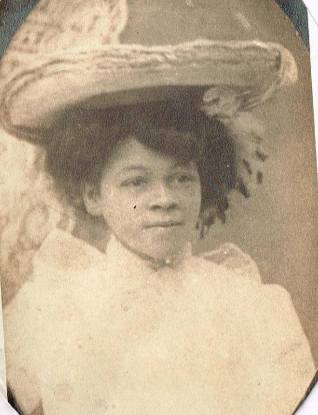
Callie Rose is a nod to my great grandmother Callie whose husband worked at EE Hughes – Memphis Florist Company where he often brought home open roses at the end of the day. Great grandma Callie was the first generation to be born free from the institution of slavery. She would represent the transition of life as a citizen of this country and the mother who then birthed a line of advocates who would fight throughout their life to secure those citizenship rights from the right to vote, to creating a business, school integration, fair housing, etc.
Through invoking my own family history, I wanted to lead by example in calling forth the memories of our grandparents and other honorable ancestors in a time when so many people are being uprooted and displaced through an invisible movement of containment and internment. So many people no longer know their grandparents, let alone great grandparents and thus believe they are whoever they come across tells them – verse knowing self from within. I believe this is an effect of systemic racism that devalues non-White culture and a symptom of this disease that can be eradicated with intention and safe spaces where such stories could be shared.

A community building practitioner I wanted to create a homeplace, a safe community based space where people did not enter with deficiency labels such as mentally ill, homeless, re-entry, and other diagnosis. Ms. Jewel’s home, my former caretaker, became my inspiration.
Ms. Jewel was from Louisiana. Her white wooden home with a winding southern porch was on 39th Place off of Normandy. Inside the home one always heard a background soundtrack of soap operas like General Hospital and As the World Turns. And you always smelled food – mainly burning grease preparing bacon for a white-bread bacon sandwich or fried chicken dinner. Inside were many adults called Kin. You never knew how everyone knew each other, but to us children they were just “uncle” or “auntie” and anyone of them could spank you if you got sassy.
Outside on Ms. Jewel’s block you could see the Coliseum at one end. Across the street was a modern apartment building that stuck out on the block, but where two sisters lived who became my friends. Somehow back then, it was safe to play on the streets and neighbors did not have fences so we could run for days across many lawns with no chastisement. It was about time to go back inside when the produce and fish man came down the block announcing the specials of the day “ come get your waterrrrrrr-melon, peaches, collard greens” and the moms and grandmas came out with their carts to do their daily shopping. We would then have to go inside as dinner was prepared and the street would start to repopulate with folks coming home from work. The best memory was the candy house two doors down. When “Tee” the oldest grandson came home, he would take our rascal bunch over with our saved pennies to purchase tart apple styxs, lemon heads, candied mango with chili, and maybe a sour pickle.
In essence, Ms. Jewel’s home represented love, a sense of belonging, validation, safety, food, and hospitality. These were values that may family shared and values instilled within me that I bring to my work today as a community development practitioner with a special focus on addressing systemic causes of homelessness – including racialized land-use policies and attitudes.

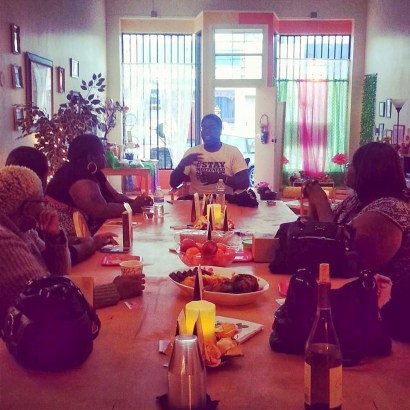
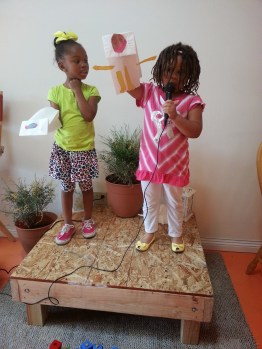
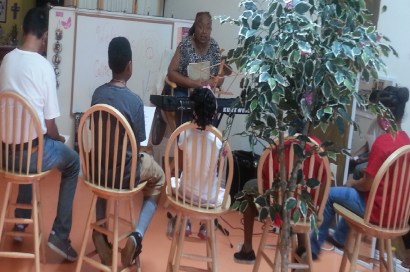
Callie Rose Literacy Arts became the manifestation of this value system. For a year, with the embracement of community members we hosted many dialogues and artistic forms to help people tap into their most authentic self through the literary arts. We hosted spoken word, book readings, films, yoga, drum circles, dinner conversations, writing classes, even genealogy. The cornerstone activity was a small stage that new guests had to stand on to introduce themselves. For many, it was the first time being seen. All of these elements achieved the goal of creating a space where people felt safe, welcomed, and that they could “be”.
Youth from Inglewood High taught other youth chess. Parents dropped off their children for help with writing – leading to one 7 year old writing her first book on her family trip to Yosemite. We had people experiencing homelessness tutoring children after-school. I had parents with young adults living with severe mental illness leave their information in case their children came through our doors and in one case, the mom anonymously paid a stipend so her daughter could volunteer as it gave her peace of mind that her daughter had a safe place to go that she liked and was understood. Another mom of a severely medically fragile five year old often came in to allow him to play in the children’s corner where a volunteer worked with him so she could have a little break to read a book or take a nap. Callie Rose magically bloomed community where it was planted.
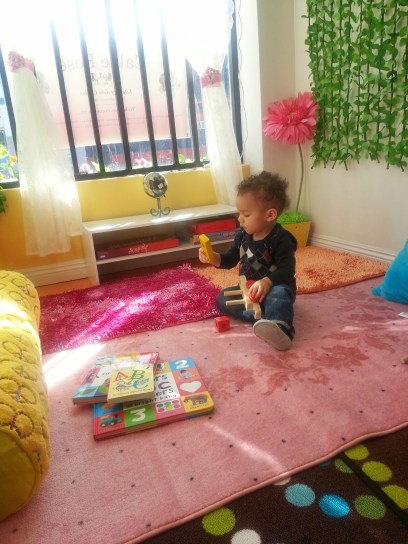
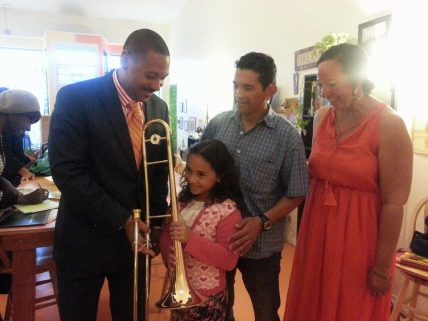
Sadly I had to close Callie Rose in February 2015. I had run out of money and listened to the bad advice. I operated on a donation basis to sustain the value system that everyone was welcomed. Her presence was so great, I know I will reopen her again in the very near future with greater understanding of how to generate income and sponsorship. The experience taught me first-hand how cultural centers operated by cultural workers are a missing piece of our mental health and homelessness systems – particularly as a cultural informed means to have a greater impact on Black people. In cultural practices performed by Black people are not about “showing off” but about “showing in” – a total recall or mirror of one’s authentic self often made invisible or outright denied in greater society. In cultural spaces with Black expressive arts genres, Black being is not a projection to create whiteness – but an expression of a liberated form of the divine right to be.
For these reasons to this day I strongly support indigenous Black cultural informed arts practices such as Urban Voices, Urban Possibility Storytelling, Skid Row Walk the Talk Parade, 3 on 3 Basketball at Gladys Park, Africa in the Americas Annual production, Vivir Brasil, FlowSkool, and so many unknown programs that are doing the work on food stamps, donations, and other sacrifices. Too many Black people are dying at the hands and consequences of the disease of racism and its spread through violence. These programs make a difference in the lives of Black people and non-Black people engaged and the greater community. My dream would be to allow these programs to be funded through mainstream services as part of all recovery programs – recovery with mental illness, substance use, and homelessness in particular. I will continue to advocate to make this change.
Today, I am heading out to Trieste, Italy with a large delegation in Los Angeles for a World Health Organization convening sponsored by the Forum Salute Mentale called ‘Good Practice Services: Promoting Human Rights & Recovery in Mental Health’. I am hoping to meet fellow advocates, consumers, and practitioners from around the world on their experience in implementing community based mental health services that support the integration of people with mental diseases and trauma verse criminalizing and isolating like we do in the States. The trip feels a little overwhelming, and yet at the same time I will be bringing a few Callie Rose seeds to plant into the conversation. I can’t wait to see what blooms.

 Alisa's thoughts on Beloved Communities