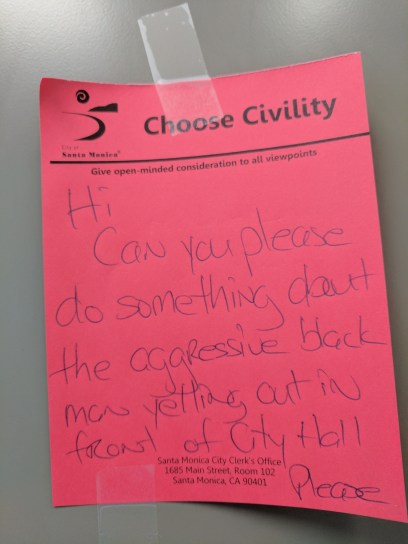
I found this note on my desk on Friday. When I read it, all I could interpret it as was a noose, a symbolic image of the innate fear that many people have of Black people, and Black men in particularly – especially in white spaces like Santa Monica.
Santa Monica has a long history of racial segregation – designating space for workers and “the help” – but for the most part protecting the edges of its hamlet against racial integration.
Implicit bias against the Black stranger invites and attracts what the unconscious most fears. Many Black men, from Skid Row, right out of jail in their black plastic gear, Venice, and communities around the country – stop through Santa Monica as a place of refuge from the violence, gangs, substance use in search of sobriety, and exploitation – especially those whom seek safety in the mist of untreated mental health crisis.
The reaction on the part of locals is a sense of intrusion – an invasion that needs to arrested, contained, criminalized. A sentiment that “these are not our own” and that they must be displaced elsewhere.
So yes, many Black men (and others) are hyper-vigilant, defensive, and will speak up when unwelcoming gazes pierce their flesh with hatred and disgust. This particular person is a veteran with PTSD who wants a home of his own so he can start a family. His behavior represents that of so many others who are protecting the boundaries of their being with what often is all they have left to maintain a connection to their earth – protecting the one place left where their feet touch the ground which given the serial displacement of Black male bodies – is often only where they are in that moment- fighting hard for the liberation “to be.”
Imagine though if in being literally the last train stop before one enters the ocean, and a retreat town where ole St. Monica calls many for respite from mental illness and healing (I am sure our pier is up there with the Golden Gate bridge if you know what I mean) – we responded with a trauma-informed community safety-net that understood how to respond to hyper-vigilance? If we had quiet safe places- public homeplaces like Callie Rose that welcomed people and allowed them to breathe, reassess their current position, and then offer a connection to services?
This morning I was thinking the most successful mental wellness model for Black men in America has been the Nation of Islam. Say what you will in other areas of their work, but when it comes to addressing historical trauma and rebuilding self-esteem and confidence, no other intervention has worked at the scale of Farrakhan’s model. That gives me pause.
In the meantime, we must overcome implicit racial biases to have empathy toward those suffering from mental illness regardless of their skin color. It is unacceptable that the majority of People of Color living with mental illness are treated in our jails and criminal justice system – and not in community based settings or psychiatric settings (although I prefer Indigenous models compared to institutions) where there are connections to treatment and family support.
The succession of mass-shootings show that no one is immune to the collective- mental decomposition of our society. Everyone is impacted. We must stop scapegoating and responding with borders and criminalization. We must understand that we are all hurting in this outlandish, hostile climate, yet privilege prevents some of us from going over the edge – privilege of faith, family, friends, access to health care, loving relationships, nature. So, let’s stop responding with fear and build empathy.
And for the record, besides having a human to human conversation (which I had on my way in and he demonstrated no harm to self or others- was just talking loud), the only thing I will do with this “aggressive Black man” is let him be.
P.S. – After a second note, found out who wrote it. The staff person was expressing the tension of other staff standing in fear in the face of mental illness and implicit biases of Blackness. Had a great conversation and transformed this situation into a beautiful teaching moment. Everyone in City Hall now knows his name and he is still unhoused, but connected to a clinical team who are patiently building trust to best serve his needs.
 ds being a long-time friend who has quietly been there during some dark times, George is an amazing professional tour guide
 Alisa's thoughts on Beloved Communities